| home | catalogue | history | references | appendix |
|
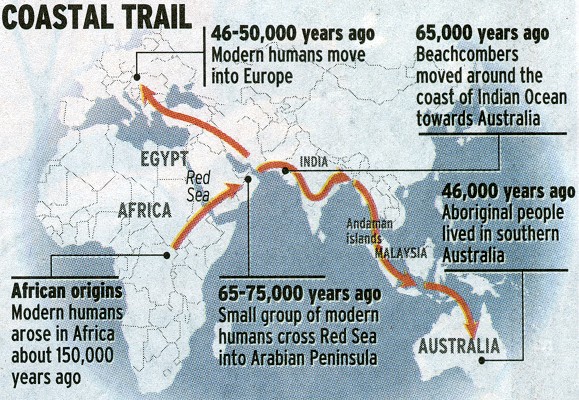
This southern journey
- dubbed the coastal express train route - which started with crossing
the Red Sea, explains how Australia was inhabited thousands of years before
modem humans colonised Europe.
It challenges the theory
that the first successful wave of people leaving east Africa went north
into Egypt and the Middle East.
"It's much easier to move
quickly along a coast," said the Australian National University's David
Bulbeck, a member of an international research team that studied people
in the Malaysian peninsula.
Seafood would have been
plentiful, and the travellers would have had to adapt to only one environment,
rather than learn how to survive in the deserts, rainforests and shrublands
of an overland route.
Most scientists agree the human species arose in Africa about 150,000 years ago.
To find out where they
went next, two teams of researchers studied the DNA of indigenous people
in South-East Asia, one testing isolated tribal groups on the Andaman Islands,
off India's east coast, and the other the Orang Asli, or original people
of Malaysia.
They looked at mitochrondrial
DNA, which is passed down from mother to daughter and can be used as a
historical clock, based on the mutations that have accumulated in different
populations.
The teams came to similar
conclusions, published in the journal Science yesterday, that
the two different populations
in South-East Asia were descendants of people who lived in India about
65,000 years ago.
The team that studied the Orang Asli calculated that the journey around the Indian Ocean coast to Australia was rapid, "most likely taking only a few thousands years", requiring speeds of between 700 metres and four kilometres a year.
Aboriginal people inhabited the south of Australia by 46,000 years ago, yet in Europe the earliest known remains of modem humans are only about 35,000 years old.
Researchers from the University
of Cambridge commented in the journal that isolated, indi- genous populations
like the Orang Asli were dwindling, so time was running out to study their
DNA.
They hoped the research
would also inspire archaeological studies in the Arabian peninsula, where
more clues about these early beachcombers could stilI lie.

| home | catalogue | history | references | appendix |