| home | catalogue | history | references | appendix |
|
The finless, vee-bottom, Hot Curl !.l" big-wave board - the cutdown version of the plank was used until 1943, when Wally Froiseth worked on a government project and John Kelly left Hawaii for military duty. Woody Brown (champion glider pilot and aerodynamics expert) remained behind as a conscientious objector, and continued to build surfboards, as well as designing the modern-day, asymmetrical-hull catamaran. Brown started to eliminate cross-belly curves on surfboards by doming the deck and foiling the rails. George Downing, too young for the draft, worked and surfed with Brown during this period.
Brown wanted to go down the curl line as fast as it traveled, and focused on the reduction of drag using aerodynamic concepts he'd learned from soaring, designing and building gliders. Downing enjoyed the speed, but felt a loss when looking back at the energy pocket. He decided to work on a board that would be able to turn back into the pocket. He learned to do this by creating drag through rail and rocker ;. curves, an approach referred to as "calculated drag." This design approach was used (preferably on balsa - whenever it was available in Hawaii) until around 1952.
Wally Froiseth, Russ Takaki and George Downing were introduced to fiberglass by Bob Simmons in June 1948. They met Simmons in California on their first surf safari outside the Islands. Simmons showed them his first unfinished prototype: a lightweight surf- board made with balsa rails, a plywood inlay deck/bottom and a styrofoam-filled core (shaped to fill the hollow cavity of the board). The balsa rails were foiled both in length and cross-section. The deck line on the bow was scooped more than any they had done or seen as of that date. Simmons told them that to build a board of this type he had to use fiberglass for waterproofing/sealing of the glue seams, and estimated the firiished weight to be 30 pounds (boards at that time were 50-120 pounds). He also showed them how fiberglass could be used to hold together a bad/failed seam by fixing Downing's wing-nose, which had broken off that day after running into the pier at Malibu during a kick-out. They watched Simmons fix the board that night, and were introduced to the complete fiberglassing process.
Back in Hawaii, Brown, Froiseth and Downing decided to work with lighter boards, and started to experiment with the skeg. The first skeg they used was one taken from a water-ski, which was both troublesome to attach and dangerous. As they lightened boards and reduced bottom curves, the tails started sliding-ass again, which convinced them the skeg needed more attention, if they were to continue on this design approach. Because of the time involved in fiberglassing a skeg onto a board, Downing invented a wooden skeg/fin box, which he made out of teak. He built a new balsa/redwood board, fiberglassed it, installed the box and started experimenting with skeg sizes and shapes made of wood. Once he got the right skeg in the right spot, it was fiberglassed to the box.
Downing used this board (see photo) until 1959, and rode the biggest waves of his life on it at Makaha Point, with Froiseth and Trent on January 12, 1958. The Hot Curl had evolved and, after this epic day, was referred to as the Big- Wave Gun; a name introduced by Buzzy Trent: "You can't shoot elephants with a BB rifle - you need an elephant gun."
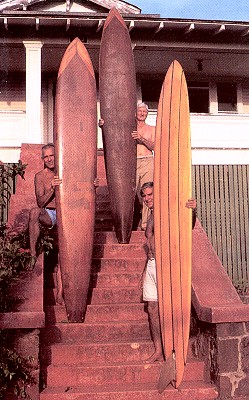
2. For Catalogue details for two boards referred to in the above article - click images below.
| home | catalogue | history | references | appendix |