 |
surfresearch.com.au
mctavish : asymmetric design, 1978
|
Bob McTavish : Ace in the Hole - The Asymmetric Story
McTavish, Bob : Ace in the Hole-The Asymmetric Story.
| home | catalogue | history | references | appendix |
|
surfresearch.com.au
mctavish : asymmetric design, 1978
|
Now why?
Three main reasons.
Firstly, you only use one rail at
a time, so why not?
Secondly, forehand you apply pressure through knees, ankles and toes -through a
series of muscles and sinews.
Backhand the pressure goes much more directly -bones more in
line, pushing into heels that can carry massive pressure.
Hence the forehand turn is the more controlled, less powerful
and the backhand vise versa.
So shape each rail to utilise these qualities.
Thirdly, surfing forehand you
generally require a longer reaching forehand turn and tighter
quicker cut back to put it back in the power.
You don't need the same arcing potential from each rail if you
consistently surf a particular spot, breaking one way.
It means that, if it's practical, you can fine tune your
equipment for a particular break, giving your forehand a more
suitable turn and tube hugging characteristics, and your other
rail a better cut back.
Make sense?
So for many years now there's
been a small flicker of asymmetric thinking.
One small shop, Nelson-Ekstrom in La Jolla California made
them for years.
Midget made a hook-back that lengthened one rail back in '63
and sold dozens.
Bob Razby shaped plenty in Byron in the early seventies, and
is now an excellent New Zealand shaper, no doubt still
thinking asymmetric.
I made my first in Hawaii in 1970.
Bob Newlands, the Surf-Aids man has been riding Razby's, his
own, and mine now for seven years.
And around Lennox, Byron there's a small but growing school of
ace-freaks.
In what way are our boards
asymmetric?
Well the general theme that pops up is a narrower longer
forehand line - 'gunnier' if you
like - that delivers excellent forehand draw and helps to find
the tube - a pocket rocket.
This forehand tail outline is just the one you personally
prefer, be it pin, wing pin, swallow, square, diamond or
round.
The general theme of the backhand
is wider and pivotier; one that cuts back better.
Over the years it was obvious that we knew little about what
makes a cutback tick, but recently by adding and subtracting
foam and glass from existing shapes that we were currently
surfing, we learnt a lot.
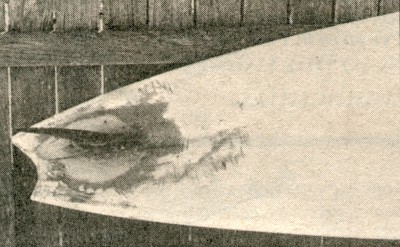
If you notice the clear board with
the complicated tail you get a before and after view.
"Before" shows the backhand as a short pin, sting coupled with
a longer wing pin forehand.
Although this combination found the tube well, its cutback was
quick but gutless.
Lost all speed and slushed out in a cutback.
The "After" shot shows the added
foam and" glass to give it a swallow backhand with increased
area.
Now she slashes cutbacks and maintains speed beautifully.
We continued this idea, area under the heels for cut- backs and the reaction has been nothing but positive.
Adding this all up, the present
recommended asymmetric shape is your favourite fast forehand
combined with an area sting backhand.
Combine this with an offset fin, (and perhaps vee to fit) one
point off to the cut back side of the stringer about 1 1/4" at
the tip, and located closer to your forehand rail.
This is vital, makes or breaks it.
It emphasises GUN on the forehand, AREA under the cutback.
In practical terms, your forehand
down-the-line turns are longer, stronger, and having the fin
closer to the rail means much control in the tube, with
positively no spinouts.
You can simply ride deeper, and make it.
And your cutback is highly efficient, putting you back into
the juice without power loss, meaning more natural feeling 'S'
turns and greater total efficiency.
The only hang-up is they only go
one way.
Not so hot for the beach break man, or the traveller, but hot
if you live on a one way spot, or often surf a favourite
break.
A spin-off from our experiments
is the understanding of twin fin toe-in and bonzer toe-in.
The line the fin points down could be called your axis.
Our allways movable fin, when only three quarters tight, found
its own axis after surfing rights.
And that axis was the one described earlier, 11/4" off to the
cutback side to the nose.
A twin fin is simply a dual-axis
board, one for each turn, with some planing foam between.
It's like two tiny guns grown together like Siamese
twins.
And the Bonzer is a tri axis.
A central dominant axis with others that take over when
banked, lengthening the turn in comparison to a single fin.
The asymmetric is a single axis,
offset to suit a one way wave, with the added fine tuning to
compliment the turn required.
We've learnt a lot, but don't pretend to boast that we know it
all.
For example, things get complicated when you try to build a
right hand point board for goofy-foot.
There's a lot to learn and it's fun all the way.
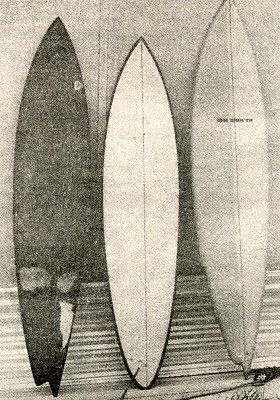 Image1 |
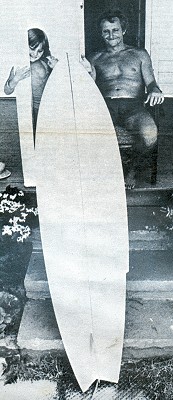 Image 6 |
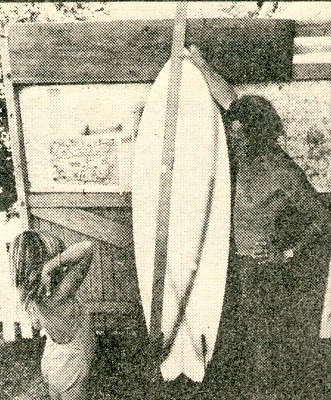 Image 2 |
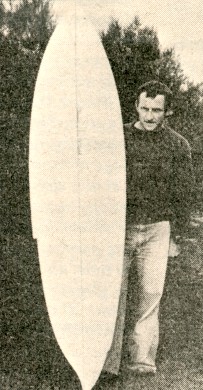 Image 3 |

|
6.
A Big Wave Board?
 This
surfboard is not symmetrical.
The plane shape of one side is completely different from the other side. The bottom of the speed side is concave for power turns and the other rolled up for easy cut-backs and re-entries. Big wave performer Terry Wall hopes to win the Australian Championships at Bell's Beach on this board. Last year he finished second to the World Champion in the Bell's Open. It is the most radical, but only one of the many new shapes being developed at George Rice Surfboards. Peter Troy and Rod Brooks have both won their last two contests in Victoria on a George Rice Competition Model Hot-Dog Board. Enquire
now about our Competition Model — $94.00. Custom
Built Standard Model—$88.00
GEORGE
RICE SURFBOARDS
673 Waterdale Road, West Heidelberg, Vic, 4591198 and other agencies. Graham Halandall, 3 Sherwood Drive, Oaklands Park, S.A. Surfing World, November, 1966, Volume 8, Number 4, page 20.
|
| home | catalogue | history | references | appendix |