 |
surfresearch.com.au
history : MR
|
mark richards
1977 - 1981
| home | catalogue | history | references | appendix |
|
surfresearch.com.au
history : MR
|
| Backdoor, April 1977 Contests - Stubbies, Michael Peterson and Mark Richards final. - Bells preview. Peter Townsend in Hollywood to make Big Wednesday. Interview - Jackson Browne. Design - Geoff McCoy |
 |
Shaun
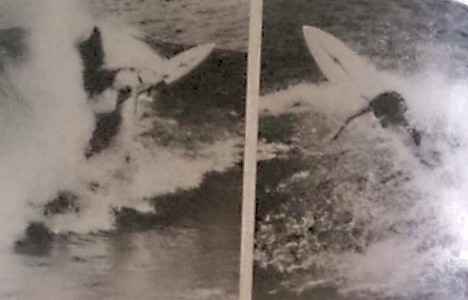
Tomson: Backhand penetration Wayne Lynch : Similar vectors. Surf (Florida), Spring 1977, Volume 1 Number 2 page 34. Photos : Lance Trout |
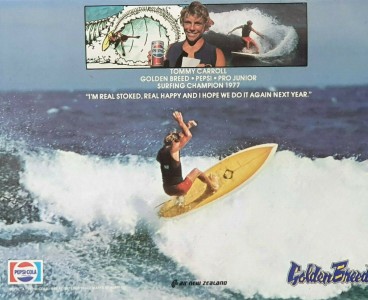
| Surfing World,
May 1977 Volume 25 Number 2- back page. Featuring Tom Carroll's victory in the 1977 Golden Breed Pepsi Pro Junior. He was then riding for Morning Star Surfboards |
 |
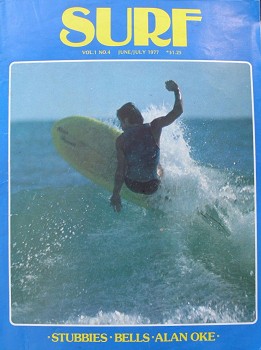
| Surf Volume 1 Number 4 June-July 1977 Cover: Reno Abellira riding twin fin fish at Burleigh Heads. Cathedral Rock EFCO Stubbies Surfing Classic, with MP, Ian Cairns , Shaun Tomson , Paul Neilson , Mark Richards and stringer, Bruce Raymond, and "young Sydney hotshot," Tom Carroll. Centre fold: Michael Peterson 1977 Rip Curl & Mordy Bells Beach Easter Open, Simon Anderson 1st, with Hawaiians Bobby Owens and Rory Russell, Wayne Lynch as advisor to Cheyne Horan, Michael Peterson with Aragorn single fin, Mark Warren, Brian Cregan, Shaun Tomson, Try Fitzgerald, Col Smith, Chris Byrne. Alan Oke Memorial Contest at Express Point Phillip Island Advertising Midget Farrelly Surfboards with superb gloss colours and resin pin lines. Salt Water Surfboards, with Gary Hughes surfing Hawaii. |
|
 |
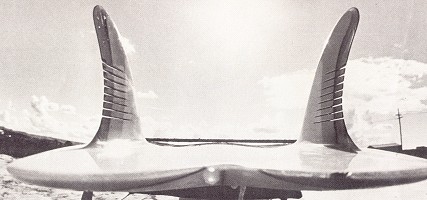
Chris Brock and Triplane Hull, 1977. Sky Surfboards, Byron Bay. Photograph : Don Blach. Surfer, June 1978. Volume 19 Number 2 page 60. |
| Michael Cundith Slotted Twin Fin , 1977. Sky Surfboards, Byron Bay. Photograph : Don Blach. Surfer Magazine, June 1978. Volume 19 Number 2 page 64. |
 |
| Surf
[Aust]
September 1977 Volume 1 Number 5 Grapevine, page 8 Probably the first Australian to dig in on the North Shore for this winter was none other than the wounded gull himself, Mark Richards. Apart from the obvious reason of wanting to settle in early and adjust his surfing and thinking to the tune of things on the North Shore, the Gull wants to pick up where he left off last season with shaping lessons from the one and only Dick Brewer. Mark said that after shaping about 10 boards with Brewer he really felt he had improved substantially. Brewer, he says, taught his mind to keep pace with his hands, so that now he is shaping a board in about four to five hours, whereas, before, it was taking anything up to 10 hours to shape a board. Mark felt that he was pretty fortunate in getting to meet Brewer as he only expressed a desire to have him shape a board, when a friend said he'd take him and introduce him to Brewer. After some design rapping, Brewer asked Mark if he was interested in learning to shape, the Gull of course seized the opportunity. You might ask, what's in a name. Well, for a Dick Brewer hand shaped custom blank only, you pay $US100, and for a gun (nine longer) you could pay up to $200. |
 |
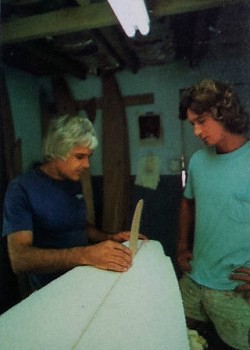 |
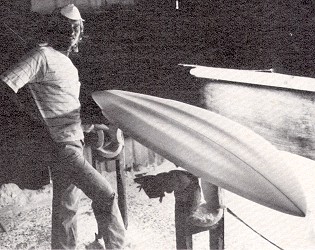
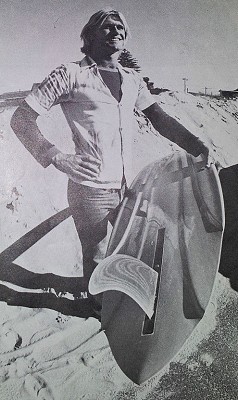
Left: Brewer and Richards, trading theories, 1977. Surf [Aust] September 1977 Volume 1 Number 5 page 8. Right: Steve Butterworth and Channel bottom, 1977. Surf
[Aust]
September 1977 Volume 1 Number 5
|
 |
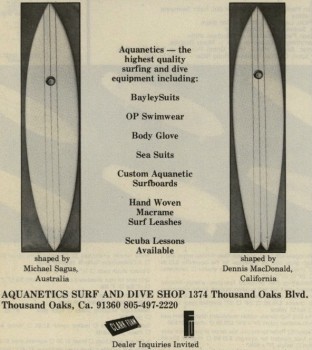
| Aquanetics Surf and Dive
Shop 1374 Thousand Oaks Blvd. Thousand Oaks, California. Shapes by Michael Sagus (Australia) and Dennis McDonald (California). The 1977 advertisement also features Hand Woven Macrame Surf Leashes. |
 |
| Surf [Aust], November 1977 Vol.1 No 6. |  |
| Surf
More Surf Products PO Box 3154 San Clemente, California 92672 The Power Unit $7.95 The Bull $8.95 The Rhino 6ft $9.95 - 7ft $10.95 Velcro Watchbands (colors) $1.95 Fin Leashes $3.50 All leashes feature the"cover up" double swivel for maximum protection. |
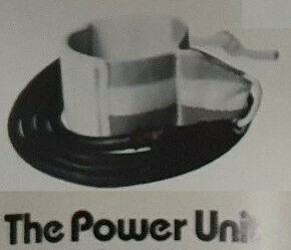 |
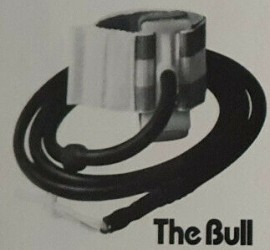 |
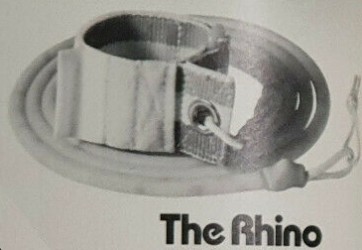 |
|
Random
thoughts by Bob McTavish and others
Photos by Peter Green When we put the small board together we had a principle in mind — to combine the speed area in the turning area. This meant you could keep the power through your turn, resulting in today's arcing power surfing. OK. That's fine when there's enough room to carve - size wise head high or over, surface smooth. But what about the all-too-common small days, sloppy days, just plain junk days? And those perfect peeling point mini-days? Re-enter the big board. With its many square-feet of soft planing area it glides over dead spots, connects the power pockets and develops phenomenal speed from small weak waves. That's the starting point. "No matter what people say about the short board being faster, I'll never believe it, because with the longer board, you just end up further down the beach." - Phil Edwards, all-time master surfer. |
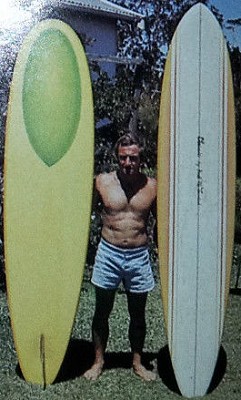 |
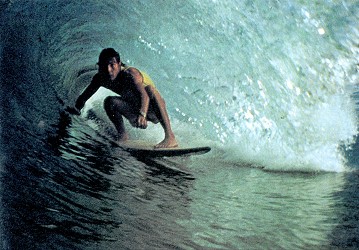 |
Shaun Tomson, Off The Wall, 1977.
Photograph : Dan Merkel Surfing February 1980. Volume 16 Number 2, page 75. |
| 1978
MR resizes Twin fin design down to 6ft after several 6 ft 4'' models. -"The green and blue board" . Mark Richards and 6 ft
Twin fin, 1978. |
 |
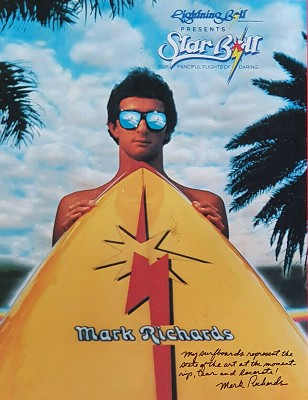 |
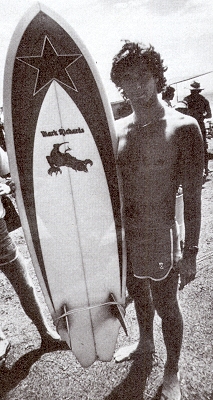
Lightning Bolt Presents Mark Richard's Star Bolt Surfer February 1979 v20n3 - back cover   Lightning Bolt :
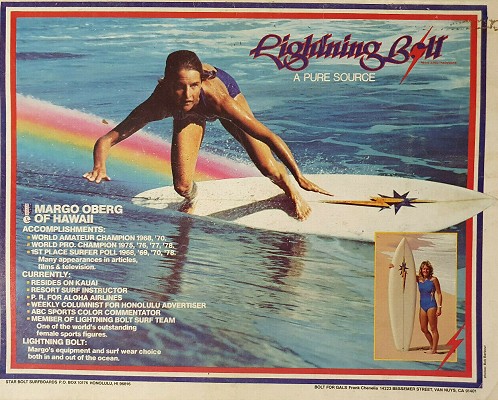
Margo Oberg of Hawaii Surfer August 1979 v20n8 - back cover |
 |
| 1979
Simon Anderson and knee-boarder Peter Crawford introduce moulded plastic boards. New Look Plastic Surfboards Both are made by the same process, but they are produced and marketed by different companies. "The Slab," a kneeboard designed by Peter Crawford, is made by the Windsurfer company, while a Simon Anderson-designed board is sold under the Power label. The boards are made of a rigid plastic exterior filled with low-density foam. Performance reports have been good for both models. Peter Crawford was seen ripping Dee Why Point on a prototype slab, and several Narrabeen locals put the Power model through its paces. The boards are selling at around $130 (Australian), $60 cheaper than most custom boards -something of a bargain, since they appear to be relatively indestructible. The extent to which surfers are willing to sacrifice their individuality to simple economics, however, has yet to be determined. At Random Surfing Volume 15 Number 3, May 1979, page 35. Terry Richardson
: Black Rock (Wreck Bay)
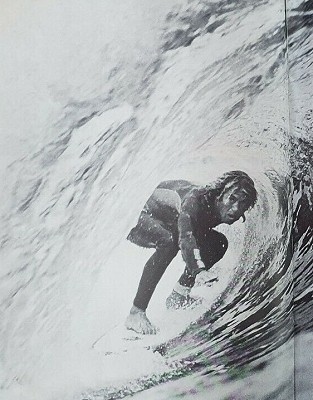
Surfer v20 n10 1979 October, page 44. |
 |
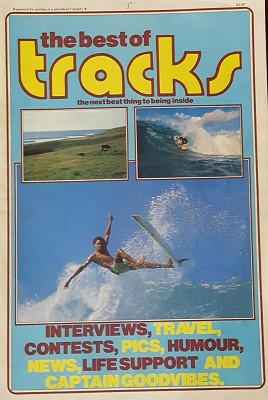 The Best Of Tracks Number 3, (December?) 1979 |
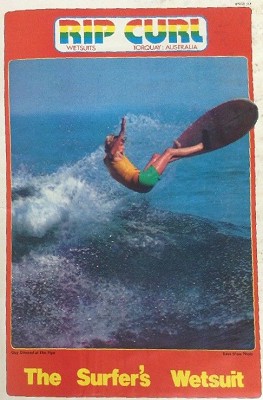 Back Cover: Guy
Omerod
Rip Curl Wetsuits |
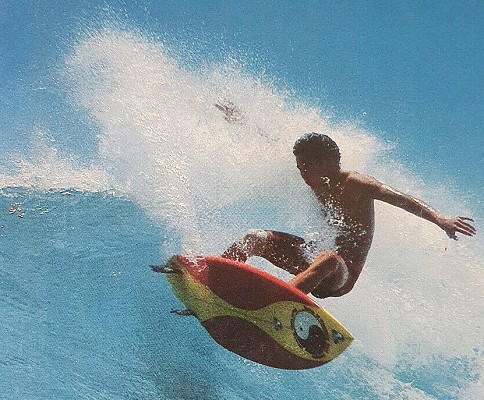 Randall Kim- both fangs showing
Cover: Surfer v20 n11 1979 November |
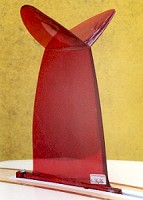
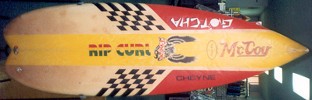
| 1980 Lazer Zap further development of the No Nose concept by Geoff McCoy based upon his work for Cheyne Horan. Later models incorporated
Ben Lexan Keel/Star fin. |
 |
| home | catalogue | history | references | appendix |
1992 Stell, Marion K.
: Pam Burridge
Collins Angus & Robertson
Publishers (Australia) Pty. Limited
A division of Harper Collins
Publishers (Australia) Pty. Limited
25 Ryde Road, Pymble NSW 2073,
Australia
1997 Warshaw, Matt : Surfriders
–
In Search of the Perfect Wave
Tehabi Books, Inc. Collins
Publishers, 10 East 53rd Street, New York, NY 10022
1978 Warwick, Wayne A
Guide to Surfriding in New Zealand Second Edition
Viking Sevenseas Ltd Wellington, New
Zealand
1979 Young, Nat ;
Photographs by McCausland, Bill: Nat Young’s Book of Surfing
A.H. & A.W. Reed Pty. Ltd. 53
Myroora Rd, Terry Hills, Sydney.
1983 Young, Nat with
McGregor, Craig : The History 0f Surfing
Palm Beach Press,40 Palm Beach Road,
Palm Beach NSW 2108
| home | catalogue | history | references | appendix |