surfresearch.com.au
 |
surfresearch.com.au
mctavish
: malibu revival, 1977
|
Bob McTavish : It's
much more fun than it looks...and it looks like fun.
Surfer
Volume
18 Number 4 November 1977.
Introduction
An article promoting the
modernised Malibu board, largely by Bob McTavish with an
extended quote by Skip Frye from California's Surfer
magazine.
An slightly edited (cropped?) version
of the article appeared concurrently in the November edition
of Surf Australia.
See Bob
McTavish, Dave Shaw & Peter Berry : Mals,
Mats and Kneelos.
The title of the Surf Australia
article, Breaking Back Into The Straight Line, revised
McTavish's mantra of the late 1960s- to break from the
straight line.
See Bob McTavish : Ladies
and gentlemen and children of the sun
Unfortunately, the claim
that longer boards are faster than short boards
by all
time master surfer, Phil Edwards, is demonstratively incorrect.
Pages
102-103
It's much more
fun than it looks ...
...
and
it looks like
fun.
by Bob McTavish
When we put the small
board together, we had a principle in mind -
to combine the speed area
in the turning area.
This meant you could keep the power
on through your turn, resulting in today's
arcing power surfing.O.K.
That's fine when
there's enough room
to carve - size-wise, head high or over,
surface smooth.
But what about the
all-too-common small
days, sloppy days, just plain junk days?
And those perfect
peeling point mini-days?
Re-enter the big board.
With
its many square feet of soft planing
area, it glides over dead spots, connects the
power pockets, and develops
phenomenal speed from small, weak waves.
That's the
starting point.
|
 |
The other day at the point, I
dropped
in on a guy on a small board.
I didn't think he had a chance.
The wave was about six feet, I trimmed
my big board for all it was worth, then added a stretch
five, It really
threw over, and I was right in there for a couple of
seconds.
Then the guy on the small board appeared
below me.
We both got bombed.
I felt lousy.
He came up hooting!
Is the big board faster?
It's a case of float or fly.
When you need the float, the big
board
is faster; when there's the power to fly, the small board is
faster.
SURFER Magazine -"Wide boards
(21" and
over) give more glide and stability.
Compare them to birds that soar;
e.g,
pelicans and eagles.
The pelican can coast on the
slightest
updraft from the smallest wave, while seagulls, who have
narrow wings,
can't glide until the surf is larger.
It's the same for wide vs, narrow
boards.
Average surf ridden calls for
wider
boards." - Skip Frye,
Fair enough?
Midget called it high-speed stall
and
low-speed stall, after hang-gliding a while.
Hang-gliding - hanging on the
nose,
and gliding under section after section.
A nice way to spend a windy
afternoon,
Which brings us to the trimmings.
Apart from getting you going
better
in weak waves, you've got the arts of trimming and noseriding.
True trimming is almost a lost art
- or was till the recent upsurge in big-board use.
Trimming is getting the maximum
efficiency
from a situation; balancing the available variables to make
the section
you're in, and the one after it, and hopefully after that.
It's a very satisfying feeling to
get
the most from it in a delicate and graceful way.
We all know what noseriding is -
but
have you experienced the in-the-tube, high-speed noseride only
available
on the big board? It's not the mushy, painful thing the short
board delivers.
Or the nose trim.
Going for maximum speed with your
whole
board hanging behind you in the tube, laying as much planing
area as possible
on the face - very thrilling, and in surf that most people
drive right
by ...just a couple of feet high, and maybe quite sloppy.
Another thing the big board can
do -
pendulum - you have to swing it to turn it, and you can
counterbalance
your weight against the board's momentum while swinging
it, and put
yourself in some radical situations.
Also, the pendulum effect gives a
kind
of rhythm - a beautiful thing that takes many years to
perfect, and simply
cannot be faked.
The bad
points?
Well, they're limited.
True, they can turn slop
into surf,
but they cannot do anything for sizable real surf.
Limited arc power.
A big man on a big board can
do it
if he's got the punch.
But generally they don't cut
it in
juicy, overhead surf.
Design?
Well, principle is as much
usable planing
area as possible within practical dimensions.
Some people are happy with
the old
ones, 9 feet to 11 feet, or so, while many who've been
solid surfing through
both eras, long and short, prefer them in between, 8
feet to 9 feet.
The more noseride you want,
the fuller
nose and more tail lift.
But you lose some trim
speed.
A nose concave gives a
stable mush
noseride, nice for beach breaks.
The pure
trimmers still like a little
more tail lift than nose lift, and a nice planing area
two-thirds forward.
The trimmers really
appreciate a wall.
|
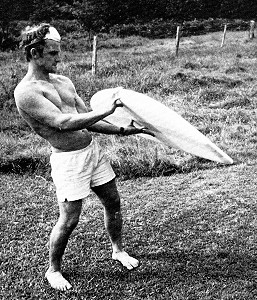
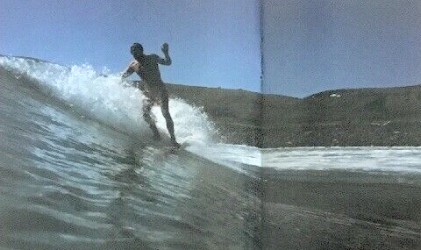
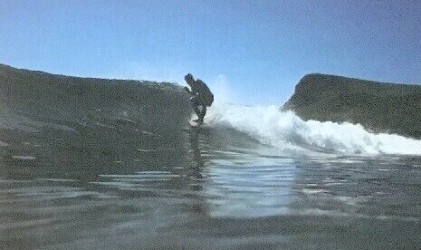
Photograph
: Greene
|
Rails vary: generally wider is
softer,
narrower is harder, for tube comfort.
At 21 1/2, a two-thirds down round
feels good.
Right down at the nose, give the
clean,
pecketrator plane.
Keep your fin deep.
So it's fun to see them back,
especially
the updated, lighter, lower, smaller ones.
It's fun, but a little sad.
Sad to see more people out in the
mini-surf
that have peeled off empty for six or seven years.
Fun, but sad, but fun!
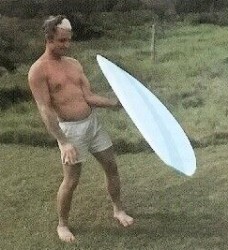
Photographs by Peter Green
from the Surf Australia article.
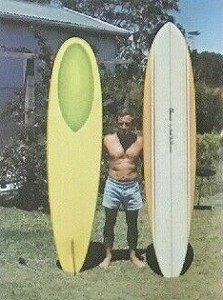
Bob McTavish and Late 70's Malibu
Board
Photograph : Greene
Surfer
Volume 18 Number 4 1989,
page 102. |
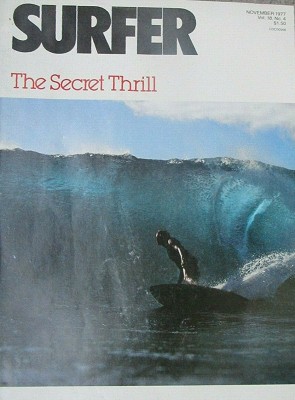
Surfer
Volume 18 Number 4
November 1977.
Cover:
Steve Dobney.
|
|
surfresearch.com.au
Geoff Cater
(2011-2020) : Bob
McTavish : Malibu Revival, 1967.
http://www.surfresearch.com.au/1989_Witzig_Nat_Nuuhiwa_SW_v8n4p10.html