 |
surfresearch.com.au
mctavish
: classic design, 1976 |
| home | catalogue | history | references | appendix |
|
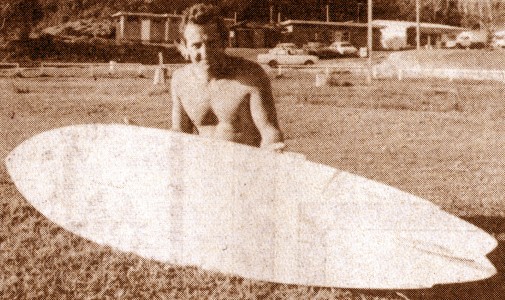
In practical terms this meant that we
were all going to have to put up with some minuses along with the pluses.
A good board was going to the one that
had plus points you could work with and minus points you could best overlook.
A bit of a dud in some conditions,
or not so good at doing some manourve (no, sic) longer holds true
for many facets of design.
It still may apply in some aspects,
for example, tail outlines, but in rails, rocker, profile bottom
and deck shapes, the story has changed for mainstream design.
After covering the spectrum in these
aspects, trying them this way and that way and in between, classic design
can now be documented in terms of measurements and definite statements.
Designs, that is all the pluses and
no minuses, for the great majority of surfers, under a broad spectrum of
surf conditions.
Consider a few features with me.
Try rails, they were soft for decades,
the hi-lo, the full low hard, now hard soft.
For the past 5 years it's the proven
design, right?
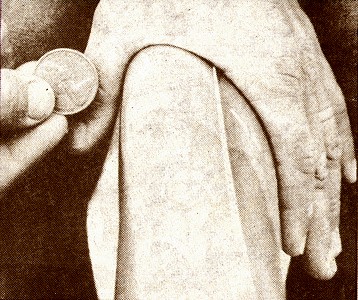
The actual size of the soft rail, at
the widest point seems just fine about the size of a 20 cent coin. Nobody
can argue that this is not the proven acceptable mainstream rail.
For years it was the flat forward tail
lift thing.
Then when boards went short and speed
was needed in the tail, rocker was reversed, straight under the tail, with
rocker in the nose.
(F, sic) four years ago a little
tail lift was found to help with vertical drops and work high in the wave.
People got a bit muddled up with this and generally fuzzy thinking
produced a too soft tail, the through-out rocker being a groovy way
of being undecided.
Now there's a sense in having the straight
under your feet.
It delivers speed without effort.
And the tail kick thing still holds
true.
So the on-the-ball shaper puts them
in very definitely.
You get speed and manourveability in
your rocker.
Front footback, back foot looseness.
(sic?)
Nose rocker can't just be dropped in.
If you use a basic arc, you end up
mushing under when you get forward, so it's accelerating the rocker thing.
The right amount of rocker that delivers
speed with safety is 5 inches in the nose, 1 1/2 inches in the tail, for
an average length mainstream board, blended in the above manner.
Now the profile.
We launched into full foil in 1970.
But your whole board isn't immersed,
so why?
OK foil your rail taper.
The lighter the nose the snapper it
is.
You can chuck it around easily.
So now we thin the nose out to remove
weight.
Carry the volume through toward the
tail to assist paddling, then taper off the last 2 feet into a fine tail.
This taper provides to water flow over
the deck-tail which is only very slight - enough to hold the tail in without
dragging the tail under.
This profile means you end up with a
slight 'S' deck.
One third up from the tail, the deck
peaks.
It provides loose, light handling,
extra good for tight turns high up in the wave, and for split second adjustments
and corrections.
This makes for more accurate surfing.
Also the profile provides good paddling.
This is because the bouyancy is back
where it needs (to be, sic) to lift the tail.
Also with the 'S' deck, you get your
feet on different deck planes.
With back foot pressure your weight
is generally back, and the angle your weight is applied to the deck
is near vertical due to the down angle.
Visa Versa for the front foot, and
it's a separate plane.
Sound like a sensible rocker?
Brewer has been doing it for 18 months,
Parrish for maybe 12.
It works.
It adds up with the bottom rocker too.
The bottom shape that really works is
like this.
Nose vee, into flat, into tail vee.
But there's a little more to it.
The tail vee is only a swelling around
the fin, due to the straightish rocker into the fin and the radical little
tail kick.
So the rail rocker line is a nice curve
due to the vee, get it?
Have a look at one closely and you'll
see what I mean.
The vee has gone by the time you get
to the very end.
Some people call it the spiral vee.
It's the only way it can all add up.
The nose vee.
You know the nose is almost never buried,
so why the vee??
If you're doing say 30 K.P.H. on the
wave, and your've got a 20 K.P.H. offshore wind your've got a kite
under your feet.
Look at all wings, they've got a vee
of some sought (sort, sic) between them.
Why?
They self-stabilise.
Follow that one?
Try it.
Try a hard wrap around cutback off
the lip, combo at the top of an 8 foot wave with a howling offshore.
It's better that a flat nose underneath.
Deck shape.
Well flat decks give nice leverage,
better than rolled.
OK, so it sounds heavy to say that all
these features are right, the best.
But try them.
The combination is the sum total of
all the research that's been sunk into surf design, the radical, the conservative,
the Aussie, the Hawaiian, and put together well.
We have the hottest mainstream design
going with an absolute minimun of hang-ups and restrictions.
In fact they feel so hot we've yet
to find a bad aspect to them.
No doubt things will change in future
years, but now true design is jelling into a most refined and delicate
stick that must be put together accurately and with understanding of what
these individual elements do, So look for it.
If your not getting it you're probably
not getting the best, in mainstream design anyway.
| LENGTHS: | 6 ' 6'' - 7' 0'' |
| WIDTH : | 19 1/2'' |
| NOSE : | 13 1/4'' |
| NOSE LIFT : | 5'' |
| TAIL LIFT : | 1 1/2'' |
| THICKNESS : | 3 1/8 '' |
| ROCKER : | Constant curve forward.
Planing area to fin. Lift behind fin. |
| BOTTOM : | Vee nose-flat-vee into fin -
flat again at tail. |
| DECK : | Flat. |
| PROFILE : | Thin nose, thickness carried through,
then last 18'' wedged off Results in 'S' deck |
| RAILS: | Tapered, but not TOO thin.
Ten cent radius soft bottom at widest point. - hard tail |
| TAIL OUTLINE : | Of your choice. |
| PERFORMANCE : | Loose tail, fast planing, no catch
rails,
zing out of turn, no spin-outs, and no sinking in turns. All blended together with 20 years of surf love for that little extra flow and zing. - Bob McTavish
|
| home | catalogue | history | references | appendix |