| home | catalogue | history | references | appendix |
|
However, wider
boards with round rails and wide tails don't necessarily put you out of
the picture. Their speed potential is locked in, and you are the key.
They can be banked
higher, and if they are finned and foiled correctly, they really take off
while sitting up on their edge.
This is due to
the centrifugal force gained from the arc pressing you into the board and
greatly increasing the board's momentum.
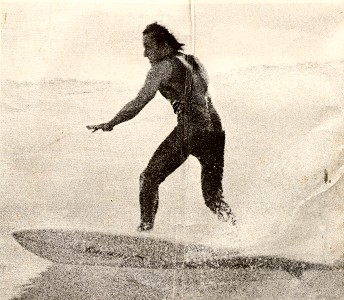
So, if you place your turns well, you can get your slug really flying. A string of full bottom arcs, and your speed increases in every turn. By this time, you're just flying over the water and your board is just a ball of spray as you kiss off each turn.
And it feels so
good!
You can really
feel surfing, feel the force and speed.
It's like a jet
plane - you don't know you're even moving at 500 mph ...unless you go into
a bank!
The ways to get
more punch from the board are many.
First, your board
needs to be in tune.
The wider the
tail, the bigger the fin and the softer the rails, the more fin you can
use.
And tune the
flex in your fin if you're behind this kind of surfing.
A good glass
fin of 25 layers with 2-3 inches of spring in the top will deliver maximum
drive.
It must be firmly
anchored on, glassed on preferably, to deliver all the thrust.
Next, you pick
up the rhythm of a thrust turn.
Go into the turn
crouching some and expand in the turn, pressing your whole weight into
it while fully banked, and you'll take off.
Up on top there's
no need to pull the nose back down, as a wide board will run along the
face banked on the other rail.
It'll keep carving
all the way.
It'll also run
way out on the shoulder if you wish, and the wide tail will not sink as
you cut back out there for the roundhouse turn back in on the curl.
In the cutback,
also, the crouch and extend thing can be used to advantage.
When you expand,
try throwing your arms up over your head for a little extra thrust.
It's a whole
rhythm that can be worked on if you've got a wide-tailed fin diver.
It's sort of
like riding a slateboard on flat ground.
You push it hard
through turns, crouching and expanding, pumping it around.
And like riding
a skateboard, you'll find yourself getting power from the wave where it
seems impossible, like right out wide on a dead shoulder.
On either kind
of board - the narrow streak or the wider, rounder fin driver - backside
turn seems to be more powerful.
I guess it's
because your heels can handle more weight than your toes.
One thing that's
worth a try in backside turns - lead your turn through with your left arm.
I mean put it
through the turn ahead of you.
You can throw
it back, ease it around, or just point with it, what ever suits you and
the situation.
It puts the power
through your back foot, which makes the turn much more controllable.
It's a form of
rotation, I guess.
Also, it leaves
you set up beautifully for a turn back or turn down off the wall, or an
explosion off under the lip, because all you have to do is throw your left
arm back the other way and follow it.
You'd better
reverse all this stuff if you're a goofie (sic).
Each kind of board
has its advantages - the streaks streak and sashay and slice inside of
big tubes, but they dud out completely in roundhouse maneuvers and distant
cutbacks, except maybe when they're super streaking (which I guess ain't
that rare).
They're right
on for those big Island tubes and walls; that's where they emerged from.
The fin drivers
seem to go extra fine in Australia's largely broken conditions- a quick
little tube
followed by a
gooshie part, followed by another tube, and in the majority of Californian
surf.
Fin drivers are
extra strong in short surf that allows cutbacks and also in rough, lumpy
conditions, so they suit many East Coast surfers right to the core.
But they're so
slow in big drops that sometimes you don't make it along the bottom under
all that soup, unless you're Nat.
Someday soon someone
is going to incorporate the features of each in the one unit.
Maybe the board
needs to be flexible to provide the right curves at the right time.
But then that's
a wing.
And we'll all
be seagulls cruising. .. arcing. ..soaring. ..wheeling. .. drop!
And scream into
a big bottom turn that strains every muscle and the whole frame, and carve
up into the flow again, pick up the thin stream of power and play on it,
all day in the sunshine.
|
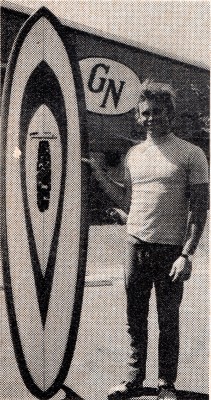
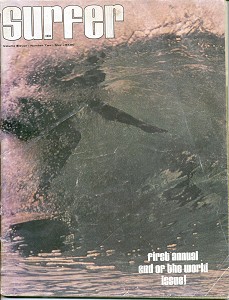
Volume 11 Number 2 May 1970 Pages 27 and 29. "First Annual End of the World Issue". Tips : Number Forty Five STREAKS AND SLUGS by Bob McTavish . Photography : Uncredited. Cover photograph,
image right:
|
![]() |
Toward Unencumbered Flight: Kneeboards, Spoons & Paipos..
The New Adam: Merv Lason and his Wave ski, 6 pages
Waves and the Silent World: Jacques Cousteau: .,4pages
Advertisements:
Hansen S/b with
Lopez, Hobie S/b with Micky Munoz, Bing S/b Maui Foil.
| home | catalogue | history | references | appendix |