 |
surfresearch.com.au
farrelly : pintails 1968 |
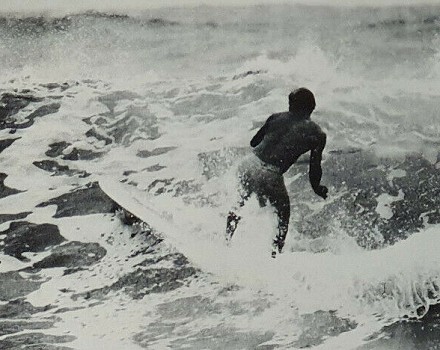
Midget Farrelly : The Art of the Pintail, 1967.
Midget Farrelly : The Art of the Pintail.
Surf International
Vol. 1. No. 5 April 1968, pages 12 to 15.
| home | catalogue | history | references | appendix |
|
surfresearch.com.au
farrelly : pintails 1968 |
| Page 12 The Art of the
Pintail
Midget Farrelly DID
you ever see a gull coasting over the surface of the
ocean, then accelerating swiftly over a swell?
This
is how I think of a pintail. It's not a new design- its origins ... |
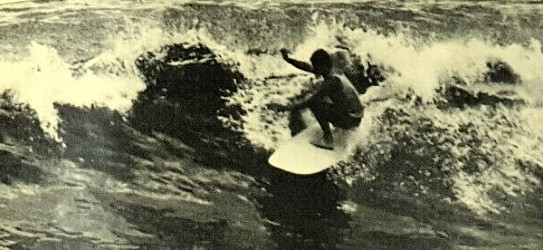
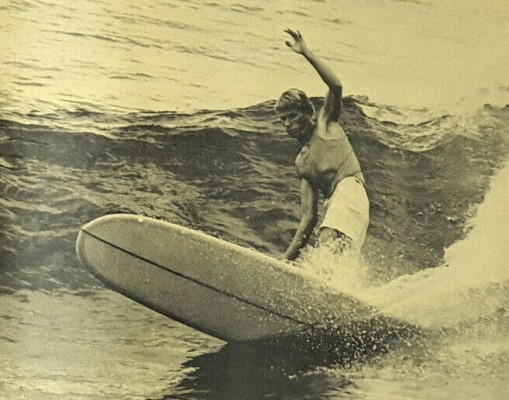
Page 13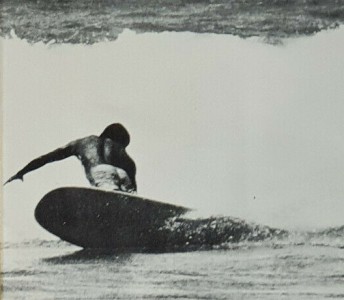 Peter Drouyn on his pintail. Ric Chan Photo. |
... can be traced back to Makaha point surf days, several decades past.
The form it
exists in today is quite revolutionary.
A good pin
is rather pointed at either end, reminiscent of a big wave
board.
The fine
extremities will shake up a few old principles, like nose-
riding and tail stalls, which are generally associated with
a full wide nose and tail.
A better
surfer feels at home on a pin, working from the centre out
to the ends, this being governed by the rise and fall of
wave speed and vertical face.
A more
challenging wave is the supreme test for a pin, as gentle
tiny beach breaks don't bring the best qualities out.
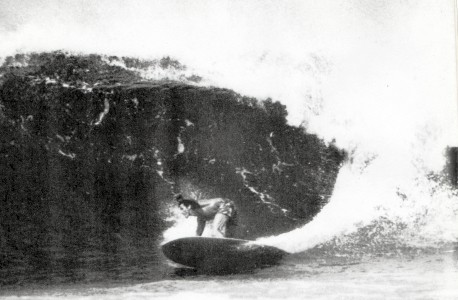
Angourie
seems made for bold, precise surfing, allowing for few
mistakes if the curl is to be ridden.
Here the
pin will hide deep behind the white water, or high in the
thick revolving tube.
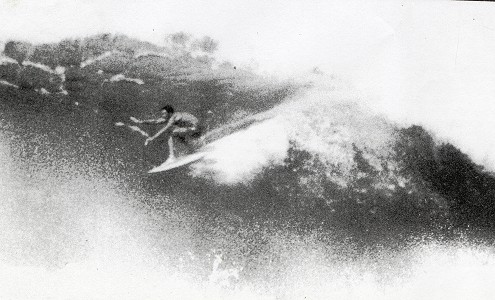
The speed
leaves you breathless and wondering what took place between
the time you dropped in and finally kicked out.
Speed seems
the real asset of the pin, but it is the sustained flow
between manoeuvres that blends them together as one, a thing
so simple that is constantly sought after by surfers at
their best.
This flow
can be had on a pin with bump-free outline.
To turn on a
wide tail short board, the board must be coaxed off its tail
block, up, over and on to the rail, which appears as a short
jerky turn often resulting in the whole rail being buried up
to the nose, and followed by a loss of speed.
The pin is
all rail, having no block, so when the surfer puts his
weight back, and then on to the rail, the two appear as one,
and have instant effect on the board's direction.
Shorter,
more critical turns can be had by moving on to the tail and
dominating the fin.
The pin does
not stall easily, so a re-entry often turns into a
roller-coaster unless checked.
Noseriding
is performed in the wave, not on the shoulder.
The nose
outline fits the face or wall without throwing the tail
free.
Noseriding
is not a separate manoeuvre but merely the most forward trim
position.
In general
trim the surfer's feet are one behind the other, so you can
imagine the difficulties a beginner would experience.
The ...
 |
 |
Page 15
|
Midget
Wins Again
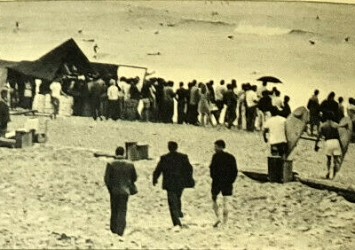
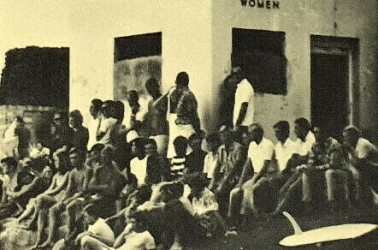
Kevin Parkinson FOR only about the second or third time in years, a sizable number of big-time Northside surfers met Southside surfers in a give-no-quarter contest of major proportions. Surfers such as Midget Farrelly, Ted Spencer, Keith Paull and David Treloar matched their ability against surfers like Ken Middleton, Frank Latta, Bob Conneeley and Chris Brock. The place for the Bobby Brown Memorial was Cronulla. By far the most well organised and competitive contest to hit the Southside, it was definitely a perfect tribute to a great surfer and a great friend of mine, Bobby Brown. The surf for the contest on the whole was pretty bad, but then again it always is for a contest. The waves on Sunday really gave the competitors a hard lime, with a very srong N.E. wind blowing across the face of occasional 4ft to 5ft waves, making it very difficult to ride. But that was not the only worry heal winners had to face- their main one was the barrage of invited and seeded surfers in Sunday's quarter-finals. These quarter-finals were held four to a heat with one to qualify for the semis. ... This is were the competition really started because when you draw a semi-final with top surfers, you just naturally compete to your utmost; maybe you realise how close you are to the final and and how much of a waste of lime it would be if you did not try. |
Page 39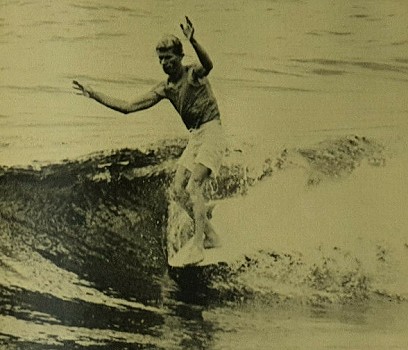 |
 |
 |
 |
 |
 |
 |
 |
 |
 |
Page
44 Wayne Lynch Wayne LynchThey date back to 1963. ... |
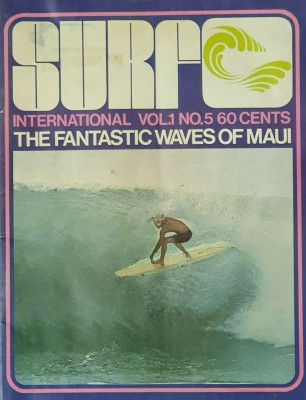 |
Surf International Vol. 1. No. 5 March 1968. Cover: Buddy Boy, Honolua Bay. |
| home | catalogue | history | references | appendix |
Take What We Have
& You'll Have What It Takes
The Midget V Pintail, our new
variation of the popular Midget V. along with the Frye V, the
Fry Baby Gun and t.he Hot Curl represent the Iatest designs.
Each design is different.
Something for everyone.
Uncomplicated lines for
versatility.
Fast lines for mInimum drag and
speed.
The basic formula used for all of
our boards includes lightness and shortness.
The short, light board is the
prImary influence into days surfing.
Our boards weigh 14-18 Ibs.
Anything over 20 Ibs. is
consldered too heavy.
We have geared all of our models
to be ridden at the following sizes or shorter depending upon
personal taste:
| 105-115 Ibs 115-125 Ibs 125-135 Ibs 135-145 Ibs |
.......... .......... .......... .......... |
7'6" 7'8" 7'10" 8' |
145-155 Ibs
155-165 Ibs 165-175 Ibs 175-185 Ibs |
.......... .......... .......... .......... |
8'2" 8'4'' 8'6" 8'8'' |
OUR DESIGNERS
KNOW WHAT'S BEST
Skip Frye, a top competitor in the
United States is also tops in surfboard design.
He is in the water six days a week
from 4 to 6 hours a day testing, trying and modifying.
He has put a lot of knowledge into
his models.
Skip's work on fin design over the
last two years is unparalleled ... the results have
opened up new experiences for everyone.
The high performance fin and the
new 6" free foil fin are Skip's contributions.
Midget Farrelly runs his own
surfboard factory in Australia.
He is on top of everything
happening down under.
Midget is one of Australia's top
competitors and leading surfboard designer - his ideas come to
us from 9000 miles away by mail, phone and an occasional
visit.
Midget foresaw the short light
board over two years ago when we started with his stringerless
model.
He predicted surfboards weighing
ten pounds at a time when everyone had 28 lb. boards.
In May 1967, Midget wrote to us
about a completely new thing that he was working with.
It was the V Bottom.
This was our first introduction to
this radical design.
We delayed work on it because at
first it sounded impractical, and we questioned its
acceptance.
Finally in the fall of '67 we were
convinced that Midget's new Model for '68 would be a V Bottom.
We are now offering this same
model with a pintail.
The pintail is not necessarlly
better.
It merely lends variety to a
popular thing.
Some will like it better, but many
will prefer the square tail.
It's your choice.
PIease try them ... and remember,
take what we have and you'll have what it takes.
G &S
Surfboards
5465 Gaines, San Diego, Calif.
92110
We use Clark Foam
& W.A.V.E. Set Fin System