 |
surfresearch.com.au
history :
greenough
|
george greenough, 1966 - 1969
| home | catalogue | history | references | appendix |
|
surfresearch.com.au
history :
greenough
|
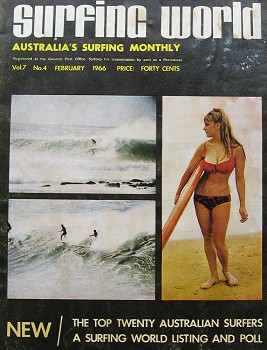
| Surfing World
Volume 7 Number 4 February 1966 David Milnes- Central Coast Interlude Top Twenty Australian Surfers Poll White's Beach Interview by Rick Elliot- John Lewis John Pennings- Golf Course Reef John Bevans- Sue Cullen Why, Why, Why. Photos from the Readers, includes Bobbie Brown and John Moonie Advertisements Midget Farrelly Surf Skate Mgf Co. Greg McGillivray- The Performers. Gordon Woods Surfboards- big wave guns. Ron Surfboards. The Dee Why Surf Shop- America's Top Maker Gordon and Smith now available in Australia. Ron Taylor: Shark Fighters (skin diving) plus Surf Scene. Hayden Kenny Surfboards- custom by Bob McTavish for 3 pounds more. Bower Boy Surf Wax. Ampol Surfboard Wax . BMC- Mini Deluxe. |
 |
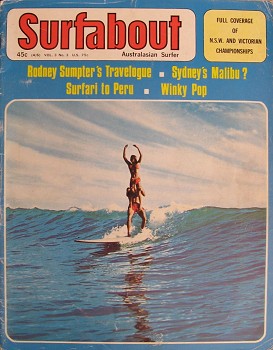
| Surfabout Volume 3 Number 3 1966 . Cover: Tandem surfing. Jack Eden: Sandon Point, with Gary Birdsall and Bobby Brown Barry Sutherland: Winky Pop Rodney Sumpter's European Travelogue, includes Cribben (England) and Guethany (France) Surfabout Personality: Rodney Sumpter Nipper Williams: Wake surfing, with Wayne Burton and Kevin Platt. N.S.W. Championships, with Nat Young, Bobby Brown and Robert Conneeley. Barrie Sutherland: Victorian Championships, Rod Brooks 1st, Juniors- Wayne Lynch Bob Pike: Surfari to Peru South Avoca Jack Eden: Sydney's Malibu? (Oak Park Sandshoes) with Frank Latta Centre fold: John Coleman Advertising: Surf Posters: Rusty Miller at Sunset , John Peck at Pipeline and 6 others. Keyo Surfboards: new moulded fin Gordon and Smith Surfboards, Carringbah (since 1959 in California) Peter Clarke Surfboards . O'Neill Wetsuits Quane Surfboards, New Zealand . Scott Dillion Surfboards, with Dave Passenger ex- Dale Surfboards. |
 |
| Surfing World Volume 7
Number 6 of May / June 1966 Cover: Accent On Africa. Contests: Bell's Beach Classic by Lester Brien- 1st Wayne Lynch, 2nd Bill Monie, Bob McTavish freesurfs large waves, Articles: Exploring the South Coast (6 pages), Werri Beach South Africa and Aussies Abroard The Top Twenty- Nat Young, Bob McTavish, Robert Conneely and Bobby Brown (equal), Peter Drouyen (sic) , Midget Farrelly, Russell Hughes, John "Nipper" Williams, Rodney Sumpter, Kevin Brennan, Glenn Ritchie, Wayne Lynch and Butch Cooney (equal), Lester Brien, Richard Harvey, Kevin Parkinson, Mick "The Pom" Carabine, Bruce "Lovedog" McManus, John Monie, Keith Paull, Kevin Platt, Bob Bell. Contests: 1966 State Championships at Avoca with Nipper Williams Advertisements: Gordon Woods- Nat Young Model Hayden Kenny Surfboards- Ken Adler signature model (Available from John Arnorlds surf shop) Keyo Surfboards- plastic Nylon moulded Dork fin Wallace Surfboards Catalina Surf and Swim Wear (fold-out)- Mike Doyle, Ken Adler, Makaha Big Gun Surfers T-shirt, Pipeline board shorts. |
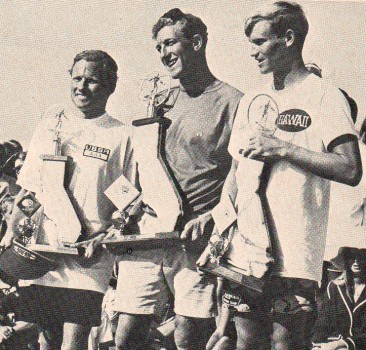
| 1966 World Contest:
Corky Carroll, Nat Young, Jock Sutherland. Accompanying an article on surfers-knots or board-bumps. International Surfing Volume 5 Number 1 page 47. February-March 1969.  |
 |
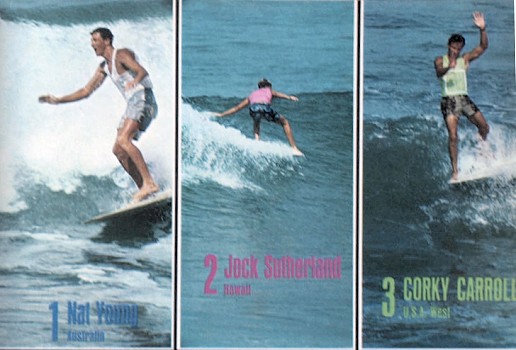
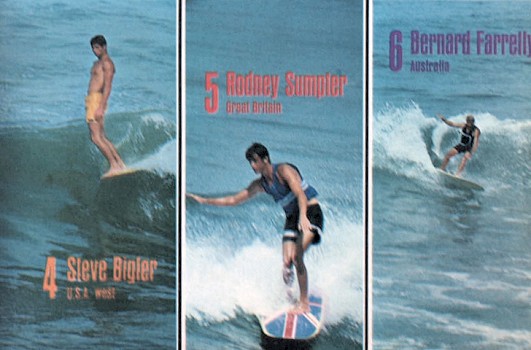
| Surfer
January 1967 Volume 7 Number 6 page 43. World Contest Finalists Nat Young, Australia. Jock Sutherland, Hawaii 3. Corky Carroll, USA West 4. Steve Bigler, USA West 5. Rodney Sumpter, Great Britain 6. Midget Farrelly, Australia |
 |
 |
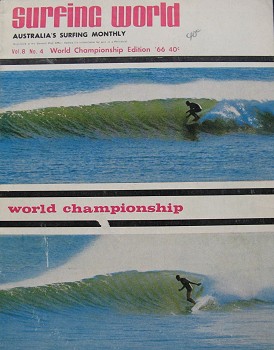
| Surfing World
Volume 8 Number 4 [November-December] 1966 World Championships Edition, California (held in October), pages 8-9. John Witzig: World Contest Story (San Deigo) Malcom Lock: Boomer Beach, South Australia John Arnold: Myaponga, South Australia Fold Out: Nat Young at the Kick, Collaroy. George Greenough: his house , his 100 MPH go kart and a story of the writer catching sharks on his surfboard along with George. Advertising Gordon and Smith Surfboards: The Stretch, a US noserider model with a square tail and square nose, nose concave, +9ft(?) Scott Dillon Surfboards: Junior racing car Gordon Woods Surfboards: Congratulates Nat Young Shane Surfboards: The Russell Hughes Excellor Model Kustom Surfboards by Allen Kirton, Main Beach, Queensland., page 38. Dunlop: Bumpers [sandshoes-sneakers] featuring Nat Young Dale Davis: Inside Out, featuring Mike Doyle, Mickey Dora, and Corky Carroll, plus the largest wave ever filmed ridden by Pat Edwards and the War at Malibu. (Dora versus Johnny Fain) Bob Evans: High on a Cool Wave George Rice Surfboards: A Big Wave Board? - asymmetrical outline and concave hull. BMC: Mini Delux |
 |
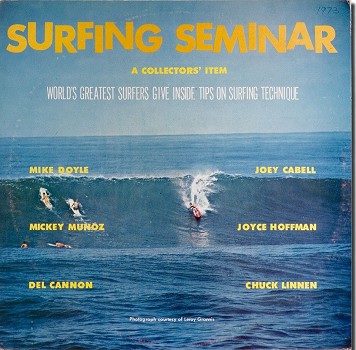
| Surfing Seminar LP record, 1966. The Adelaide surf scene / distributed by Geoff's Surf Shop. 1966, Illustrated edition http://trove.nla.gov.au/version/43759413 [24] p. : ill., port. ; 22 cm. Adelaide : Geoff's Surf Shop, [1966] |
 |
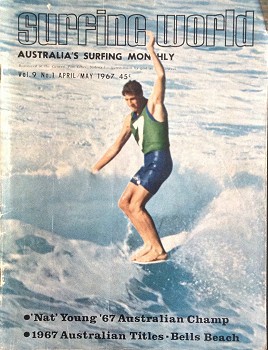
| Surfing World Volume 9 Number
1, April-May 1967 . Cover: Nat Young. Bells as tolled by Ross Kelly, photographs by Alby Falzon, 1967 Australian Titles,1st Nat Young NSW titles Andrew P. Llewem: Don't say it, spray it! (spray on surf wax.) Advertisements Bob Evans: High On A Cool Wave. Paul Witzig: The Hot Generation (movie poster available for 40c) White Stag Wetsuits: Wave Rave. Slip Check, spray on surf wax. Keyo Surfboards, McTavish Tailor Mades- McTavish shapes and skegs each board. Quarter inch redwood strip and Greenough stage III skeg with hot foil and flex standard gear. Dunlop: Bumpers, sandshoes as worn by Nat Young SW Subscription plus a Citizen watch BMC: Mini |
 |
From context, the implication is
that in mid-1967 Brewer was committed to this significant
reduction in length: "For some reason, all of this
innovation led to Brewer being relieved of his command at
Bing.
Gary Chapman had purchased a
reject blank and carried it over to Bing's factory where
Brewer shaped it into an 8-foot 6-inch mini-gun.
"Bing fired me the next day,"
Brewer told Kampion."
- Marcus: Surfboard
(2007) page 160.
It would appear that Brewer's
dismissal was in fact at least twelve months later.
Initially employed in May 1967, Bing
Surfboards were still promoting Dick Brewer's Pipeliner
model in July 1968.
- Bing Surfboards
Advertisement, Surfer Magazine July
1968.
Reproduced in Holmes: Bing Surfboards (2008)
page 97.
Tom at the Classic Bing Surfboards web site post several images of a Bing Pipeliner and notes:
Chuck Linnen's original
California Pipeliner Gun.
Dick Brewer shaped three
Pipeliner Guns when he visited the Hermosa shop in the
summer of 1967, for team riders David Nuuhiwa and Chuck
Linnen and Grant Reynolds (Bing's glasser).
Unlike the other Pipeliner
Guns, which were made in Hawaii by Brewer in 1966-67, these
three were made for riding big surf in California.
This one is
10'7"!
The images include a "a photo right out of Bings order book" that indicates that Linnen's board ("#7986")
was ordered and/or shaped on "8-3-67", that
is 3rd August 1967.
- Classic Bing Surfboards
http://www.classicbingsurfboards.com/mid60sbings.html
Even accounting for the board being "made for riding big surf in California", the extreme length hardly illustrates Brewer's recollection, above, that "the mini-gun was happening in the spring of '67".
Gerry Lopez supports that story with
his own recollection: "I think it was in late
'67," he told Drew Kampion.
"Brewer had just moved over to Maui
from the North Shore and was shaping in Lahaina.
Reno Abellira and I each took a blank
over there to get our boards made by him.
Reno got his shaped first, but before
he could shape mine, Nat and Greenough and McTavish and Ted
Spencer and a couple of other Aussies showed up with those
wide-tailed, vee-bottom boards.
They wanted to go ride em at Honolua
Bay, but there wasn't any surf there.
John P Thurston had a surf shop at
the Cannery in Lahaina where all the boards were glassed, and
they came there, and we met em, and Brewer and McTavish kind of
bullshitted for a long time.
So the next day we go back to do my
board - I think wanted like a 9 foot 8-inch, which was
considered a shorter board then - and Bewer just takes the saw
and cuts a foot of the blank, and it's 8 feet 6 inches, and he
tells me, 'That's how big a board you're getting. "
Holmes: Bing Surfboards (2008)
page 164, quoting Drew Kampion in The Surfer's
Journal, unspecified.
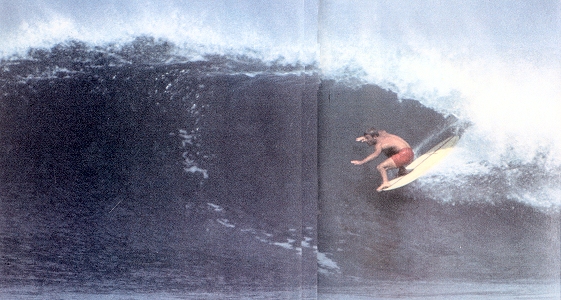
McTavish
is a charismatic character when you get him going.
As I
drank in what he was saying, I felt the life coming back,
I wanted to shape one of these little machines and go
surfing. Bob explained how the vee bottom in the tail sat
the back of the board in the water, allowing it to roll up
onto one side and carve an arc. My first thought was that
these boards would have all the action in the rear end;
they were really only turners and I wasn't sure that was
such a good thing because it struck me that nose-riding
had been thrown completely out the window. I thought the
concave noses were a feeble attempt to get the boards to
nose-ride but they just wouldn't do it like the old boards
did. For the first time in my surfing career lightness had
become a factor; everyone was building their boards out of
stringerless blanks to keep the weight down.
I asked
Denny Keyo if I could use Bob's shaping bay and, for the
first time in six months, I shaped a new board. It was 8
feet long by 23 inches wide and like McTavish's had a
12-inch pod across the tail with a 4-inch vee.
The
stringerless blank was really hard to hold while shaping
and I had to use a brick to keep it in one place.
The
thickness of those Plastic Machines also made them appear
strange, as they held the thickness of the centre right
through to the tail.
And I
soon found that glassing them was a nightmare.
The idea
was to get the board as light as possible, so a thin skin
had to be put on the bottom to hold the curve, then a
couple, of layers on the deck to give it some strength and
rigidity.
I took
the new board out in a 3-footer inside Narrabeen "Alley"
to test it and thought I'd never get used to the feel, it
was so weird.
After an
hour of practise, and a few long swims to the beach, I
began to get the feel of the vee and found how interesting
the pocket-riding type of surfing could be."
-Young: Nat's Nat (1998)
page 162.
 |
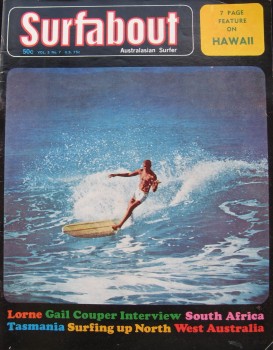
| Surfabout Volume 3 Number 7 1966. Cover: Nat Young early 1963 photo of Nat Young, and the previous edition was a painting of a photo taken by John Arnold of Malcolm Lock oat Moana. Centre Fold: Kevin Platt . Barrie Sutherland: Lorne Point, featuring Wayne Lynch Surfabout Surfer: Russell Hughes Trevor Burslam: Surf Riders Winter Championship, Western Australia Hawaii Ian "Fritz" Smith: Dog Gone it Man ! Let's Surf the North- The Pass , Greenmount, Noosa, Currumbin, Lennox Head, Seal Rocks and Port Macquarie. David W. Roberts: Tasmania John Thorton: Elands Bay, South Africa Coalcliff, NSW Interview: Gail Couper Cross word puzzle Advertising Gordon Woods Surfboards Keyo Surfboards: leading shaper Kevin Platt Dunlop Surfboards: removable plastic fin Shane Surfboards: Excellor Model with Kevin Brennan Duke Kahanomoku Sneakers in Aloha Print canvas Scott Dillion Surfboards Gordon and Smith Surfboards: Hot Dog shape a little shorter, a little wider and a hell of a lot thinner with a Pivot George Greenough fin. |
 |
 |
1968
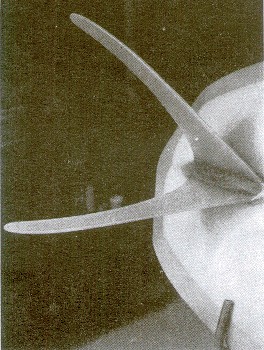
Butterfly fin by Scott Dillon: " Happiest surfboarder anywhere is Dr. Bob Spence. The 'Doc' has a board which he swears is the complete answer. 'Nat' has ridden it ...'Kenno' has ridden it, many others have too, and everyone agrees there is something really different and interesting about this board. Scott Dillon designed and built it and this is a pretty radical unit. Top plan shape is modified 'stubby,' though not quite so wide in the tail, bottom rear is convex, vee rails are straight though swept up at front end, but, the real punch line is the fins ... yes, I said fins (plural). Both skegs are joined at the base and then project out-ward and upward, gull wing style. The whole unit is very gracefully constructed and, according to 'Doc,' gives unbelievable stability and ease of manoeuvrability. ..the unit is just over 8 feet long." Volume 10 Number 4, March-April 1968, page 43. |
 |
Keith
Paull, Billy Hamilton and Mark Martinson, France,
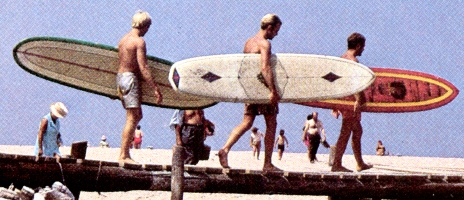
1968. Photograph : MacGillivay-Freeman Surfing Magazine March 1984 Volume 20 Number 3 page 99. Note that the two American surfers have variations of the Australian wide tail Vee bottom, whereas Keith Paull had moved onto a round tail design. |
| Surfing,
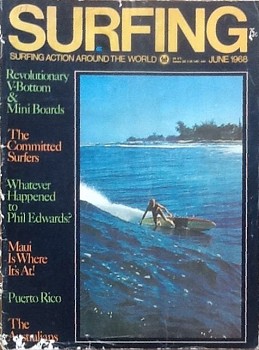
June 1968 Revolutionary V-bottom and Mini Boards, The Australians- Nat Young,Ted Spencer, Bob McTavish, Peter Drouyn, and Midget Farrelly. Maui Puerto Rico What happened to Phil Edwards? Ron Haworth: Duke Kahanamoku- the last days. Is there any surf in Tahiti? Innovative moves in surfing, including a small air cylinder pack for big wave wipeouts. Advertising Greg Noll Surfboards- the Bug. Gordie Surfboards O'Neills Wetsuits, with a long haired Bob Cooper. |
 |
|
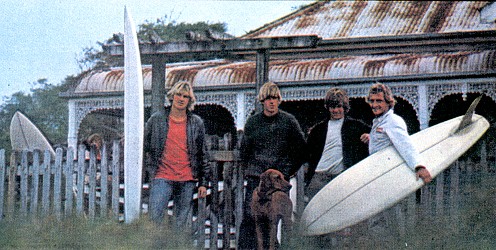
Bob McTavish. Wilderness factory, Angourie - Byron Bay ?, 1969. Surfing World Magazine, Volume 12, Number 5, 1969. |
 |
| home | catalogue | history | references | appendix |
BOOKS
1972 The Best of
Tracks (Vol. I) Editors : Falzon, Albert;
Stewart, John; Grissim, John. :
Tracks Publishing Co Pty Ltd. P.O.
Box 178 Avalon, NSW.
'Bob McTavish’s Personal History of
Surfboard Design – Pods for Primates Parts 1' (pages 120 – 122).
1992 Stell, Marion K.
: Pam Burridge
Collins Angus & Robertson
Publishers (Australia) Pty. Limited
A division of Harper Collins
Publishers (Australia) Pty. Limited
25 Ryde Road, Pymble NSW 2073,
Australia
1997 Warshaw, Matt : Surfriders
–
In Search of the Perfect Wave
Tehabi Books, Inc. Collins
Publishers, 10 East 53rd Street, New York, NY 10022
1978 Warwick, Wayne A
Guide to Surfriding in New Zealand Second Edition
Viking Sevenseas Ltd Wellington, New
Zealand
1979 Young, Nat ;
Photographs by McCausland, Bill: Nat Young’s Book of Surfing
A.H. & A.W. Reed Pty. Ltd. 53
Myroora Rd, Terry Hills, Sydney.
1983 Young, Nat with
McGregor, Craig : The History 0f Surfing
Palm Beach Press,40 Palm Beach Road,
Palm Beach NSW 2108
1972 Surfing World. Volume 16 #4. Bob Evans : 'remember the time when...' pages 30 to 35.
| home | catalogue | history | references | appendix |