surfresearch.com.au
 |
surfresearch.com.au
phil
edwards : what is good? 1964
|
Edwards, Phil:
Contests
- What Is Good?
Surfer
Volume 5 Number 1
February - March 1964.
Copy courtesy of
the Graham Sorensen Collection.
Introduction
By the beginning
of the 1960s, surf riding contests had established several basic
features,
some in evidence since the turn of the 19th century:
- competitors
classed
by age and gender,
- the use of
identifying
shirts,
- timed
heats
(usually indicated by signal flags)
- progression by
elimination to a final, and
- performance
assessed
by a panel of experienced elders.
However, at
each
contest the organising committee established its own format,
rules, and
appointed the judges, thereby determing the (usually otherwise
unstated)
performance criteria.
The oldest and
most prestigious contest at the beginning of the decade was
the Makaha Contest,
held each winter since 1954?
Unlike most
contests
it had established performance criteria, given its reputation
of of big
wave location, wave size was critical, in conjunction with
length of ride,
usually indicted by the positioning of a buoy inside the
break.
As well as
surfboard
riding, some contest featured a range of events, including races
with boards
or boats, tandem surfing, or the use of alternative craft, such
as inflatable
surf mats.
These events
enhanced
the contest for competitors and spectators, as well as providing
alternatives
given the unreliability of good surf coinciding with the
prescribed contest
date.
This article
precedes
Phil Edwards' attendance at the 1964 World Championships at
Manly, Australia,
as the head judge.
Although he
competed
but, apparently, never won a recognised surfing contest,
Phil Edwards
was held in high regard by the world's surfing community for his
skill,
knowledge, and pleasant demeanour; the later often contrasted
with fellow
California surfer, Micky Dora.
He was selected
on
the Senior Men's list for the first annual United States
Invitational Surfing
Championships to be held in mid-February 1964 at the Oceanside
Pier, but
declined in order to head the panel of judges.
- page 59.
Unfortunately, the
articles'
title creates unfulfilled expectations, in that it poses rather
than answers
the question.
Edwards establishes that
there are two different schools of (small) wave riding, the trickster
and the functional, and, while clearly indicating a
preference for the
later, suggests that officials provide competitors with standardised
rules, regulations, and judging.
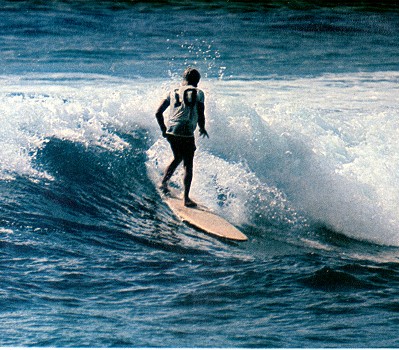
The uncredited photograph of Midget
Farrelly at Makaha in 1962-1963, said to demonstrate the trickster
school, is unfortunate.
In a subsequent
letter to the editor, titled Injustice, Phil Edwards wrote:
In regard to
my
recent article in SURFER Magazine on contests, I felt that the
accompanying
picture and caption did Midget Farrelly an injustice.
Midge's
grace and
smooth style do not only deny the caption, but make him the
epitome of
the "stylist" surfer.
Phil
Edwards, Dana
Point, California
The editor responded:
Our apologies to
Midget and Phil.
The caption
was
written in haste and referred to an early stage in Midget's
surfing development...ed.
As head judge at the 1964 World Championships in Australia,
Phil Edwards was instrumental in awarding first place to Midget
Farrelly.
Sections of the Australian surfing
press characterised Farrelly's style, heavily influenced
by Edwards, as Functional; later challenged
by the New Era approach expounded by Bob McTavish and Nat Young.
Also in
this Edition.
Dwight Crum:
Swimming
... a part of surfing, Surfer Tips 9, page 11.
Mickey Munoz:
Makaha International Results,
page 59
U.S. Invitational
Selections, page 59.
Pacific Catamarans,
designed by Carter Pyle, page 28.
Page
30
CONTESTS - WHAT
IS GOOD?
BY
PHIL EDWARDS
Midget Farrelly, caught
in the middle of a spinner, or perhaps a series of
spinners, demonstrates
the
school of surfing where the wave is
an incidental means of expressing
one's ability to others.
Australian surfer
and 1962 Makaha champion, Farrelly is a "trickster"
almost without parallel.
|
 |
Page 31
Everyone
discusses
them in private surfing talks, but hesitates to write anything
because
of the controversial nature of the subject.
They come up
with new ways to judge them, but someone always finds
something wrong with
whatever is proposed.
The fact that
they are so controversial makes one believe that present
conditions in
contests are not satisfactory.
Why?
In my
experience
I have taken part in many of these discussions and judged many
contests
and they have always boiled down to one common lacking-what is
good?
No one knows.
We are in a
new
sport and have not decided what is good.
There are
different
styles of surfing and different lines of thinking, but until
we combine
the thinking of the leaders in the sport, the contests will
not take on
the meaning they should have.
In contest
surfing
there are two schools of thought.
There is the
"stylist".
I have been
termed
this by many people who have borrowed the word from skiing.
As far as I
can
ascertain, applied to surfing, it would mean that the surfer
concentrates
primarily on maintaining complete control at times - with good
form (whatever
that is).
This naturally
limits maneuverability and tricks.
I know of no
name
for the other school or style, but in every surfing contest I
have judged
there was always the contestant who "gets the job done."
These surfers
do many things on a board and are willing to lose some control
and composure
and even take an occasional spill.
In contrast,
, there will be an equally good surfer doing a little bit
less, but always
maintaining control.
In other
words,
the "stylist" will look smoother, but he won't be doing as
much.
If he was, he
wouldn't look as smooth, and vice versa.
During the
winter
on the north shore of Oahu, the best surfers live and surf
together every
day.
Naturally,
there
is competition among them.
In fact, the
keenest surfing competition in the world can be seen almost
every day of
the week.
No one is
better
qualified to judge this competition than the surfers
themselves.
They are
experts
in their own field and only they know enough to compensate for
the various
surfing styles.
At the end of
the winter these surfers usually know where they stand on the
list of champs.
The big
letdown
for some is that there is never a complete victory:
One
will
have done the best in big waves.
Another
will
have done better in the smaller surf.
Still
another
(sometimes a tie) will have done best in the intermediate
sized waves.
One will
get
the best ride of the year.
There will
be
the most aggressive or daring rider of the year.
Finally,
there
will be the smoothest wave rider.
The "north
shore
competition" offers no trophies, but often the winners are
recognized through
surf movies, magazines, and elevated reputation.
Of course, it
is impossible to break a standard contest into as many
divisions as this
and include the most important surfing asset of versatility.
But contests
are good for the sport and we must have them.
They've done
a great deal to elevate surfing in the eyes of the general
public.
What can be
done
about them?
The surfers
who
have done best in contests are the ones who have completely
understood
the rules and conditions and have been able to adapt their
style of surfing
to fit the situation.
Now it is up
to us, if contests are to continue, to clearly define the
difference between
the various styles and abilities and weigh them accordingly.
The contests
cannot
improve until the leaders in the sport understand more of what
they are
trying to accomplish and what they are judging.
Setting up
better
contests must start somewhere and the start can be in trying
to set up
standards of what is good.
The skiing
contests
have presented similar problems which have been handled well.
An association
has standardized rules, regulations, and judging.
If our
contests
are to improve, we must have standards that the judges can use
in selecting
the winners.
In the
situation
that exists now, you are often limited by obsolete rules and
if you judge
the way they tell you, the results will often be different
from your own
opinion.
The most
successful
contests have been the "loose" ones where the judges were left
to judge
on their own.
A different
cross
section of judges will bring different results.
Older judges
will pick a contestant with control.
Young judges
will pick strictly performance.
If Australians
were judging, the surfer that had the best wipe-outs would
win.
Remember,
there
are two schools of thought - often it becomes apparent in the
style.
In the first,
the wave is an incidental means of expressing one's ability to
others;
often a gym or track field would serve the same purpose.
In the second,
or other school, a wave is simply a beautiful expression
of nature
and respected as reason enough to participate.
The "stylist"
merges with the wave, while the former merely "uses" the wave.
What is good?
- PHIL
EDWARDS
Page
11
Surfer
Tips 9
Swimming
... a part of surfing.
By DWIGHT
CRUM
Captain,
L.A.
County Lifegards
[Black and white photograph: Dwight
Crum,
Captain, L.A. County Lifegards]
We have been
confronted
in the past few years by many surfers who do not know how to
swim!
This was not
always a problem and formerly, when a lifeguard saw a surfer
in the water,
he practically forgot him, knowing that he would be a good
swimmer and
water man.
Five or ten
years
ago, many surfers were lifeguards or associated with surfing
clubs who
had swimming as part of the requirements.
The swimming
problem has developed to such a point that last year in the
heavy surf
in the Redondo area alone there were seven resuscitations and
over 200
rescues of surfers in a two-week period.
These rescued
surfers, after losing their boards, could not swim to the
beach by themselves.
There were
several
deaths last year of surfboard riders which were directly
attributed to
poor swimming.
It doesn't
take
Sunset or Makaha surf for this problem to arise.
The danger is
present in four or five foot surf to the poor swimmer.
When he loses
his board: he suddenly finds himself in trouble.
Basically, he
has not learned to swim well enough and is not at home In the
water.
In addition to
this, on the beaches up and down our coastline, the rip tide
is a very
important factor to surfers.
It can be used
as a tool to get out through the surf, but if the surfer loses
his board
and ends up in a rip, he must know how to get out of it.
A rip tide is
caused by the incoming waves bringing water in with them and
piling it
up next to the beach.
Water seeks
its
own level and it will flow out at the point of least
resistance.
This outgoing
flow of water is like a river flowing out to sea.
This is a rip
tide (or current).
When a surfer
finds himself in a rip tide, he should not swim directly
against it toward
the beach, but rather, across it- to an area where the rip
current is not
pulling and then swim in to the beach.
Upon losing
their
boards, poor swimmers, who are usually beginning surfers, try
to get in
where the waves are smallest.
This is
generally
where the rip tide action is taking place.
The water is
usually discolored and very choppy in a rip tide area.
Because rips
are due to surf, wherever there are surfers and waves- there
will usually
be rips.
I feel that
the
basic swimming requirement for surfboard riding should be 300
yards without
stopping.
From personal
observations I would say that very few of the beginning
surfers these days
can meet this basic requirement.
The first time
some of the beginning surfers think about swimming ability is
when they
lose their surfboard and find that they're in water over their
heads.
Some surfing
areas have jetties or piers that the novices can walk out on
and launch
their surfboards.
This is
extremely
dangerous because they can do this in large surf and be in
much more danger
upon losing their board.
A valuable
swimming
technique that should not be overlooked by the beginning
surfer is treading
water.
In some
situations,
especially in very big surf, you can stay outside of the
breaking area
for a long time, expending little energy. Also, you can tread
water after
a wipe-out and be washed in by waves.
Another area
that
has been neglected by many beginning surfers is body surfing.
They learn to
swim a few yards and then by-pass this wonderful sport
completely to learn
surfboard riding.
Body surfing
comes in very handy to the surfer who has lost his board and
faces a long
swim.
It is a very
good conditioner for learning to surf, timing the take-off,
judging the
waves, and being at home in the surf.
It also takes
up the void during the day when the wind blows unfavorably for
surfboard
riding or when local regulations prohibit surfboard riding.
In the big
surf
in Hawail there is even more swimming ability and conditioning
required.
Many big wave
riders start working out before they go to the Islands so they
can be in
top condition to handle the big surf.
These are
experienced
surfers and good swimmers who know that they must be even
better in big
surf.
For the novice
surfer to go to Makaha or Waimea without being in very good
shape and without
having a great deal of experience in large waves would be like
trying to
scale Mount Everest with very little mountaineering experience
behind you.
There is a lot
more to surfboard riding than purchasing the board, going to
the beach,
and standing on it.
Learn to swim,
learn to body surf, and know the water.
This will make
your surfing much more enjoyable.
Photograph: The shot
below
illustrates the riptide action at Sunset Beach.
The
shoreward,
feeding the rip in the white water on each side pours
center, (arrow indicates
center of outward flow).
Page 59
MAKAHA
CHAMPIONSHIPS
Bulletin: Just received
are the results of the Annual Makaha International
Championships as covered
by contestant Mickey Munoz.
Unfortunately,
press time does not allow us
a more complete coverage.
CABELL
WINS MAKAHA INTERNATIONAL
by Mickey
Munoz
Joey Cabell
walked
off with First Place in the Makaha International Surfing
Championships
held in Makaha's dream surf- 20-foot point surf.
According to
contestants and viewers, it was the best contest ever, with
good waves,
good riding, and a strong representation of the world's top
surfers.
The
semi-finals
were held December 21 and 22 in extremely rough 25-foot
surf.
The Men's
finals
were held the following Friday, December 27, in the
perfection 20-foot
point surf.
Saturday saw
the surf go down to 12 to 15 feet and Fred Hemmings win the
Junior Men's
Championship.
By Sunday,
the
29th, the surf had dropped to about six feet -just right for
the Senior
Women and Tandem.
Nancy Nelson
of San Clemente, California, repeated as Women's champion,
while Mike Doyle
and Linda Merrill took top honors
in the
Tandem
event.
Wally
Froseith
can be credited with the smoothly-run contest that, along
with outstanding
surf conditions, produced the best Makaha Surf Championships
to date.
In the
Annual
Diamond Head Paddle Race Corky Carroll put the field to
shame as he won
the stock board paddle and broke Tommy Zahn's old record.
Only Mike
Doyle
(on a racing board) could stay ahead of Corky.
The rest of
the
contestants, including those on racing boards, paddle
boards, etc., were
left in the dust.
MAKAHA
INTERNATIONAL
CONTEST RESULTS:
|
Senior Men:
Senior Women:
|
1st Joey Cabell
2nd
Boots Mathews
3rd
Kealoha Hakaio
1st Nancy Nelson
2nd
Joey Hamasaki
3rd
Janice Husick
|
Junior Men:
Tandem:
|
1st Fred Hemmings
2nd Jay Clarke
3rd LeRoy Ah
Choy
1st Mike Doyle
- Linda Merrill
2nd Nappy Napoleon
- Laura Blears
3rd Rabbit Kekai
- Momi Adachi
|
U. S. INVITATIONAL
The First Annual
United States Invitational Surfing Championships are to be
held in mid-February
at the Oceanside Pier.
Only the top
surfers from the United States have been invited to
participate in the
select contest.
20 Senior Men,
16 Junior Men, 8 Women, and 4 Tandem teams were chosen by a
committee of
experts.
Contestants were
selected on the basis of open contests won in 1963 or
outstanding surfing
ability.
The Oceanside
Chamber of Commerce has wisely turned over the surfing portion
to recognized
top surfers and surfing authorities and the event promises to
be one of
the best contests of the year.
One of the outstanding
features of the invitational is that there will not be a great
mass of
surfers to wade through to eventually come up with the tops.
The contest starts
with the tops and this allows more time for heats, possibly
double elimination,
and, in general, a fairer contest.
This is not to
say that all contests should be invitationals.
However, there
is definitely a need for an event of this sort and it looks
like Oceanside
is going to come up with one of the most interesting
talent-packed contests
of the year.
Below are the
selections and the alternates in each division, as well as a
list of judges.
Phil Edwards,
who was selected on the Senior Men's list, declined in order
to head the
judges.
SENIOR
MEN'S
Mike
Hynson
L. J.
Richards
John
Peck
Butch
Van Artsdalen
Joey
Cabell
Ilima
Kalama
Mickey
Dora
Paul
Strauch,
Jr.
Mike
Doyle
Skip
Frye
Rusty
Miller
Donald
Takayama
Butch
Linden
Mickey
Munoz
Lance
Carson
Robert
August
John
Fain
Bill
Fury
ALTERNATES
Ron
Sizemore
John
Mason
Mike
Haley
Pete
Kobzev
Buster
Teague
Mike
McCassey
Kemp Aaberg
John
Hayward
|
JUNIOR
MEN
Corky
Carroll
Mark
Martinson
Danny
Lenahan
Shawn
Claffey
Francis
Thompson
John
Wilke
Jeff
George
John
Close
Tom
Lonardo
Harry
Layton
Steve Dabney
Jo
Jo Perron
Mark
Hammond
Brett
Kastlle
Jackie
Baxter
ALTERNATES
Peter
Pope Kahapea
Buster
Kruger
Dale
Keller
Bruce
Wood
Mike
Stevens
Scott
Hoxeng
Jimmy
Irons
|
TANDEM
Pete
Peterson
Hobie
Alter
Rabbit
Kekai
Mike
Doyle
Bob
Moore
Nappy
Napoleon
Mouse
Robb
Illma
Kalama
WOMEN
Joyce
Hoffman
Judy
Dibble
Nancy
Nelson
Margo
Scotton
Joey
Hanasaki
Linda
Benson
Linda
Merrill
Candy
Calhoun
Jan
McPherson
ALTERNATES
Robin
Leedy
Robin
Calhoun
Marilyn
Malcom
Kathy
Pierce
Marge
Calhoun
Shelly
Merrlck
|
Page
27
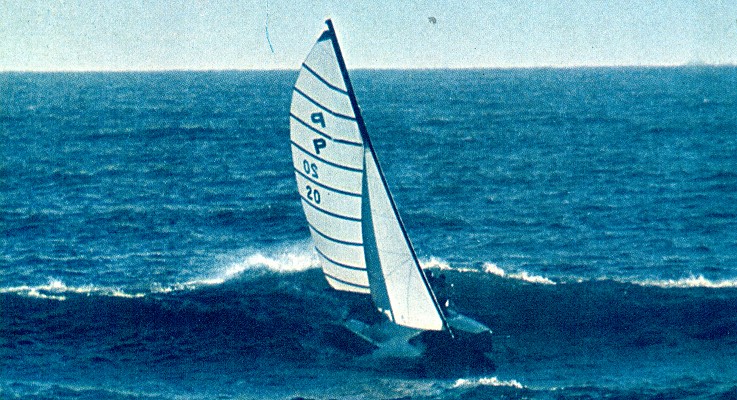
[Carter
Pyle
and Dick Pittet surf a 19 ft catamaran at "Killer Capo,"
South Laguna.]
Photograph: Bev
Morgan or John Severson.
Page 28
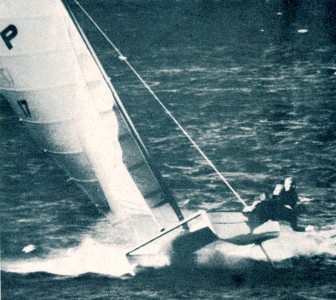 |
PACIFIC
catamaran
...more
than
just something to do when the surf is blown out!
Sailing
a rugged,
all-fiberglass 18'9" PACIFIC can be exacting and
exciting with superb control
in a curl and enough strength to power through the
soup.
The
only catamaran
designed with the sport of surfing in mind and proven
in the surf in California
and in the Molokai Channel in Hawaii.
Kick
up rudders
allow you to sail right up on to the beach.
Designed
by Carter
Pyle and built by Newport Boats to the highest
standards of quality.
$2285.oo
F.O.B.
Newport Beach,
Calif. phone (714) Midway 6-4737
Direct
inquiries
to: Box 1023, Dana Point, California
|
|
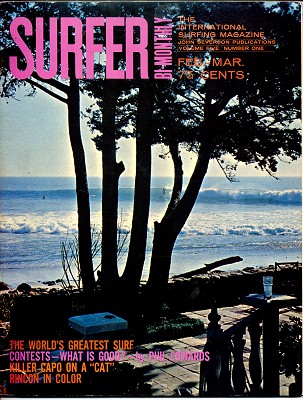
Surfer
Volume 5 Number
1
February - March
1964 .
Cover:
Rincon by John Severson.
|
surfresearch.com.au
Geoff
Cater (2000-2018) : Phil Edwards : What is Good?, 1964
http://www.surfresearch.com.au/1964_Edwards_WhatIsGood_Surfer_Feb_p31.html