surfresearch.com.au
 |
surfresearch.com.au
australian women's weekly : surfing,
1960
|
Australian Women's Weekly : Surfing, 1960-1965.
Extracts from
The Australian Womens' Weekly
1961, 1962,
1963, 1964 and 1966.
Introduction.
A selection of
articles, many by Kerry Yates, reporting on the growing
enthusiasm for surfboard riding on Sydney's beaches.
The articles are
often included in the Teenagers' Weekly Supplement.
The Australian Women's Weekly
Wednesday 15 March 1961, page 90S (Supplement-
Teenagers' Weekly).
LETTERS
...
Surf licences
I am in favor
of surfboard licences.
This way
inspectors can keep check of surfboard riders and deprive them
of their licences if they cause serious accidents through
carelessness.
- D. R. Cann,
Deewhy, N.S.W.
The
Australian Women's Weekly
Wednesday 20 September 1961, page 84S (Supplement-
Teenagers' Weekly).
"DOWN THE MINE" ON SURFBOARDS
By KERRY
YATES
"Who are
these handsome surfboard champions?
Where are
these beaches?
Can I REALLY
learn to ride a board from the instructions in the book?"
These were
just a few of the questions I fired at 19-year-old Sydney
boy Lee Cross.
Lee, a
suntanned blond from Bronte Beach, had just shown me a copy
of the ''Australian Surfer," a book which he had written and
published himself.
'"Grab your
swimsuit next , Sunday morning," he offered. ' "and we'll be
off with my surfboard to find out."
So at 8
o'clock that Sunday morning Lee and some of his surfing
mates called in a car, with surfboards tied on the roof to
take me along on their usual weekend wave hunt.
The forecast
was that the best surf would be rolling on Sydney's northern
beaches, M
decided to
start at Fairy Bower, near Manly.
Travelling
north to Palm Beach, we would have 16 surf beaches to choose
from
The boys
said they would looking for "hot-dogging'' waves (long,
tapering swells) on which they could "go down the mine"
(ride their boards, sometimes hundreds of yards).
We beeped
our car horn to a passing truck with surfboard piled on top.
I buttoned a
heavy coat over a chunky sweater and began to feel excited
about surfing on a sunny winter's day.
As we
crossed Sydney Harbour ...
(Photographs)
PETER THOMAS,
of Manly (left), wearing zip-tweeds, "goes down the mine" at
Fairy Bower.
Below, three
of Sydney's outstanding riders show what they can do on a
surfboard - (from left), Johnny Payne, of Newport, rides
toes-on-the-nose.
Bob Evans, of
Queenscliff, ready for a "head dip" (diving off), and Bernard
"The Midget" Farrelly doing a perfect "quasimoto."
Ron Perrott,
of Harbord, took the pictures on this page and the one at the
foot of the opposite page.
Page 85
(Photograph)
DAVID JACKMAN,
of Harbord, on one of the mighty waves surging over the
Queenscliff bombora last June.
... Bridge
to the north side ( I was strictly a south-sider, coming
from Bondi!), Lee Cross told me a little about himself and
why he wrote his book on surfing.
Lee has been
a keen surfboard rider for four years and spends most of his
weekends and holidays riding the waves.
Since he
left high school two years ago he has worked with a North
Sydney advertising company.
He believes
that surfing should be given more encouragement as a
world-wide sport.
So Lee set
out to produce a book about the Australian surfer, the best
surfing spots, how to ride a surfboard, about the new South
Pacific Surf Riders' Club (the first successful attempt to
form a club to cater for the needs of the surfboard rider),
with pictures and news about the local champions.
And he did
just that, with the help of some of his teenage surfing
mates.
The dramatic
cover shot of a surfboard rider was taken by 17-year-old
Terry Flemming, of Bronte, a trainee photographer with the
Sydney Water Board.
Illustrations
and
jokes were drawn by an 18-year-old East Sydney Tech, art
student, David Letts, of Newport.
Lee was
telling me of his plans to bring out a second edition of the
book before the end of the year when we arrived at Fairy
Bower.
One of the
"Bower Boys" filed that the "waves were on"and the surf was
"too much" (his term for fabulous).
We raced to
the top of a cliff overlooking the spot where the boards
were starting their journey "down the mine," about a mile
off Manly Beach.
The surf
looked wild and rough, but the boys had it mastered, and the
champs of this area, like "Nipper" Williams, Bob Pike, and
Glen Richie (all pictured in the book), dared to ride with
no fear of hitting the craggy stone bottom.
We were off
again, giving Manly a miss, and were heading for a closer
view of the Queenscliff bombora.
The great
bombora, where the sea surges over seven layers of rock,
nearly two miles out from North Steyne Beach, thunders in a
big sea.
lt has been
conquered by only a handful of boys, including 21-year-old
Dave Jackman, of Freshwater.
Three months
ago "Jacko" successfully cracked four of the mighty bombora
waves.
(See picture
above.)
Northwards
again, we passed Freshwater, Curl Curl, Deewhy, and Long
Reef without stopping.
The surf was
too big and there was danger of losing surfboards, which
would go crashing against the rocks and so "ding" (a bang
which splits the fibreglass on a surfboard) badly.
The boys
told me that Long Reef usually supplies the works-
everything from 3ft. to 30ft. waves.
The top man
among some mighty locals of this area is Peter Clare, the
senior surfboard champion for 1961.
The Collaroy
boys were really "hot-dogging" on "Pitt Street" shoots
(waves with five or six riders catching them), but we were
orí to find where the surfboard riders from the south side
had "camped" for the day.
We didn't
have to go far.
As we
reached the sands of North Narrabeen we could see cars,
surfboards, and riders, and we knew that this was THE beach
for the best surf.
Shark scare
North
Narrabeen is best known as the "home-water" for Bernard ("The
Midget") Farrelly.
At 16 "The
Midget," a surfboard-maker by trade, is the junior champion of
the Sydney surf-riders, and in November he is going to Hawaii
to compete in the International Surfing Championships.
Lee Cross and
his friends untied their surfboards from the top of the car,
changed into their "zip-tweeds," and were off into the surf.
I was at the
edge of the water, ready to take my first plunge of the
season, when there was a yell and everyone headed for shore. I
looked out to sea about 150 yards and saw three shark fins
circling the area.
Everyone was
quick to agree to head further north in search of another
beach.
But we were
out of luck.
At every beach
the waves were too big for me, so we headed back to Collaroy,
where we watched
the experts do
their surfing tricks.
Some were
riding "toes on the nose" (standing with feet on the front of
the board), some were going for a "wipe out" (instead of
cutting off a wave when it begins to dump, they keep on riding
it till they are thrown off the board), and others were
crouching in "quasimoto" style (body bent nearly in two with
one hand stretched out in front and one behind).
We knew that
the surf back home at Bondi was flat, so the boys finally took
me there to learn to ride a surfboard from the instructions in
the "Australian Surfer."
I put a jumper
over my swim-suit.
The sun had
gone and a wind was blowing, but I wanted to have just one go
at trying to ride.
I found it
easy to kneel on the board as long as I kept my hands
paddling.
I tried and
tried to stand up in one action, as the book said I should,
but I can't even do that on land!
After about 30
minutes I learnt to stand in a strictly non feminine fashion
(one leg struggling up after the other).
In spite of
the comments from Lee and his mates that ''the fin must have
been stuck in the sand" just because I could stand up, I was
sure that I'd be a surfboard rider one day.
(Photographs)
LEE CROSS, 19,
author and publisher of the "Australian Surfer," is an expert
on the surfboard, too.
BOB PIKE, a
renowned "Bower Boy" is hit by a backwash from the beach while
cutting across a wave.
Trove
1961 '"DOWN THE MINE" ON SURFBOARDS', The
Australian Women's Weekly (1933 - 1982), 20 September, p. 4.
(Teenagers' Weekly), viewed 01 Sep 2014,
http://nla.gov.au/nla.news-article47249167
The Australian Women's Weekly
Wednesday 11 October 1961, page 3S (Supplement-
Teenagers' Weekly).
This
popular sport is a mystery to many - so, here's . . .
How to ride a surfboard
By KERRY
YATES
WHY don't
you, too, join in the fun?
Don't say,
"I couldn't do it."
You could,
quite easily.
Here are the
FOUR main steps for the beginner.
I've just
tried and found them successful.
Follow the
lessons and with plenty of practice you'll be "hot-dogging"
(riding confidently, expertly) something like champion style
in a few months.
(Photograph)
STEP ONE: Kneel or lie (whichever you prefer) on your
surfboard so that it floats level in the water.
Paddle out,
swinging both arms together, beyond the breaking waves.
(Photograph)
STEP TWO: To "crack" your first wave, lie flat.
Let the
first wave go by.
When the
second is about 20ft. behind start paddling until you feel
the swell lifting you along.
(Photograph)
STEP THREE: Making sure that your surfboard is moving with
the wave, slowly rise to your feet (about three-quarter way
back from the nose of the board) in one movement.
(Photograph)
STEP FOUR: Bend your knees -slightly, one foot in front of
the other, and lift your arms to the sides. Try to lean a
little forward and let the board make its own way to shore.
TIPS FOR
BEGINNERS
Paste these
handy hints in your beach hat:
- New
surfboards can be bought from specialised board
manufacturers or sporting stores, but for the beginner a
second-hand surfboard will do fine.
For a
''bargain" board, ask a dealer, or scout around a surf club.
- Before
taking your surfboard into the water, rub the top with
paraffin wax, which is available at chemists.
This stops
you from slipping off the glass-like finished surface.
- The
fashionable "zip-tweeds," those long cotton shorts that so
many surfers prefer (they are comfortable) to ride in, can
be made by cutting down an old pair of slacks or jeans.
- Look
after your board.
Don't drag
thc fin through the sand; carry it to the water's edge.
Repair a
split in the fibre-glass covering immediately.
Keep clear
of the experts, but close enough to note their movements.
Don't,
however, try cutting across another rider - it can mean
trouble.
- If you
take a tumble, try to fall clear of your surfboard and dive
deep to avoid being struck by it.
- Most
surfing beaches have special areas marked off for
board-riders.
If the beach
where you're surfing has no such restricted area, keep clear
of the water "between the flags," don't go near any large
group of surfers "on foot."
- Practise
on land, rising to a standing positiftn in one movement.
Lie flat and
try to get to your feet by pushing up with your arms.
This will
soon become an automatic movement.
The
Australian Women's Weekly
Wednesday 6 December 1961, page 46S (Supplement-
Teenagers' Weekly).
Surfboard team to race in Hawaii.
By Kerry
Yates
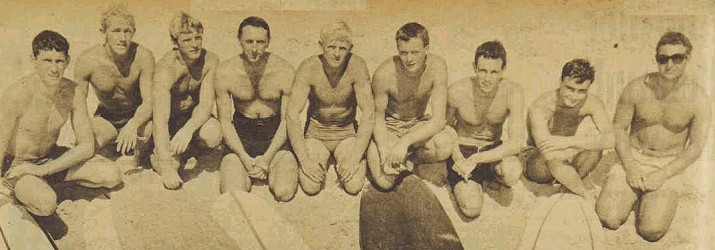
REPRESENTING
AUSTRALIA
for the first time at the International Surfing
Championships in Hawaii, these boys are members of the
20-strong team.
From left:
Owen
Pilon, David Jackman, Mick McMahon, Bob Evans, lan Wallis,
Ken Bate, Graeme Treloar, Jim Geddes, and Graham Henry.
This week
20 Australian surfboard riders, eight of them teenagers,
will meet in Hawaii to form a team to compete in the
International Surfing Championships at Makaha Beach in
December and January.
It will be
the first time Australia has been represented by an
organised team at the championships, which bring competitors
and spectators from all over the world every year.
All members
of the team paid their own fares to realise this dream of
most surfboard experts.
Some used
the savings of two or three years to travel by ship.
Others took
advantage of an airline company's "fly now, pay later" plan.
Unlike most
overseas travellers, the boys didn't take much luggage.
Swimsuits,
"zip tweeds" (long pants worn on surfboards), and a few
casual clothes were all they thought they'd need - so that's
all they took.
And, of
course, their boards!
Each of them
took two boards - a special malibu-type, the light and
easy-to-handle board used on most Australian beaches, and a
big, solid "elephant-gun" board, used in heavy surf.
Bob Evans,
of Narrabeen (one of Sydney's northern beaches), organised
the team and arranged for it to compete in the
championships.
The boys
will contest junior and senior surfboard championships and
body-surfing events.
The South
Pacific Surf Riders' Club supplied the team with T-shirts in
the Australian national colors - gold and green.
This newly
formed club, which has a modern clubhouse at Narrabeen,
hopes to sponsor
an
Australian team to Hawaii for the surfing titles each year.
The members
of the Australian team are:
Bob Evans,
at 32, is the oldest member of the team.
He believes
that some of the Sydney surf-riders will be a real challenge
to the established champions from California.
David
Jackman, 21, of Harbord, is a surfboard builder by trade and
well known to Sydney board-riders as "Jacko," the boy who
rode four big waves over the Queenscliff bombora earlier
this year.
John
Williams, 21, of Queenscliff, is another surfboard builder.
Owen Pilon,
18, of North Narrabeen, is a process worker in a city
electrical firm and has saved for this trip since he started
work several years ago.
Graham
Henry, 20, of Harbord, is known as "Buz."
He works
hard at various jobs during the winter so that he can spend
the whole of summer riding the waves.
Mike Hickey,
24, of Bilgola, gave up his job as an insurance clerk to
become a member of the Australian team.
Jim Geddes,
17, of Narrabeen, sat for the last exam for his Leaving
Certificate at his school, Waverley College, a few days
before leaving Sydney for Hawaii.
Ian Wallis,
21, of Collaroy, is a city storeman and describes Hawaii as
"the surfboard rider's paradise."
Bernard
Farrelly, 16, of Narrabeen, is known as "The Midget."
A surfboard
builder by trade, Bernard was the junior champion of
Sydney's surfboard riders this year.
Bob Pike,
21, of Manly is a woolclasser and says his main interest in
going to Hawaii is to see if the waves are really as big as
everyone says.
Mick
McMahon, 25, of Harbord, is a butcher.
Before
leaving he said, "I'm keen to have a go at the big waves and
look at the Hawaiian girls."
Graeme
Treloar, of Manly, is a commercial traveller and Sydney's
senior surfboard champion.
Gordon
Simpson, 21, Harbord, is a former surf champion.
Ron Grant,
22, of Wollongong, is the only non-Sydney member of the team
and the only one who has previously competed in surf races
over-seas - in California.
Ken Bate,
18, of Manly, works in a city stockbrokers and has been
saving for this trip since he started work three years ago.
John Bill,
20, of Manly, gave up his job as an accountant to join the
team.
Ben Acton,
25, of Harbord, a member of the Police Force, got leave of
absence to make the trip.
The other
three members of the team are Reg Shortland, 19, Laurie
Short, 18, and Roy Sloan, 18, all of Maroubra.
1961
'Surfboard team to race in Hawaii', The Australian Women's
Weekly (1933 - 1982), 6 December, p. 4. (Teenagers' Weekly),
viewed 01 Sep 2014,
http://nla.gov.au/nla.news-article51392771
The Australian Women's Weekly
Wednesday 7 March 1962, page 41S (Supplement-
Teenagers' Weekly).
HIS FILMS ARE ALL SPLASH HITS
By KERRY YATES
Young American film producer and
camera- man Bruce Brown, of California, really gets himself
into deep water.
Bruce makes films (the action
pictures on this page are "stills" from them) on
surf-board-riding, and while he some times shoots film from
tops of cars, helicopters, and boats, the main location set is
in the water.
Bruce, blond and tanned, recently
toured the east coast of Australia showing his surfing films
to local enthusiasts in hired halls and theatres.
"I find the best angle to film
surf-board-riders is right in front of them," said Bruce, "and
that's why I'm usually in the water."
His 16mm. color movie camera has
a specially designed waterproof case.
Bruce treads water, sometimes
hundreds of yards from shore.
He films surf- board-riders as
they speed toward him and then ducks to let the boards go over
his head.
"I've picked up a few stitches
(though no serious injuries) learning when to duck," said
Bruce, "but it seems the only way to capture the height of
mighty waves."
He also attaches a camera by
suction-caps to the front of his surf- board and paddles out
to join the riders.
Moving on his board beside the
riders, he films them as they speed past.
Bruce brought his three
full-length surfing movies to Australia.
Titled "Slippery When Wet,"
"Barefoot Adventure," and "Surf Crazy," they were filmed in
the surfs of California, Mexico, and Hawaii.
Each movie runs for an hour and a
half and shows the thrills and skills of surfboard-riding.
Bruce commentates from the stage
during the color films, telling who's riding the waves and all
about the beaches on the screen. "This gives it a personal
touch," he said, "'and I can adapt different styles for
different audiences."
The background music to the
films, which seems to capture the sound of the sea, was
composed and played by Bud Shank, a popular American jazz
musician.
A big band backs Shank.
Bruce, 24, from Dana Point,
California, has been interested in photography for eight
years.
At 18, as a member of the American
Submarine Service, he was stationed at Hawaii.
While he was there Bruce produced
his first short color film of board riding.
An American surfboard building
company decided to sponsor the showing of the film at seaside
towns in America.
Since then Bruce has produced his
three full-length movies and "about half a dozen short surfing
films for television."
With his films he has toured the
islands of Hawaii, most of California, and eastern U.S.A.
During his tour of eastern
Australia (the tour, in January, was his first visit here),
Bruce was thrilled with the enthusiasm of the
surfboard-riders, mostly teenagers.
He filmed most of his new
full-length movie, to be released some time this year, at
surfing beaches along the coast of N.S.W.
Although the films show many
local riders from the different beaches, Bruce usually takes a
couple of champion surfboard-riders with him to appear in the
films.
A top surfboard-riding star, Phil
Edwards, of Oceanside, California, toured Australia with
Bruce.
Phil, 23, nil and rugged, is a
surfboard and sailing-boat builder by trade and has his own
company in the U.S.
FOOTNOTE: Bruce got into "hot
water" one day when he was filming board-riders at a quiet
Californian beach.
Military police arrested him for
"spying."
Bruce had to develop Iiis film to
prove to the police that he had not been using his
telescopic-lens camera to photograph a nearby "hush-hush" Army
installation.
(Photographs) Bruce Brown-producer,
Phil Edwards-star.
1962 'HIS FILMS ARE ALL SPLASH HITS', The
Australian Women's Weekly (1933 - 1982), 7 March, p. 5.
(Teenagers' Weekly), viewed 01 Sep 2014,
http://nla.gov.au/nla.news-article59834088
The Australian Womens' Weekly
Wednesday 22 August 1962,
Teenagers' Weekly (Supplement)
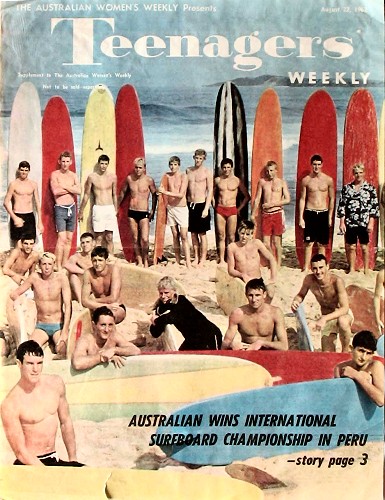
cover
Cover
image contributed by John Witzig, with many thanks,
May 2011.
Our
cover boys are some of the surfboard riders who
competed at Narrabeen, one of Sydney's northern
beaches, during the rally organised by the South
Pacific Surf Riders Club last season. ( -page
41).
Cover
story:
Australian
Wins
International Championship in Peru -story page 3.
John
noted that Midget Farrelly is kneeling in the centre
of the photograph.
The
other surfers require identification.
Note
that most of the boards, probably early foam, are
coloured and decals are impossible to identify.
Some of
the boards in the centre appear to be balsawood.
Also
note the twin fin bellyboard, centre of the rear row.
While
most wear long legged boardshorts, several are in
nylon briefs.
Some
boardshorts have an external thick white waist cord, a
short-lived fashion accessory- for example those of
John Knobel (see below).
|
|
Garry Crockett
uploaded this image on his Surf City Blog,
April 24th, 2011, with the following notes:
"Just had a
call from John Knobel, Bondi local in the 50s and 60s.
That’s him
standing second from the left in front of the red balsa
malibu, wearing his home-made blue board shorts with a snazzy
rope belt.
John surfed on
a Norm Casey hollow 16 foot toothpick before the malibus
arrived in Sydney in 1956 although he was never part of the
lifesaving scene.
As a youngster
he wheeled his board the few blocks to the beach on a hand
cart made from a packing case.
The switch to
light-weight balsa in the late 50s was an amazing break
through because “they could be thrown about from the tail” and
unlike the old longboards were thrilling to ride.
It was also
pretty clear that shorter boards meant more fun in the surf,
so his early boards were under 9 foot.
John also
recalled hopping over the back wall into the lifesavers’
change rooms at Bondi to rescue surfboards impounded by the
likes of Aub Laidlaw.
Peter Bowes
added in some names..
Top row left –
Denis Lindsay
Top row right,
Hawaiian shirt – Mick Dooley
Middle row
right with spikey hair – Dave Standen
Black suit –
Midget
Next but one –
Bob Fell
Front row right
– Puppy Dog Paton."
Page 3
International surf champ
By Kerry Yates
(Photographs)
BOB PIKE riding one of the great Hawaiian waves during
last summer's international championships.
Below,
holding the bronze seagull trophy he won in the Peruvian
Championship while John Severson is presented with his cup
for second place.
Wherever the surf is running best - anywhere on
the coast between Surfers' Paradise, Queensland, and
Torquay, Victoria - there you'll find Bob Pike.
Enjoying the sun, sand, and salty spray, he's
also training hard, for in a few months he plans to be off
again to South America to defend his title of Surfboard
Riding Champion of Peru.
BOB, now
22, won the championship last March in competition with the
best from Hawaii, California, France, and Peru, and he made
such a hit with the people of Lima that they asked him to
come back next March - all expenses paid.
An old boy
of The King's School, Sydney, Bob's home is at Manly, just
north of Sydney Heads.
The first
Australian to win a surf championship overseas, he was a
member of the 20 strong Australian team which competed in
the International Surfing Championships at Makaha Beach,
Hawaii, last summer.
Because he
injured a leg he had to drop out before the finals.
Several
members of the team qualified, but had to return home before
the finals, delayed by lack of a suitable surf, were held.
Bob,
however, got a lucky break soon after the Hawaiian
championships were over.
John
Severson, a champion Californian rider who was visiting
Hawaii for the surfing titles, offered Bob a trip to Peru.
The editor
of the American magazine "The Surfer," John won all the
board-riding events in last year's Peruvian championships
and, before he left, the organisers asked him to arrange for
Australian, Hawaiian, and Californian riders to compete in
their 1962 championships.
John chose
Bob and a Sydney friend, Mike Hickey, of Bilgola (another
northern Sydney beach), to represent Australia.
It was all
a great surprise to Bob.
"I didn't
even know they surfed in Peru, but what a way to find out!"
he said.
So off he
went to California, where he joined two other boys heading
for Peru, and they all drove down to Mexico with their
surfboards tied to the roof of the car.
Taking a
couple of weeks for the trip, the boys stopped to surf at
all the famous beaches along America's west coast.
From Mexico
they took a plane to Lima, capital of Peru, where they were
put up at the best hotel, as guests of the city's Waikiki
Surf Club.
During
their month's stay the visiting surfers went to a party as
guests of the President of Peru and were lavishly
entertained by the city's citizens.
"There are
several beautiful beaches near Lima," Bob said, "but the
surf is small.
"The
biggest waves are about 10ft. high, and a permanent
off-shore wind makes the water too choppy for really good
surfing.
"But Peru
itself, and the people! They're terrific."
For winning
the international exhibition board-riding event, Bob was
awarded a bronze carving of two seagulls mounted on a marble
base.
The trophy
weighs 361b. and is valued at £150.
Bob said
that all the visiting surfers received "royal" treatment.
(Photograph)
Below, holding the bronze seagull trophy he won in the
Peruvian Championship while John Severson is presented
with his cup for second place.
Servants
employed by the Waikiki Surf Club took charge of their
surfboards, rubbed them down with paraffin wax. carried them
to the water's edge, and even waited to carry them back
after Bob and the other boys had finishing riding.
The
servants handed them towels after they showered in the surf
club, and even rubbed suntan lotion on their noses before
they went out in the sun again.
After
leaving school at 15, Bob did a two-year course at Sydney
Technical College to become a qualified woolclasser.
He worked in
shearing sheds in N.S.W. and Queensland to save the £600 for
the trip to Hawaii.
During that
time he visited every surf beach in the eastern States.
"Fairy
Bower, about a mile off Manly Beach, is THE spot in
Australia when the waves are on," he says.
"The surf
in Hawaii, however, is even better-j ust like I'd always
imagined.
But it is
very different from ours.
"Waikiki
Beach is similar to many Australian beaches- and not so
good.
''But for
the keen surfboard rider other Hawaiian beaches have the
perfect waves.
These
beaches - Makaha, Sunset, Alamoana, and the Banzai Pipeline
- have the best surf in the world.
"'The
waves, building up to heights of 15 to 25ft. and then
dumping on the shore, are very exciting to ride.
"And the
greatest thrill of all is the Banzai Pipeline.
"This is an
area where the waves, often reaching 25ft., curl over at the
top to form a 'pipe' before dumping on a rocky shelf of
jagged coral.
"And this
was the place that put me out of the Hawaiian championships.
"I lost my
board going down the Pipeline, but got out of it with a few
scratches and an injured leg.
My board,
however, was wrecked.
All the
front was bashed in and the fin was snapped off."
Notes
1962
Peruvian International Contest, Lima Peru
Inaugural
contest at Kon Tiki Surf.
Large wave,
small wave and paddling races.
The Big Wave
contest was won by Felipe Pomar.
The same week
a speciality Big Wave contest was held at Villa Beach, won by
Australian surfer, Bob Pike.
Correcting the
previous entry, Felipe Pomar emailed in January 2010:
I was
enjoying your site when I came across a mistake .
You site
shows Bob Pike from Au. as the winner of the Peruvian
International 1962 Big Wave event.
Bob was my
friend,and a great big wave surfer.
And he did
win that event that year at Villa beach.
That event
however was a specialty event.
The Peru
International Big wave event was held that same week at the
Kon Tiki Surf spot.
The winner
of the Peru International Big Wave Contest in the year 1962
was Felipe Pomar.
Sorry to
point out a mistake in your site.
Hopefully
you can correct that .
Many thanks to
Felipe for this contribution.
The
Australian Womens' Weekly
Wednesday 22 October 1962,
Teenagers'
Weekly (Supplement), page 47S.
SURF - RIDERS' DICTIONARY
BY KERRY YATES
This summer thousands of
Australian teenagers will be going surfboard-riding.
With the sport growing enormously
in popularity, special sections of most beaches are now
reserved for board-riders, and the riders have developed a
language all their own.
So if you're a sandie who dreams
of riding an elephant gun out the hack, waiting to beach a
boomer without going down the mine, you'd better study this .
. .
ANGLE: Direction a surfboard
travels across a wave, for example, left angle.
BAGGIES: Baggy pants worn over
swimsuits when riding a surfboard.
BEACH BUM: A boy who doesn't work
or go to school, just hangs around the beach all day and
surfs.
BEACH A WAVE: To ride the same
wave all the way to the beach.
BIG SETS: Groups of extra big
waves, breaking and rolling in one after the other.
BIG W: Dramatic fall off a
surfboard.
BLASTER: A big wave.
BLEACHIE: Surboard-rider who
bleaches his hair.
BOARD SHORTS: Pants worn for
riding surfboards. .
BOARD WAGGON: Car used for
transporting surfboards from beach to beach.
BOATIES: Members of a surf club
boat crew.
BODGIES: Lumps on knees and feet
caused by constant surfboard-riding.
BODY SHOOTING: Riding a wave
without a board.
BOMBIE: Short for bombora, where
waves break over a reef of rocks just below the surface.
BOOMER: Big wave.
"BOWER" BOYS: Name given to expert
riders at Fairy Bower, a surfing spot about one mile off Manly
Beach, Sydney, famous for its big and sometimes dangerous
surf.
CORNER: Changing direction while
riding a wave. For example, left corner is to turn to the
left.
CUT: Another method of turning
across a wave. To right cut is to move sharply to the right
when riding a wave.
DEEP-SEA FIN: Special type of
surfboard fin, made from fibreglass or balsa, with a solid
square shape.
DING: Split or hole in a
surfboard.
DOWN THE MINE: When nose board
goes under the surface an heads for the bottom, throwing tk
DUMP: A big wave which breaks
suddenly and steeply, with most of the water hitting the
bottom hard.
Can be very dangerous.
ELEPHANT GUN: A type of surfboard,
long, tapered, and heavy, used in big surfs.
Used to shoot the big ones, hence
the name.
EL SPONTANEO: Method of trick
riding-right at the front of ihe board, feet apart and
crouching over.
FLICK-OFF: Method of getting off a
wave as it nears the shore. Moving to the back of the board,
the rider flicks the board backwards over the wáve.
GAS: Anything which is very good.
GIDGET: A girl surfboard-rider.
GOOFY FOOT: A very good rider
whoreverses the usual way of standing by putting right foot in
front of left.
GRAB THE RAIL: To grab the side of
the board to avoid losing it on a wave.
GREENIE: A big wave before it
breaks into white foam.
GREMLIN: A mythical figure who
tips up boards, or a young surfrider with bleached hair.
HANGING TEN: A trick method of
riding with toes tucked over the front of the surfboard.
HAWAIIAN PULL-OUT: Grabbing nose
of board and pulling it through a wave.
HEAD DIP: Trick riding - putting
head in and out of a wave while riding it.
HEAVY: A big wave.
HO-DAD: Anyone who annoys board
riders while they surf.
HUEY: The surfboard-riders' god of
the waves.
They often call, "Come on, Huey,
send the waves up," as they wait for a big one beyond the line
of breakers.
HUMP: A wave.
KAHUNA: Similar to "Huey" - the
god of the Californian and Hawaiian board-riders.
KING: The best rider at any beach.
LAYBACK: A supreme test of skill
in trick riding.
The rider lies flat on his back,
with feet facing the way board is going.
LEPRECHAUN: Surfboard-rider under
13 years old.
LOCAL: Usually a good rider who
lives and surfs most of the time at a particular beach.
MALIBU: Type of surfboard made
from foam, balsa, or fibreglass and under 10ft. long.
MUNCHIE: Any type of food.
NOAH: Shark, from rhyming slang
"Noah's Ark."
NOSE-RIDING: Standing right at
front of the board while riding a wave.
OKINOUIE: Type of board similar to
the malibu.
OKS: Bermuda shorts worn for
surfboard-riding.
OUTSIDE or OUT THE BACK: A long
way out at sea, beyond the first line of breakers.
PIRATE: A board-rider who crashes
into other riders and makes a nuisance of himself.
PLANK: Any type of surfboard.
PIG: Type of surfboard with back
and front ends shaped to a point.
PITT STREET SHOOT: A wave with
four or more riders on it at the same time.
POLY: Type of board made of foam
and fibreglass.
POPE: The best rider of a group of
locals or, more usually, the best of a number of neighboring
groups.
Better than a "king."
QUASIMODO: Trick riding, with body
bent nearly double, with one hand stretched out in front and
the other behind.
RUBBISHED: To be thrown off wave
and dumped on shore.
SANDIES: People who sit on the
beach and don't usually surf; and learners.
SHORE DUMP: A wave which breaks
heavily on the sand.
SLIDE: Moving smoothly on a
wave-front the crest to the trough.
SLICE: To travel across a wave
with sharp cut to the right or left.
STRINGER: Strip of hardwood set
into a foam board to strengthen it.
SURFTE: A fond term for a good and
keen surfer. ,
SURF KING: A good rider in an
area, sometimes conceited.
SURF SAFARI: A trip around
different beaches to find a good surf.
TANDEM: Two people riding on one
surfboard.
TEARDROP: Type of surfboard with
wide back and pointed front.
TIKI: Lucky charm worn by some
riders.
TOES-ON-NOSE: Trick riding,
standing at front of board with toes curled over the edge.
TOURIST: A board-rider who travels
from his usual beach to another for the day.
Sometimes refers to a beginner who
becomes a pest to other riders.
TUBE: The area of a dumping wave
between the breaking crest and the trough.
UTOPIA: Makaha Beach in Hawaii,
considered by board-riders as the best surfing spot in the
world.
WALL: A steep wave.
WAX: Paraffin wax, rubbed on a
board to prevent slipping.
WHITE WATER: Area of surf where
the waves are breaking.
WIDOWS: Girls left sitting on the
beach all day while their boy-friends ride their surfboards.
WIPEOUT: A dramatic fall off a
board when a rider is trying to catch a wave.
WIPEOUT WAGGON: Car used for
transporting boards and riders from beach to beach.
ZIP TWEEDS: Long shorts worn for
board-riding.
Trove
1962 'SURF- RIDERS'
DICTIONARY', The Australian Women's Weekly (1933 - 1982), 24
October, p. 3. (Teenagers Weekly), viewed 01 Sep 2014,
http://nla.gov.au/nla.news-article44027354
The Australian Women's Weekly
Wednesday 2 January 1963, page 47S (Supplement-
Teenagers' Weekly).
Seeing the world on surfboards
By KERRY
YATES
Three young
Sydney men have formed a successful partnership with the
inviting slogan "See the world on a surfboard."
THE
partners are Paul Witzig, Peter Clifton, and Paul Quiney,
all 21 and all expert surfboard riders.
The firm,
Surfing Promotions, was formed about nine months ago as the
Australian agency for an American film producer, Bruce
Brown, of Dana Point, California.
"Bruce has
a large studio in Hollywood," said Peter, "and travels the
world shooting scenes for his surfing movies.
"He has
already had three outstanding successes with 'Slippery When
Wet,' 'Surf Crazy,' and 'Barefoot Adventure.' "
Paul Witzig
met Bruce Brown in Hawaii two tyears ago.
Paul was on
his way to join his parents for a holiday in Europe, and
Bruce was filming "Slippery When Wet."
Paul, who
owned his first surfboard when he was eight, said he
couldn't pass through Hawaii without trying its famous surf,
so he stopped off for two weeks.
"I stayed
with some Californian surfboard riders in a beach house at
Sunset Beach," he said, "and Bruce was living next door.
"I got to
know many of the local Hawaiian and Californian riders and
they wanted to know all about Australia.
"Bruce was
very interested in our surfing and I offered to sponsor him
on a trip to Australia to show some of his movies."
Bruce
accepted the offer and this was the beginning of Surfing
Promotions.
Last tour big success
After Paul
had arranged showings and publicity, Bruce toured the east
coast of Australia last summer with "Bare- foot Adventure*
and "Slippery When Wet."
The tour
was a great success.
Paul made
enough money to cover Bruce's air fare to Australia and all
touring expenses, a reasonable profit, and still had
something over as working captial for new ventures.
While he
was in Australia Bruce filmed part of his latest film,
"Surfing Hollow Days."
A
full-color, feature-length movie, it stars surfing champions
of Australia, New Zealand, Hawaii, California, Mexico, and
Florida.
To a
surfer, a "hollow day" is a day when the waves curve up and
curl completely over before crashing on the shore - thus
forming a hollow tunnel of water.
The film
mostly features board-riding, but there are also exciting
scenes of body-surfing, sailing, and water-skiing.
Surfers play with shark
One
dramatic sequence shows surfers at Santa Barbara playing
"Nip and Tuck" with a 15ft. shark.
Paul Witzig
appears a few times in the film, riding huge waves at
beaches on the north coast of N.S.W.
Peter
Clifton stars in the water-skiing scenes, and is also shown
"free-planing" - which is skiing behind a motor-boat using a
surfboard (waxed heavily to stop the skier from slipping)
instead of skis.
Paul Witzig
asked Peter Clifton and Paul Quiney to join him in Surfing
Promotions to bring this film to Australia.
"Surfing
Hollow Days" opened in Sydney a few weeks ago and the firm
has arranged 60 showings in Queensland, N.S.W., Victoria,
and South Australia during the next few months.
Peter and
Paul Quiney have been riding surfboards at Sydney beaches
for about five years and met Paul Witzig while surfing.
Although
Surfing Promotions means only part-time work so far, the
boys signed contracts with Bruce Brown, registered their
partnership, and set up a modern office at Newport (a beach
suburb on Sydney's north side), where they employ a
secretary to do typing and answer inquiries.
(Photograph)
EXAMINING a sequence in the film "Surfing Hollow Days"
are, from left. Peter Clifton, Paul Witzig, and Paul
Quiney.
Paul Witzig
has just completed fourth year Architecture at Sydney
University.
As head man
and organiser of the firm, he flew to the States a few
months ago to make official arrangements with Bruce Brown to
bring "Surfing Hollow Days" to Australia.
When the
film arrived in Sydney he had to arrange for it to be
cleared through Customs and the Censorship Board.
(Photograph)
PHIL EDWARDS, of California, riding a huge wave at Sunset
Beach, Hawaii.
Phil, who
is recognised as the best surfboard-rider in the world,
stars in the film which is now being shown in Australia.
Peter, a
copywriter for a Sydney advertising agency, is the Press
agent and publicity officer for Surfing Promotions.
He has
organised an extensive advertising campaign in local
newspapers and national surfing magazines, designed posters
and pamphlets, and has arranged radio and television
interviews to promote the film.
Paul Quiney
is studying accountancy and works as a junior accountant in
a city office.
He handles
the legal side of the firm, the financial worries, and the
theatre bookings.
Surf safari with film
The firm
owns its own film projection unit and employs Peter Hamill,
20, a surfboard builder, to run the projector at every
showing.
Paul
Witzig, on university holidays, will tour with the film for
the whole run.
And Peter
and Paul Quiney will take their annual holidays to help him.
The boys
are making the tour in an old car, with four surfboards tied
on the roof and posters for the film plastered all over the
body.
"On all our
trips we keep a lookout, and Stop whenever we find a good
surf running," said Paul Witzig.
"Our
business trip is a surf safari, too."
The boys
are not drawing weekly wages from their firm, but plan to
divide the profit at the end of the tour, leaving enough in
"kitty" to finance their next enterprise.
In this way
they hope to develop Surfing Promotions into a profitable
full-time business.
Trove
1963 'Seeing the world on surfboards', The
Australian Women's Weekly (1933 - 1982), 2 January, p. 3.
(Teenagers' Weekly), viewed 01 Sep 2014,
http://nla.gov.au/nla.news-article51603206
The Australian Women's Weekly
Wednesday 6 March 1963, page 75S (Supplement-
Teenagers' Weekly).
The "Midget" does Hawaiian ... and wins world
title.
By Kerry Yates
Bernard
Farrelley, the 18-year-old Sydney boy who recently won the
International Surfboard Riding Championship in Hawaii,
became a film star at the same time.
The film,
being produced by another Sydney surfer, Bob Evans, is due
for release in Australia within the next few weeks,
Benard, a
lanky, blue-eyed lad, is known to his friends as "Midge,"
and his nickname inspired the title of the film: "Midget
Goes Hawaiian."
Evans, who
edits a surfing magazine and has aleady produced two other
feature-length surfing movies and several shorts for
television, chose Midge as the star after he had won several
local surfboard championships.
Work on the
film began last March.
Bob, Midge,
and other expert board-riders visited the best surfing
beaches on Australia's east coast to record sequences for
the first half of the film.
Bob then
organised a team to represent Australia at the international
Surfing Championships held annually at Makaha Beach, Hawaii.
Three other
Sydney boys, David Jackman Mick McMahon, and Barry Cardiff,
joined Bob and Midge to form the team, and they flew to
Hawaii just before Christmas.
The surfing
championships are not held on any set day, only on days when
a good surf is running at Makaha.
Race Delayed.
When the
plane on which the boys and their surfboards were travelling
set down in Hawaii, they heard that the semi-finals were in
progress that day at the beach 30 miles away,
An urgent
phone call to contest officials delayed the last semi-final
so that the Australians could compete.
The boys
hailed a taxi, the driver loaded their surfboards on the
roof and they made a dash for it.
At Makaha,
traffic police escorted them through the crowds and thev
were cheere by competitors and spectators as they hurried to
the dressing-sheds to change.
The waves
were really big, and the Australians were competeting
against riders from California, Peru, and Hawaii in front of
spectators from all over the world.
The contest
is judged by experts standing on a tower high above the
sand.
Points are
given for length of ride, ability to manoeuvre, and good
sports-manship.
As leader
of the team, Bob said all the Australians surfed the 15ft.
waves like veterans.
"Midge was
outstanding," he said, "'and we were not surprised when he
was selected for the finals.
"These were
held a few days later.
Unfortunately,
the
waves were much smaller, breaking at three or four feet.
"Most riders
paddled a long way out in the hope of picking up a few big
ones, but they were out of luck.
"Midge
adopted a now or never attitude, and moved to within 200
yards of the beach.
"'He cracked
every wave that came along, large or small, and proved his
skill so well that he was crowned champion of the year.
"We expected
him to put on a good show, but winning the grand event was
just wonderful."
The trophy
Midge won was a statue of a surf rider and his board, carved
from wood.
The
presentation of this prize is a highlight of Bob's movie,
which also shows Midge riding in the final.
This was the
first time a competitor from a foreign nation had won the
title - the highest honor in the surfing world.
Midge, who
is a surfboard builder by trade, designed and made the two
surfboards he took to Hawaii.
One is a
light "hot-dog" board used for fast turning and trick
riding.
The other is
a heavier board for big seas.
The
Australians shared a house on Sunset Beach, 40 miles from
Honolulu.
They spent
the next four or five weeks on a surf safari - travelling
round the surfing beaches of Hawaii.
Bob was
always on location, filming the adventures of the Sydney
surfers as they rode big waves alongside the champions from
Hawaii and California.
The boys are
now back in Sydney, already saving for another trip.
Most of them
hope to compete again next time, but Midge is determined
that he will.
"I just must
get back to Hawaii to defend my title," he said.
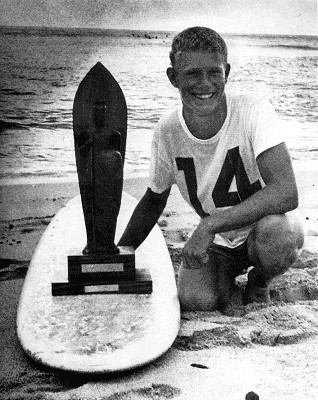
MIDGE
FARRELLEY, with the trophy he won in Hawaii.
(Photograph
Ron Church)
The Australian
Women's Weekly
27 March 1963, page 9.
What IS a
Surfie?
With discussions raging about Sydney's
newest teenage groups, Surfies and Rockers, we asked Kerry
Yates, one of our cadet journalists, to tell us what she
knows about the cults.
I OWN a surfboard and spend much of my spare time riding the
waves at different beaches.
I like to think of myself as a surfer, not a surfie.
Lately there's a big difference.
The true surfer hates the term Surfie, and can you blame
him?
It has come to label all surfboard riders as young ???nsters
who bleach their hair with sink-cleaners and chase away
visitors from the beaches where they surf,
This is not so.
Riding has become THE sport for many hundreds of teenagers.
Sure, we have a common interest - a love of sun and surf -
but we are not one big cult, as recent publicity makes out.
Every beach has its locals, who live nearby and usually surf
on the same part of the beach all summer.
But an
interesting thing about surf
ing is that you don't al-
ways stay at your own beach.
Every weekend the surf
safari is on. The really
keen riders tie their surf-
boards on to the roofs of
cars and travel around in
search of the best waves.
So if you happen to see
a couple of hundred surf-
board riders at one end of
the beach, it's not a meet-
ing of the Ku-Klux-Klan
it's just that the best surf
is there.
Why do they seem to
gather in groups in one part
of the surf and sand?
Most beaches mark off
special areas for riding
boards, and if we ride "out
of bounds" there's a chance
of our boards being con-
fiscated for a few weeks and
even of our being fined.
The so-called Surfies seem
to include all the teenagers
with blond hair, long shorts,
and bare feet who happen to
be fond of riding surfboards.
Nowadays it seems to be a
crime to be one of them.
Surfies are said to be
guilty of using indecent
language on the beaches,
gatecrashing private parties,
riding their boards into
groups of body-surfers, and
most recently brawling with
another teenage group,
namely, the Rockers.
But I think the boys and
girls involved are just
common larrikins in a new
guise - that of the Surfte.
A Surfie usually bleaches
his hair with peroxide, lemon
juice, or even sink-cleaners
By KERRY YATES
for that sun-bleached out-
door look which most real
surfers acquire naturally.
But this is not really
offensive - just immature.
Some buy surfboards and
may even become good
riders. They wear cut-down
jeans (they protect your
knees and the insides of
your legs from rubbing
against the board), but the
trouble is they never wear
anything else, so they look
untidy most of the time.
Only the other day I saw
two boys coming out of the
surf at Manly carrying their
boards and wearing blond
wigs. The wigs were the
synthetic ones that Sydney
women buy in thousands,
priced about 49/11. The
boys certainly proved the
wigs were washable!
This was quite amusing
and strictly for fun. But it's
no joke when Ho-dads
help to brand all surf-
board-riders as beach hood-
lums.
(Ho-dads: Characters who
try to surf without know-
ing how, or observing the
unwritten rules. Nuisances.)
Now I'm not saying that
all board-boys are fine, up-
standing citizens. There are
many who just think surf,
surf, surf, and do nothing
else - day in, day out.
Many wag school, others
take night and shift jobs,
and lots work hard all winter
to save enough money-all
to surf as much as they can.
It's immature to put a
sport ahead of a career,
and let's hope they wake up
to this before it's too late.
But even these boys seem
to be well behaved and are
annoyed at the recent con-
fusion of surfboard-rider
with beaclj bodgie.
The same goes for the
Rockers - the rival gang to
the Surfies. The public is
led to believe that all the
Rockers, usually teenagers
who live in Sydney's West-
ern Suburbs, are toughs.
Rockers wear their hair
long in flat-top or brush
back styles and usually dress
in T-shirts, jeans, leather
jackets, and leather motor-
cycle boots.
Their girl-friends, the
Rockettes, wear their
bleached white hair piled up
in a teased beehive and dress
in tight slacks (vivid colors),
bulky jumpers, and rubber
thongs (if they wear any-
thing on their feet at all).
Rocker 'image'
They certainly give the
impression that they are
looking for fights when
great mobs of them drive to
the beaches on motor-bikes
or in hotted-up cars.
But some of the Rockers
interviewed over recent
weeks protest that they are
not all louts, who carry
knives and bike chains.
I am sure some boys and
girls who are known as
Rockers do not measure up
to their bad reputations.
The boys say that if they
ever go to dances or parties
outside their own suburbs
the girls they meet ignore
them when they learn they
come from the Western
Suburbs.
People say that the Rock-
ers are modern louts, just a
further generation of the
pushes and razor-gangs.
They blame broken homes,
drunken parents, and poor
education.
But this is not always so.
There are boys and girls
from wealthy homes in most
exclusive suburbs who be-
have just as badly as the
worst Surfies and Rockers.
They attend big-time
schools, they wear smart
clothes, college-style hair-
cuts, and many go to univer-
sity. These teenagers have
lots of money and flash
sports-cars, but they are still
bored. So a favorite pastime
is to gatecrash parties -
"just for the thrill of it."
They speak perfect Eng-
lish, and usually have such a
confident "front" that they
have no trouble getting into
private parties and dances.
The same teenagers also
hold wild parties - but in
beautiful two-storeyed
homes. Where are their
parents? Half-way round
the world on a business trip.
Poor excuse
The Rockers say there's
not much to do in' the
Western Suburbs. They say
they race cars and motor-
bikes along the highways,
gatecrash dances and parties
- for lack of something
better to do.
Well, really that's a poor
excuse. The Western
Suburbs may lack beaches,
but there are swimming
pools, bowling - alleys,
squash-courts, picture-shows,
etc., just as at the beach
suburbs.
In fact, the surfboard
riders also have a problem.
Many lifesaving clubs are
against special board clubs
and seem to think they will
lose members to this sport.
But some beaches have
been able to come to suc-
cessful arrangements. In re-
turn for a clubhouse to
leave surfboards, hold dances
and film nights, the board
riders do patrol duty and
help run the surf clubs.
But until all beaches come
to some agreement, the
board-boys also have to look
round for something to de
at night and when they can't
go riding at the weekends.
Fun and entertainment
don't just ' happen - they
have to be made. Anyone
would be bored meeting the
same people every day at
the same corner or milkbar.
It would be easy to be led
astray by someone offering a
little excitement.
The Rockers could really
put their cars and bikes
to better use - as transport
to a beach for a swim. And
I mean a swim.
It's only natural that
Surfies become suspicious of
the crowds who come to the
beaches but don't go near
the water.
So the local Surfies yell
"Go home, tourists," and'
the Rockers complain that
they won't be told what to
do by the Lemon Drop Kids
(Surfies with bleached hair).
And so the war is on.'
The public are alarmed.
They read and hear that
these are examples of Syd-
ney's youth. Well, they're
BAD examples!
Page 3
Trove
1963 'What IS a Surfie?', The
Australian Women's Weekly (1933 - 1982), 27 March, p. 9. ,
viewed 01 Sep 2016,
http://nla.gov.au/nla.news-article48213389
The
Australian Women's Weekly
Wednesday 27 May 1964, page 25.
NO SURFIES, By REOUEST
Visiting
international surfboard experts say that although they
spend all their spare time riding the waves they aren't
"surfies."
By KERRY
YATES
(Photograph)
LINDA
BENSON, U.S. women's champion.
This is
her fifteenth board.
"Of course,
we have a few 'ho-dads' (young larrikins), too, who bleach
their hair and hang around the beaches all day," said Joey
Cabell, the American who won the last international
surfboard championships at Hawaii.
"But nearly
all the surfers in California and Hawaii go to work or
college, and surfboard riding is only a sport, not their
life.
They devote
many hours to it and take their sport seriously, but so do
most tennis and football
players."
Joey and the
national champions from the United States, Peru, New
Zealand. France, Britain and South Africa came to Sydney to
compete in the world surfboard championships held at Manly
last weekend.
Although
most of the overseas stars have to return to work next week,
they stayed on after the championships to ride as much
Australian surf as possible before flying home.
"Weather
doesn't bother the true surf fanatic," said Gordon Burgis,
surfboard champion of Great Britain.
"In Jersey
last winter we were riding when the water was only 36
degrees."
Gordon, 20,
lives with his parents in Jersey, one of the Channel
Islands.
"Board-riding
is
just becoming popular with teenagers there," he said.
"I've been
riding for about two and a half years now - until then it
was mostly visiting Australians who surfed there."
The British
championships, the first, were held at Jersey recently with
competitors from Australia, France, South Africa, and
England.
"Most people
are surprised to hear of surf in England, but there are some
good waves in Cornwall," he pointed out.
Keen Parisian
Gordon
sometimes surfs at France's famous surf spot, Biarritz, near
the Spanish border, with the French national champion, Joel
de Rosnay.
Joel, 26, a
research chemist at the Louis Pasteur Institute in Paris,
drives 500 miles to Biarritz whenever he has a free weekend.
President of
the Surf Club de France, he was taught to ride a surfboard
by Peter Viertel, the American writer who is married to film
star Deborah Kerr.
"'Peter's a
champion surf rider and snow-skier, too, and brought one of
the first surfboards to France about 1956," said Joel.
"Now there
are two or three hundred riders on the coast."
Joel, who's
married to an English journalist and has two babies, thinks
the teenagers who ride the boards in Sydney are similar to
those in France.
"In France
they wear the same types of T-shirts and board-shorts, and
have lots of fun riding the waves," he said.
"We haven't
got any 'bleachies,' as you call them, but everyone's doing
the Stomp there.
"We call it
'Le Surf,' but it's the same as your Stomp."
On the way
to Australia, Joel surfed in California and Hawaii with Joey
Cabell.
Born in
Hawaii, Joey, 25, learnt to ride a board when he was seven,
and became one of the island's top riders before moving to
California four years ago.
He's a
restaurant-owner, but had time to win the famous
international surf- board championships at Makaha Beach,
Hawaii, last December.
Joey likes
the Sydney surf.
"We've
struck some good waves here," he said, '"and the shore break
(when the waves break almost on the beach) is unique.
I don't
recall having surfed anything like it before."
Four other
champions from California, John Richards, Mike Doyle, Phil
Edwards, and top American girl surfer Linda Benson, also
came to Sydney.
''Little
John" Richards (as he is known) holds the American west
coast championship.
A salesman
for a surfboard manufacturer, he's 24 and married.
Mike Doyle,
23, of Long Beach, has been surfing for 10 years, and for
the last two has won every tandem (two riding on the same
board) event in California.
Mike and his
partner, Linda Merrill, 19, won the international tandem
event in Hawaii last year.
"Tandem
riding is something quite new, but is becoming a big sport -
it has great spectator interest," he said.
"Linda and I
have made up dozens of tricks, starting from the simple
hand-stands or her standing on my shoulders.
"We usually
practise for hours on sand before trying them out."
Mike, who is
studying to be a science teacher, surfs Hawaii every summer
and has starred in many surfing movies, riding by himself.
"But I like
tandem riding best in competitions" be said.
"Most of the
single riders' tricks have been discovered, but there are
still a thousand more for tandem teams."
Phil
Edwards, 25, another top rider, was chosen as the
international judge for the world titles in Sydney.
A surfboard
and sailing boat builder at Oceanside, California, he first
came out here two years ago to star in American film
producer Bruce Brown's surfing movie "Waterlogged," which
featured him riding at many Australian beaches.
Linda
Benson, 20, is the present United States invitational
women's surf- board champion.
"I've been
riding for nine years now," she said, "but it's only over
the past few summers, since the movie 'Gidget' was released,
that girls have really taken to board-riding in California."
Linda, who
lives in Encinitas, California, is a secretary for one of
America's biggest surfboard shops and goes surfing whenever
the "waves are on" at nearby beaches.
She always
goes to Hawaii on her annual holidays, and recently
"surfed-in" for the American film star Annette Funicello in
the board-riding scenes in two films, "Muscle Beach Party"
and "Bikini
Beach."
Not "Muscly"
Tiny and
feminine, with a pretty, blond "urchin" haircut, Linda thinks
that board-riding is not strictly a boys' sport.
"I've heard
people say that girls get too 'muscly' and big riding boards,"
she said, "but I find it's good for the figure."
Champion of
Peru, Hector Velande, 23, sells real estate in Lima and has
been riding a surfboard for nine years.
"We have a few
hundred keen board-riders in Peru now,"' said Hector, "mostly
teenagers who take advantage of our customary three hour
lunch-break from work to go surfing.
"The boys who
ride are mostly sporty, casual types who go to school,
universities, or jobs," he said. "We haven't any 'surfies' who
bleach their hair.
"'Most of our
boys have dark hair with fairly long cuts- but they're not
Beatles, either."
Hector will be
spending three months on a trip around the world before he
returns to Peru, and hopes to surf in France, Hawaii, and
California.
And after
talking with the South African cham pion, Max Wettland, he'd
like to surf in Durban, too.
Durban craze.
Max, 25, is
a professional lifeguard at Durban Beach and has been riding
a board for nine years.
He thinks
that a visiting Australian surf team took the first board to
South Africa about 1954, but says it's only over the past
two years that board-riding has caught on over there, and
the teenagers are "stoked" (the surfer's term for crazy)
about it.
"But we
don't have any beachcombers," Max said.
"The Twist
is still big there, but I've promised to take back the Stomp
with me."
Max plans to
stay a few weeks longer in Australia to surf the N.S.W.
coastline.
"From all
reports, it sounds as though most Australian surfs are very
similar to ours," he said, "but I'd like to find out for
myself."
(Portrait
Photographs)
HECTOR
VELANDE, Champion of Peru.
MIKE
DOYLE, Tandem co-champion.
JOEL de
ROSNAY, Champion of France.
MAXY
WETTLAND, S. Africa champion.
JOEY
CABELL, Hawaii champion.
PHIL
EDWARDS, international judge.
"LITTLE
JOHN" RICHARDS (Calif.)
GORDON
BURGIS, British champion.
WOMEN'S DAY
DECEMBER 28 1964
SURFING
SURFSIDE 65 SPECIAL , pages 18 to 37.
The Australian Women's Weekly
27 May 1964 , page 4.
Murray's Rose-y movie future
MURRAY ROSE, Austro
' lian former Olympic j
' swimmer, in Hawaii j
' while making his film
I debut as a surfer.
none Help
TWO STARS of Murray Rose's film, "Ride the Wild
Surf-Peter Brown
and Shelley Fobares - at Sunset Beach, Hawaii, the film
location.
. "I am hooked on surf-
boards - and film acting,"
Murray Rose said recently.
T^HE tall, blond Australian Olympic
swimmer spent seven weeks on loca-
tion at Sunset Beach. Hawaii's surfing
centre, in his first movie, "Ride the Wild
Surf,'' a Columbia Pictures production.
While riding a board in the turbulent
waters off Sunset Beach, Murray suffered
a slight accident which temporarily put
him out of action.
"I fell off the board during one shoot-
ing sequence,-' Murray said at his Holly-
wood home. "A corner of
the board struck nie in
the mouth, breaking off
two teeth.
"I was able to have
them capped in Hawaii.
Luckily there was no dam-
age to my mouth or nose,
so I was able to go right
back before the cameras."
Murray had never
surfed with a board before,
nor acted in films, al-
though he had spent
months in Australia last
year doing television plays
and other TV work.
Studied drama
He had also studied
drama at thc University
of Southern California,
from which he graduated
two years ago.
"I'm very keen about
both surfing and the
movies," Murray said.
"I have bought my own
board, fitted out my car
with overhead racks, and
intend to do a lot of surf-
ing here in California. 1
am also determined to
have a crack at a careel
in films."
ABOVE: Murray Rose
(centre) in a surfing scene from "Ride the Wild Surf."
Co-star Fabian is second from right. Beside him is actor Peter
Brown. BELOW:
Murray prepares his board for a scene. He had not ridden a board
before.
Murray is reported to
have done a good job of
acting in his role as Swag,
an Australian surfer.
Stars in the cast in-
cluded Tab Hunter.
Fabian, Peter Brown, Jim
Mitchum, Shelley Fabares,
and Barbara Eden.
Ironically, Murray had
been going to an acting
coach in Hollywood who
worked on softening his
Australian accent.
"Then I got the assign-
ment to play an Aussie
and I forgot everything
I had been learning!" he
said with a laugh.
Murray, a triple gold
medal winner for Austra-
lia, will not be a spectator
in Tokyo for the Olympics
next October if his pres-
ent plans materialise.
Other roles?
He has several prospects
for other film parts which
would keep him in Holly-
wood.
Murray is now living
with his parents, Ian and
Eileen Rose, in their
Hollywood home.
Ian Rose is an advertis-
ing executive and writer.
Murray's mother, an ex-
pert on vegetarian foods
and diet, has also written
a book on thc subject.
Murray attributes his
extraordinary physique
and stamina to the fact
that he has never tasted
meat, poultry, or fish and
adheres to a strict diet of
none Help
fruit, cheeses, soya beans,
sunflower seeds, goat's
milk, and seaweed jelly.
Murray chose the Uni-
versity of Southern Cali-
fornia over other institu-
tions - notably Yale,
Harvard, and Michigan
State Universities which
offered h i m athletic
scholarships - because he
felt Californians were more
sympathetic to his ideas
of nutrition and health.
His feelings for thc
stage and drama were also
given full scope at U.S.C..
where he majored in Tele-
communications.
He played many lead-
ing roles in university
drama presentations.
While a student he ap-
peared as a guest on such
TV programmes as "Art
Linkletters House Party."
on the qui? show "Tell the
Truth,'' and on "The
Groin ho Marx Show .'
Murray is known in
America as "The Golden
Boy." because of his color-
ing and physical fitness.
Interior scenes and voice
dubbing of some sequences
kept the cast busy for sev-
eral weeks.
Thc film is scheduled foi
release in the United
States in August, and io
Australia early next veai
Trove
1964 'Murray's Rose-y movie future', The Australian Women's
Weekly (1933 - 1982), 27 May, p. 4. (TEENAGERS' WEEKLY), viewed
01 Sep 2016, http://nla.gov.au/nla.news-article51779988
The Australian Women's
Weekly
Wednesday 27 May 1964,
page 25.
JUST GIVE NAT THE SIMPLE SURFARI
LIFE
By
KERRY
YATES
[Teenagers Weekly]
LEFT: Sydney surfer
Nat Young shows the style that has made him a world surfboard champion.
ABOVE: Nat surrounded by some of the trophies he has won.
He bought the llama-skin rug in Peru, where he recently won a world surfing title and was
runner-up in another.
The red-carpet treatment for surfers in Peru - from a
luxurious
clubhouse to the boys employed to wax and carry members' boards to the water-didn't impress top Sydney board-rider Robert ("Nat")
Young.
BOARD-RIDING
is more a
social
symbol than a sport in Peru," said Nat.
"It costs
about 1000 dollars
(about £A500) a year to
join the exclusive
Waikiki Board Club there.
'There are very few teenage board-riders.
Most are
around 25, because the young ones just can't afford to keep up with Peru's select 'surfie society.'
Surfboards
which cost about
£45 in Australia sell for as
much as 300 dollars, about
£150)," said Nat.
"In fact, I sold one of mine for £190 when I was there."
Nat, 17, of Warrawee, N.S.W., spent four weeks in Peru to compete in this year's World Surfboard Championships, which were held at Ponta Rocas Beach in February.
He won the seven-mile World Paddle Race and took second place in the World Surfboard
Championship, won by
a Peruvian surfer Felipe Pomar.
"Thc Peruvians were perfect hosts and booked us in a fabulous hotel just near the beach," said Nat.
"It
certainly was enjoyable for a few weeks, but I couldn't live there - I'd miss the casual atmosphere of surfing in Australia.
"I guess the riders in Peru would be amazed to see how we rough it on surfaris
in Australia -
steeping on beaches or in cars and doing what we like when we like.
But that's the best
thing about the sport.
"Everything's so organised in Peru," said Nat.
"I'd crawl
out of bed about 10
o'clock and send a message down to the beach that I'd be down in five minutes.
The
'beach boys', young local lads employed by the club, would have my board
waxed and
waiting for mc at the water's edge.
Hard work
"It sounds as if the Peruvians have it made, but unfortunately no one seems to take board-riding
seriously," he
said.
"And it's like any sport, if you want to be good you've got to work at it."
Nat is recognised as one of the world's top surfboard riders.
As well as tho two silver trophies (a world globe and a model surfboard)
he
brought home from Peru, Nat has won 14 other trophies and two overseas trips for surfing.
He won a trip to Hawaii for the 1964 International Surfing
titles as Australian
Champion and won his trip to Peru in a seven-mile paddle race in Sydney.
Though Nat has "surfed" Hawaii, California (on the Hawaiian trip last year), and Peru, his favorite surfing spot is in Australia.
"Byron Bay, on the far north coast of N.S.W., is my pick," he said.
"I'm not saying it
has the best waves in the world, but I always enjoy the good long rides there."
Since Nat left school two years ago there's been hardly a day when he hasn't gone surfing.
"I think board-riding is a full-time sport if you want, to reach the top," he said.
"But, of course, most boys have jobs and careers to think of first and ran only be weekend surfers.
"Fortunately, I've been able lo make surfing my business, too."
When he visited California Nat noticed the latest craze with American teenagers was the skate board
- a miniature
surfboard on wheels.
When he returned to Australia, he and two friends formed a company and started the craze here.
"In no time we had 17 people working for us. and were selling hundreds a week," said Nat.
"I sold my
partnership in the company just before I went to Peru."
Designing
And since he returned to Sydney Nat has been designing equipment- from board shorts to a surfboard
for
manufacturing companies.
He's also been modelling surfing
fashions and has made
personal appearances in
some of Sydney's leading department stores.
Next month Nat, who's already appeared in several Australian and American surfing
movies ( including The
Endless Summer, Surfing the Southern Cross, and The Young Wave Hunters), plans a trip to South Australia with Sydney film producer Bob Evans.
"We want a surfing trip along the Great Australian Blight, with Bob shooting scenes of me riding waves foi his new movie," said Nat.
Trove
1965 'JUST GIVE NAT THE
SIMPLE SURFARI LIFE.', The Australian Women's Weekly (1933
- 1982), 2 June, p. 71 Supplement: Teenagers' Weekly, viewed 18
April, 2014,
http://nla.gov.au/nla.news-article47120949
The Australian Women's Weekly
Wednesday 19 October 1966, page 21.
WONDER BOY OF THE WAVES
Australian
teenager who won the world surfboard crown
By KERRY
YATES
Whenever
friends come looking for Nat Young, his mother tells them,
"Wherever the surf's on - that's where you'll find
him."
Nat, the
Sydney teenager who recently won the World Surfboard
Championship in California, spends most of his life at the
beach.
"It's been
the same for the past eight years," Mrs. Young said.
"Every day-
morning and afternoon- he goes off surfing.
"At least I
know where he is- and it's really paid off now."
At Ocean
Beach, near San Diego, California, more than 80,00
spectators watched Nat take the world title.
He was
riding his favorite surfboard which he calls "Sam" and took
with him from Sydney.
In the
Women's Championships, Australian girls Gail Couper, of
Victoria, and Phylis O'Donnell, of Queensland, came fourth
and sixth respectively.
Nat, 18,
scored 293 points to win by 63 points from Jock Sutherland,
of Hawaii, and 70 points from Corky Carroll, also of the
United States.
"The 8ft.(?)
waves were similar to ones we get at Manly Beach- and just
what I'd hoped for," said Nat
after the
contest.
Australia's
wonder surfer has a long list of titles.
As well as
being Australian champion, Nat currently holds he N.S.W.,
Newcastle Hunter Valley, and Bell's Beach, Victoria, titles
and has won a string of local and interstate surfboard
rallies.
He has 25
impressive trophies in a cabinet in his Warriewood home, and
has won tb i ee overseas trips.
As
Australian champion he won a trip to the World Titles in
Hawaii in 1964, and another to the recent ones in
California.
Last year he
won a trip to Peru for the international contest in a
seven-mile paddle race on Sydney Harbor.
In Peru he
won the World Paddle race and took second place to Peruvian
surfer Pillipe Pomar, in the World Surfboard Championship.
"Peru as a
good lesson to him- he lost the big title by one point,"
Mrs. Young said.
"Nat knew he
could never count on winning.
He never
even mentioned the possibility of pulling it off in
California."
But that
didn't stop him putting in weeks of practice.
He surfed
every day and spent most weekends on surfaris up and down
the eastern coastline.
"My favorite
haunt is Noosa Heads, about 80 miles north of Brisbane," Nat
always says.
"But if I
can't make it that far, I settle for the good long rides at
Crescent Heads and Byron Bay."
After they
heard the good news (the Australian team manager, Bob Evans,
rang from California), Mr. and Mrs. Young, their two married
daughters, and younger son, Chris, couldn't even walk down
the street without someone offering congratulations.
"And for
days the phone didn't stop ringing," Mrs. Young said. "We're
all so proud."
Just before
he left Australia, Nat joined an interna tional sports wear
company.
He will
visit their main office in Portland, U.S.A., before
returning to Australia via Hawaii.
In Hawaii
he'll star in a movie by Australian surfer film-maker Bob
Evans.
It will be
released Australia wide in January.
Then, after
six weeks away, Nat will be back to catch up with all his
commitments in Sydney.
As a top
surfer, Nat has a weekly column in The Sunday Telegraph,
demonstrates and promotes his own custom surfboards, and
makes personal appearances at Sydney stores.
Quiet and
unassuming, Nat has definite ideas for the future.
He has made
quite a lot of money from "surfing side-lines."
He saves
every penny and has bought a block of land at Whale Beach in
Sydney.
He hopes to
become a professional surboard rider and build a house with
a beach on his doorstep.
(Photograph)
WORLD
SURFBOARD CHAMPION Nat Young, 18, of Warriewood, N.S.W.,
with some of his trophies.
He won the
world title this month in California, U.S.A.
The Australian Women's Weekly
Wednesday 16
October 1968, page 3.
At 15, Judy is a champion board-rider
...
A GIRL WHO RULES THE WAVES
By MARGARET ANN KANDAL
SIX years ago a cult swept Australia.
It brought with it new jargon for the teenagers' already
revolutionary vocabulary-words such as "gas," "king,"
"noah," "gremlin," and "femlin."
New signs, appeared on beaches showing
restricted areas for the cult. Songs and dances were
dedicated to it.
And most probably sales of lemons and bleaches went up because of it.
Six years ago saw the boom of surfboard-riding.
Young people no longer went to the closest beach
for a dip or a swim.
They followed the sun and went where the best waves were.
But though board-riding is gaining immense
popularity it is still not recognised as a national
sport, despite the fact that Australia
has provided two of the three world champions to
date.
Judy Trim knows just how hard it is to get
financial support, and she's the Australian Women's
Open Surf- board Champion!
For months she has been seeking
sponsorship so she can enter the 1968 international
championships in Puerto Rico from November 6-14.
|
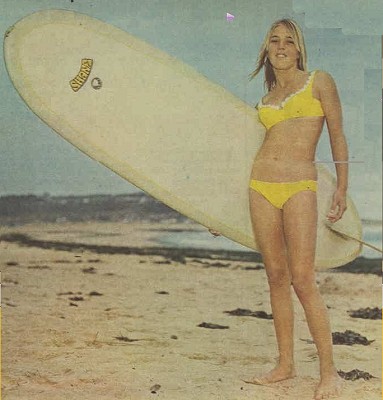
JUDY TRIM at Dee Why beach, N.S.W.,
with her board.
She's been seeking sponsorship to compete in
the 1968 international championships overseas.
Pictures by staff
photographer Keith Barlow
[Not reproduced]
CHAMPION Judy with her trophies for both
the N.S.W. and National board championships.
|
It could be her age- after all, she only recently turned 15.
Unfortunately she has come good in a bad year, because the financial support usually given to sport by companies has been directed to the Olympic appeal.
Then again, she's a female board rider.
Judy is what one would call a typical Australian girl -long, gently sun-bleached blond hair, large hazel eyes, and a scattering of freckles on her rather babyish face.
She
has a golden year
round tan.
She's
very shy.
"Unknown"
It
was only early this year that Judy was persuaded by friends to enter her first contest - the New South Wales Championships at Wollongong.
Very few of the surfing fraternity had heard of the young rider from Dee Why, and the 1967 winner, Lynn Stubbins, was reported to be a long way ahead of any of her rivals.
Even when Judy won, it was simply reported as "Lynn Stubbins went down to an almost unknown surfer."
A
few months later she entered the Australian Championships, competing against such experienced surfers
as Phyllis O'Donnell and Gail Couper.
Judy won the title, but it was no easy victory.
The contest took place at Long Reef, Sydney, in a huge surf
whipped up by
cyclonic southerly gales.
Waves
were nine and ten feet high, and during the gruelling week of heats she
had to
use every trick she knew to stay on.
Judges acclaimed her as "world class in the making" and her performance was highly praised by
experts Bob Evans and "Snow" Mc Alister.
Judy was also awarded the special Duke Kahanamoku Award, given for
the
first time in Australia to the most improved surfboard rider of the year.
"I got my first board for my 11th birthday," she said, "but I've had two since
then.
A
friend who makes them gave me my new one when I won the championship.
"No, nobody ever taught me to ride - I just learnt by watching everyone
else."
Judy loves surfing.
She wears no wetsuit during
the
winter months, the season she prefers as the best time to surf, when the tides and winds give a bigger,
better
roll to a wave.
Judy thinks school life is very important, and should come before anything
else.
She
wants to do her Higher School Certificate and make a career for herself in
commercial
art, preferably lettering.
Not a tomboy
Whatever the weather, she's down at the beach almost every afternoon
as
soon as school's over.
All
her weekend is taken up with surfing,
too.
"She would live and die for the surf,"
said her
mother, "but she's still very interested in school.
She's
never taken up with dolls or girls' activities at all.
"And now she's become known as the only girl who rides like a boy."
She handles her board with ease, swinging it up and on to her head to carry
it
the few hundred yards from her home at Dee Why, Sydney, to the beach.
Yet she is not at all tomboyish,
even
in jeans and board shorts.
One of the most important things before you get a board is to be a
good,
strong swimmer.
Judy is.
She
has been top champion in her age group at the Dee Why Swimming Club a couple of times.
Her greatest wish is to represent Australia overseas.
Originally the International Surfing
Federation
was allowing only four Australian surfers
to compete in
the world championships in
November.
Following protests, this
number has now been raised to a team of seven men and
three girls, with two reserves.
The International Surfing Federation has agreed
to pay for two male team
members
and a judge accompanying them, but the others
have either to find their own sponsor or pay their fares themselves.
Judy has been selected as the number
one
girl to go.
Accommodation would be
no problem to Judy because
the Puerto Rican Government
is providing that free
for the duration of the contest.
They have specially built bungalows on Rincon Beach, where the
competitions will be held.
But at the moment nobody holds much hope that Judy, the champion without a sponsor, will be able
to go.
Trove
1968 'A GIRL WHO RULES THE WAVES.', The
Australian Women's Weekly (1933 - 1982), 16 October, p.
3, viewed 18 April, 2014,
http://nla.gov.au/nla.news-article51553744
The Australian
Womens' Weekly
1961, 1963,
1964 and 1966, 1968.
surfresearch.com.au
Geoff Cater (2011-2014) :
Australian Women's Weekly : Surfing, 1960-1968.
http://www.surfresearch.com.au/1960_Aust_Womens_Weekly.html