pods for primates: a catatogue of surfboards in australia since 1900
home catalogue history references appendix

Return to Surfer Bio menu
surfresearch.com.au 
ross renwick : sydney surboard club, 1959 
 Extract:
Unaccredited (Ross Renwick): New Type Surfing Club for Sydney.
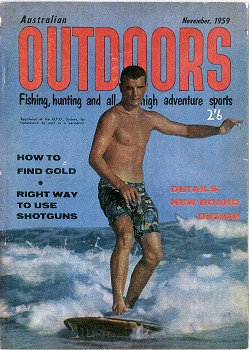
Australian Outdoors, November 1959.
Pages 74-75.

NEW-TYPE SURFING CLUB FOR SYDNEY

SURFING has been a major sport in Sydney now for over 50 years, but in many respects it is still in its infancy.
Only three years ago, a new type of surfboard was introduced to our beaches.
The Okinuee board opened up a completely new and more exciting method of riding the wild waves.

Now a completely new (for Australia), facet of the sport is being probed - the formation of a surfing- social club - a club of devotees of the surfboard; a club where surfers can relax in comfort, drink, play, discuss waves, boards and beaches.

Nobody will deny that the Surf Life Saving Association is incredibly efficient in the art of saving people from the surf, but faced with broader issues - such as the intangible, but very real challenge of the short board - they are incredibly lethargic.

The fantastic interest generated by these tiny slips of balsa has begun a drift away from the surf clubs.
The boards are easily managed by lads of 10 or so in light surfs.
Normally, these youngsters would join surf clubs when they reached the required age, but now they find that they can have all the fun of surfing and board riding without belonging to a club.
Now they reject the rigid discipline of the surf club, fearing that they might be required for patrol when t.hey could be out riding boards in a good surf.

The result? A percentage of the already established membership of the Surf Association is wavering,
while the actual source of membership - the teenage male - finds that the surf clubs have little to offer them in comparison with the thrills of being a surfing nomad.

The fault lies partly at the door of the Surf Life Saving Association.
During the four seasons that small boards have been establishing themselves in this country, the Association has done little to cater for the increased interest.
This is the first season that they have compromised.
Experimental "hot-dogging" contests will be held at surf carnivals.
Previously they have held only paddling races - a rather incongruous business - for if ever a craft was designed for anything BUT paddling, it is the balsa surfboard.
Maximum riding efficiency of these boards is attained when they JUST float the rider. and no more.
At this point of floatability, paddling efficiency is very low.

But the S.L.S.A. has persisted in wasting good carnival time holding races for 16 ft. boards and surf skis, both single and double.
I would be surprised if 16 ft. boards now comprised two per cent. of the gear used on our beaches.

No doubt a small band of enthusiasts will scream their protests, but I think holding races for 16 footers could be compared with holding a Monte Carlo Rally for steam cars.
The same thing applies to skis; but although they're "old-hat", they have limited use as pieces of rescue equipment.
But the S.L.S.A. continues to encourage them competitively, catering for a minority, and almost
completely ignoring the short board majority.

(Board designer, Gordon Woods. offered to build an experimental tandem balsa surfboard, to be used as rescue equipment. His offer was not accepted.)

It is obvious evolution that surling-social clubs would spring up sooner or later.
It is a matter of wonder that the S.L.S.A. has not been faced with the problem before this.
The trend away from the surf clubs had to come.
Now the Mallbu board has provided the immediate cause.
The S.L.S.A. will have to find a means, not to combat them, but to llve in peace with them.
They will have to provide better clubhouse amenities than the bare dressing-room - cold-shower - boatshed type of clubhouse now in use.
The Federal Government, which has sidestepped the financial issue for years, will certainly have to foot a certain percentage of the bill, to ensure that this Australian Institution does not deteriorate.

Apart from the tangible assets of surf lifesaving, there is the almost unrecognised intangible one - the fantastic publicity value overseas of the "virile Australian lifesaver".

The S.L.SA. will have to begin their own type of public relations campaign to win back to the
organisation the glamour appeal it has always had, and which it is losing the short-board men - many of whom are fast becoming surfing giants in Australia.
It can't be denied that the glamour of the Surf Lifesaving Association is one of the motivating factors behind many applications for membership.

There is no reason why two types of club should not live side by side: the surfing social clubs will be filled with devotees of board and body surfing.
They will in all probability, become a major (if unoftlcial) rescue force, in themselves.

Two of the men who are forming the first of these clubs, the South Pacific Surfrlders' Club are Gordon Woods and Bob Evans.
Between them they have over 30 years of surf club service.
They both think that the present trend is inevitable but hope for utmost co-operation between the two types of club.

Gordon Woods says:
"There is no reason why a prospering social club, catering for board riders. should not financially assist a surf club on the same beach."
Bob Evans goes into more detail:
"No matter where in the world you may be, the mention of Australians and Australian sportsmen gives rise to debate as to how a continent of such large proportions yet comparatively tiny population can arrive at such world prominence in so many fields of athletic endeavour.
It is generally attributed to the fact that sucn a large proportion of the people are actively engaged in participating in one sport or anotner, if not through their individual skill then through some form of sporting club where they are encouraged to develop team spirit.

"Which brings us to the point in relation, the sport we are thinking of, the individual and somewhat unusual skill - surf-riding.

"Through the auspices of the Surf LIfe Saving Association of Australia the young man has always been encouraged, through active competition, in attaining emciericy in surf life saving operations and a keen spirit
of sportsmanship.

"In the last two years there hss been a noticeable outburst of enthusiasm by hundreds of surfers in
the sport of surf riding, through the introductiori of the Malibu surf board and the smaller body-board. Their portability and ease of handling has resulted in thousands of them being used, and so many previously un-surfed locations are being opened up, that it is now considered the local standard equals that of Hawaii and California.

"In March, 1959, approximately 150 enthusiasts got together and discussed the possibility of forming a club, developing a code of ethics to encourage and develop surfriding skills, and to become legally recognised as a social, sporting club.
Surfers wanted to enjoy the many comforts established in similar clubs, whether they be gold, football, cricket, rowing or bowling.
Why not surfing?
 
"It was decided to establish a pro-tem committee and to open lists for membership, limited to 250. 
Well, over 150 surfers have already signed and with enthusiasm mounting the membership is fast filling. 
Any adult who has more than a passing interest in surfing should consider himself eligible. 
Whether tastes are passive or active they will be catered for. 

"In drawing a parallel, we could mention the Outrigger Canoe Club of Hawaii or the Club Waikiki in Lima, Peru which are both world famous as sporting and social clubs. 
Why not the South Pacific Surfriders' Club also, here in Sydney where we have the world's best beaches and the most exciting surf.

"Lima, Waikiki, Sydney -the world's top surfing centres."

If you are interested in joining the South Pacific Surfriders' Club write to either:
Bob Evans, 149 Woorarra Ave, Elanora; 
or
Gordon Woods, 87 Brighton Street, Harbord, N.S.W. 

Image Right :
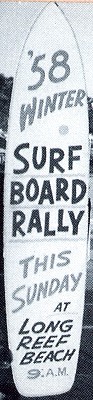
Surfboard template roadside signage : Surf Board Rally  Long Reef Winter 1958
Cropped from original photograph by Snowy McAlister
Reprinted in Nat History, 1983, page 89.


Unaccredited (Ross Renwick)
New Type Surfing Club for Sydney.
Australian Outdoors, 
November 1959.
Pages 74-75.

These articles contributed by Mick Mock, with many thanks, October 2004.
Cover image contributed by Mick Kershler, with many thanks, October 2008.

Return to Surfer Bio menu
surfresearch.com.au
home catalogue history references appendix