 |
surfresearch.com.au
aust womens' weekly : bondi,
1958
|
Australian Womens' Weekly : Bondi Boardriders, 1958.
Extract from
The Australian Women's Weekly
Wednesday 3 December 1958, page 3.
| home | catalogue | history | references | appendix |
|
surfresearch.com.au
aust womens' weekly : bondi,
1958
|
Hot
doggers' of the surf.
By leaving
behind
balsa-wood surfboards after a 1956-57 visit to Sydney, a
Hawaiian surf
team helped to add a new expression - hot doggin' - to
Australian beaches.
In line on
South
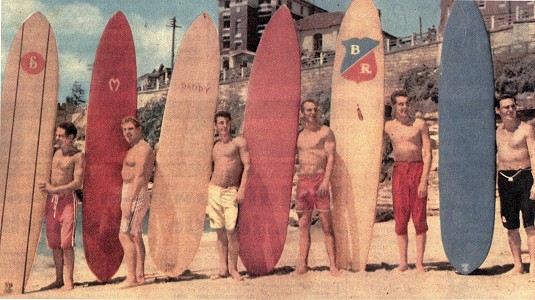
Bondi Beach are members of the South Bondi Board Club.
From left
are
Scott Dillon, "Bluey" Mayes, Andy Cochran, Rod Cartlidge,
Barry Ross, and
Des Price. Some wear long pants, and have foam rubber built
into the knees,
to protect their legs, especially when paddling their
surfboards out to
catch a wave.
Hot doggin'
is
manoeuvring a surfboard at high speed,
The Hawaiian
boards were 20 lb. lighter and 6ft. shorter than the type
then used in
Australia.
On a big
wave
they could reach speeds of more than 50 miles an hour - 20
miles an hour
faster than Australiain boards.
Thrilling to
the pace of the balsa surfboards, Sydney swimmers went on to
try other
materials, using new lighter synthetics for greater speed
and easier handling.
Hot doggin'
now
provides thrills for 500 surfers in Sydney alone.
To cater for
them, the Surf Life Saving Association is to add a
surfboard-riding contest
to carnival progammes.
In surfboard
riders' jargon the event will be a hot dog meet.
lt will
differ
from surfboard races.
Contestants
will
be judged on ability in riding the waves, not on paddling
power.
Three
experts
will judge each event for style, daring and "walking the
plank' - walking
as far as 8ft. to
the front of
the board for speed and to the back for fast turning.
Instead of
riding
the wave straight to the beach, contestants will move in all
directions,
do reverse turns, trying to out hot dog each other.
Because of
the
popularity of hot dog meets on Hawaiian and Californian
beaches, action
films of expert board-riders are big business in the United
States.
Two
Californian
surfboard manufacturers recently spent nearly £3000 on
photographic
equipment and paid all expenses for three of California's
best surfers
to go to Hawaii for a three-month film-making trip.
Brilliant
surfer
Bud Browne, of Honolulu, financed a trip around the world
with two exciting
50-minute films taken on Hawaiian beaches.
On this trip
Browne realised an ambition - to surf in the choppy, cold
water of the
Bay of Biscay.
Hollywood is
to make a film with a surfboard theme, based on an American
best- seller,
"Gidget," written by Californian journalist Frederick
Kohler.
Introduced
to
a number of surfboard riders by his daughter, Mr. Kohler
liked their philosophy
and jargon.
He called
his
book "Gidget," meaning girl midget, the surfers' nickname
for his daughter.
|
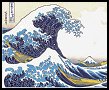
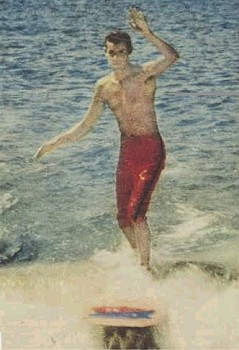
BELOW: Barry Ross shows the expert balance needed for good hot doggin'. Barry and other members of the South Bondi Board Club keep their surfboards in a shed on the beach. Color pictures are by staff photographer Ernie Nutt. THRILLS OF HOT DOGGIN' in a big surf at Makaha Beach, in the Hawaiian Islands. Hot dog meets have been held on Hawaiian and Californian beaches for years. They attract tens of thousands of spectators, who have their favorite board-riders in the same way Australians follow the performances of jockeys or cricketers.
Trove |
 |
| home | catalogue | history | references | appendix |