pods for primates : a catatogue of surfboards in australia since 1900
home catalogue history references appendix

surfresearch.com.au 
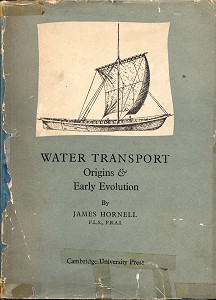
hornell : water transport, 1946 
James Hornell : Water Transport, 1946.

Extracts from
Hornell, James: Water Transport- Origins and Early Evolution.
Cambridge University Press, Cambridge,1946.

Introduction.
Important.

Page 1
GROUP A.
Floats, Rafts and Kindred Craft

CHAPTER I. SWIMMING FLOATS & RIDING FLOATS

Using the term 'Floats' in a restricted sense the group may be divided into two sections, (a) Swimming Floats, and (b) Riding Floats.

Swimming Floats are accessory devices designed to assist in supporting the body while swimming, whereas Riding Floats are simple means of transport which are bestridden by fishermen and travellers who propel the rude craft paddlewise, with their hands.

Swimming floats form a fairly compact and well-defined class, but it is difficult to draw any definite line dividing riding floats from the simplest descriptions of true rafts, for floats of this type are undoubtedly the precursors of rafts; a complete evolutionary series can be built up to show the graduated steps by which the riding float, formed of a single unit - a log or a reed bundle - has developed into a true raft consisting of a platform capable of bearing a load and of being propelled by one or more paddlers standing or sitting on the deck or, occasionally, by means of sail.

In the same way skin, gourd and pot floats have evolved in some areas into true rafts buoyed by a number of floats, which may be inflated animal skins, or empty gourds, or even empty earthenware jars and metal containers.

As some artificial division has to be made, I propose to restrict the term 'Riding Float' to (a) single-unit logs and reed bundles ridden astride, and to (b) those where two floats arranged a short distance apart, tandemwise, are ridden astride upon a connecting saddle.

When several logs or reed bundles are lashed together, side by side, these, even if ridden astride, are here classified arbitrarily as rafts; the caballito of Peru is a good example of how the reed raft came into being by the multiplication of an originally single unit.

SWIMMING FLOATS

It is doubtful if early man became acquainted with the, art of swimming prior to the utilization or invention of some form of buoyant appliance capable of supporting his body when he ventured beyond his depth in river or lake.
The tree trunk floating downstream with the current, with some denizen of the forest marooned in its branches, probably gave the first stimulus to man's inventiveness in this direction.
Clinging to a log it would ...

Page 2

... not be long before he found that by kicking out with his legs he could increase the speed of his novel vehicle and, to some extent, control the direction of travel.
With the discovery that leg movement was of use in the water as well as on land, an astute fisherman would soon find that a short block of light wood was more manageable than an untrimmed tree trunk, it permitted of more freedom of movement and enabled his arms to come into play in effective combination with his legs.

WOODEN BLOCKS
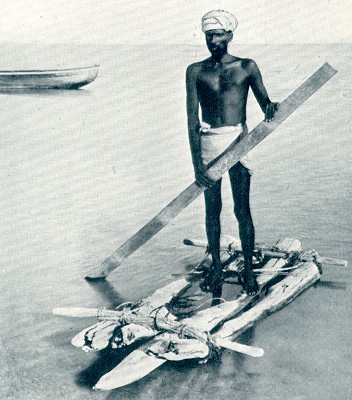
Supposing this to have been the origin of swimming floats, we find a survival of this extremely primitive appliance in Southern India, where it is employed by Tamil fishermen in the River Kaveri in the reaches below the irrigation ...

Illustration.
TEXT-FIG. I. A fisherman using a wooden swimming float, River Kaveri, South India. (Original.)

... dam known as the Lower Anicut.
Here, at the season when the Indian shad (Hilsa ilisha), a near relative of the herring, migrates in incredible multitudes up the river from the sea in order to spawn, scores of fishermen may, be seen floating downstream, each supported upon a thick block of light wood about 2 1/2 feet in length.
With his chest resting on this, the fisherman holds extended obliquely downwards in the water a short-handled dip net, the wide mouth (6 feet by 4 feet) held open on a light ovoid frame (Text-, fig. 1). The butt of the net handle tests under the swimmer's armpit and upon the wooden float, which thus serves as a fulcrum when the net is ...

Page 3

... it.
The fisherman kills the fish by biting its head, thereafter threading it on a string tied around his waist. Having floated a mile or as far as he thinks fit, the swimmer lands and walks back to his starting-point to repeat the operation time and again.

Farther north, on the River Godaveri, a curved wooden float, carefully trimmed to a definite and slightly crescentic form, is used by the primitive tribe called Koi when crossing the river.
According to a personal communication from Mr L. A. Cammiade, who was for long stationed in this district, the float used is about 4 feet in length.
The swimmer rests his breast on the fore part of the concave side of the float and propels himself by kicking frogwise with his legs on either side of the hinder part; the float takes an oblique position in the water and has sufficient buoyancy to raise the head and shoulders of the user well out of the water.
Usually he has one arm free to assist him in swimming.

Lower down the same river a similar device is extensively employed by fishermen during the annual floods to retrieve drifting wood, consisting mainly of large logs of timber washed away by early freshets from the timber depots higher up the river, where they had been stacked to await transport to Rajamundry.
This kind of float is more efficient than that used on the Coleroon, for the user is able to work it across the current of the river in full flood even when dragging behind him a log of timber.
This simple aid to the swimmer is of high antiquity in India, for on the western gateway of the Buddhist stupa at Sanchi, built about A.D. 50, in a delightful boat scene sculptured on the left pillar, we see a number of men sporting among the lotus flowers of a sacred tank (Pl. I, fig. A); several support themselves on inflated skins, but others use swimming logs just as the Godaveri fishermen do at the present day (Maisey; 1892, 58 and Pl. XXI, fig. 2).

A similar log-float device is found as far afield as Lake Chad in Central Africa.
Here every household of the Buduma tribe owns one or more am- batch floats-trunks of the extremely buoyant wood of Herminiera ela- phroxylon, so light t,hat a child can carry several, each heavy enough in
appearance to form a man's full load (Talbot, 191 I, 246).

In America the only instance of the use of a wooden swimming float is the practice of some of the tribes in the Gulf of California to rest their breasts when swimming upon two pieces of light wood lashed to a vine (Mason, 1895, 33'4).

Passing to Australia we find numerous records of the use by the aborigines of log floats.
These are most frequently met with on the shores of North Australia, where the coastal natives are enabled to make long journeys between the islands and the mainland by supporting themselves while swimming by means of a short log or piece of wood placed across the chest (Stokes, 1846, II, 15-16).

Page 4

Farther east, on the western side of Cape York Peninsula, natives cross rivers half lying on logs, 5 to 6 feet long, after the fashion of the log riders of the Godaveri in India; they propel them butt end forward (Roth, 1910, 3-4).

This section would be incomplete without notice of the surf board of Hawaii.
This specialized form of float, in the days when chief and commoner, men and women, all equally indulged in surf riding, was a broad flat plank, hewn out of the hard koa wood (Acacia heterophylla).
The minimum length equalled that of the person who rode it, the width, 14 to 16 inches; the most expert used much longer ones and the Bishop Museum, Honolulu, possesses one measuring 16 feet in length, a size that wouId require great skill to manage.
Those who could not obtain a koa board had to be content with narrower ones made from the wood of the wiliwili; a light cork-like wood considered the most suitable for the floats of outrigger canoes and of nets (Malo, 1903, 293).

Taking their surf boards with them, the surf riders swim out beyond the surf into the region where the rollers begin to rear their heads; here the riders await the oncoming of a wave, paddling with their hands till a swelling breaker begins to lift them forward and with surging impetus to carry them shorewards on its crest.
The usual attitude of Hawaiians is to lie face downwards on the board, with one or both arms folded under the chest.
The more skilful sit or even stand erect on their wildly bounding platforms.

EASTER ISLAND.
There is good reason to believe that the Hawaiian surf board, now used only for sport, is derived from a true swimming float originally of direct material advantage to the islanders in fishing and in swimming from place to place along the coast.
This inference is based upon its similarity to the swimming boards and 'mats' once possessed by the natives of Easter Island.
Unfortunately our knowledge of them is slight, confined to a few casual references.
Of these the most important are those of Lisiansky (1814,121) and D'Urville (1842, III, 162 and 387).
Lisiansky, who visited the island in 1804, saw no canoes there, but of the many natives who visited the ship, every one swam off supporting himself on what Lisiansky terms a 'rush mat'.
The wind during his stay off the island was boisterous, and he mentions that the islanders had to swim through a tremendously heavy surf.

D'Urville recounts how Capt. Rugg of the English schooner The Friends informed him that he had lain off Easter Island without being able to land, because of the south-east wind, and that nine natives had come aboard his ship with single planks (simples planches) which served to sustain them in the water even to a distance of four or five miles.
Roquemaurel, a member of D'U rville's staff, adds that each of these men was stretched out on a single plank, a description which tallies with that of the Hawaiian surf board when used for business and not sport.


James Hornell:
Water Transport- Origins and Early Evolution.
Cambridge University Press, Cambridge,1946. 

Return to Surfer Bio menu
surfresearch.com.au
home catalogue history references appendix

Geoff Cater (2011) : James Hornell : Water Transport, 1946.
http://www.surfresearch.com.au/1946_Hornell_Water_Transport.html