 |
surfresearch.com.au
newspapers : 1939
|
Newspapers : 1939.
| home | catalogue | history | references | appendix |
|
surfresearch.com.au
newspapers : 1939
|
Team Of Surfers May Visit Hawaii
Blind
Surfer Saved, In Peril From Rocks
A blind
surfer
was rescued by lifesavers at Freshwater yesterday as he was
about to be
washed against rocks.
The man, who
had been surfing on a rubber float, is Eddie Collins, 28, of
Railway Parade,
Belmore.
He was about
150 yards from the shore, when his plight was noticed.
N, Holliday
and
W. Wilson, members of the Freshwater Surf Livesaving Club,
rescued him,
'
Collins cut
his
heel on a rock, but was otherwise unhurt.
Known
On Beaches
Blind since
childhood,
Collins is akeen surfer, and visits most of the metropolitan
beaches.
He is known
to
the life savers, who keep special watch over him.
He takes his
rubber float out to the first line of breakers, and
finds his way
about in the surf by the voices of others.
"We can't
keep
him away from the surf, but we worry every time he goes in,"
his mother,
Mrs. F Collins, said last night.
Collins
walks
unerringly in the streets, sometimes rides a bicycle, and
plays a piano
accordion.
He works at
the
Blind Institute.
Page 5
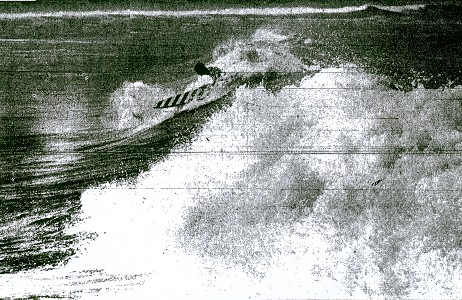 |
Poised
for
the shoot.
This surf-board rider, at Manly yesterday, has caught the crest of a huge "breaker" at the right moment for a perfect shoot. |
SURF-BOARD
MEN DIFFER ABOUT TITLE CHANCES
International
Test Planned At Hawaii
Arm-Chair
Rides
"WaIkikI
waves
are what we call 'arm-chair rides'," sald Mr. C. J. ("Snow")
McAlister,
of Manly, triple surf-board champlon of Australia,
yesterday.
"The broken
surf
of Australia demand tremendous skill of the surf-board
rider.
"I think our
best men have enough skill to match anybody in the surf.
"If they
started
with the same boards, I think our men would finish in front.
"Some of the
Hawaiians I saw in our surf were not very impressive.
"Even Duke
Kahanamoku
found our surf difficult ro begin with."
Club's
Support
ln Hawaii,
the
Beechcomber (sic) Club of American and Hawaiian University
athletes is
leading the move for an inter-national test.
A challenge
has
been received from Honolulu for Australians to match the
skill of Amerlcan
surf-board champions.
The Daily
Telegraph
has dlscussed an international surf-board match at Honolulu
In July with
the Surf Life Saving Executive.
A
sub-committee
has been appointed to suggest means of finding suitable men
to represent
Australia.
The claim
that
Australian could match anybody in the surf was made
yesterday.
Mr CIaude
West,
ex-surfboard champion, who has beaten Honolulu surfboard men
in the Australian
surf, expressed this view.
The type of
surf
we have is the toughest in the world to master, and
Australians could hold
their own in the easier Honolulu surf," said Mr West.
A challenge
has
been received from Honolulu for Australian surf-board
champions to match
the skill of Americans.
The Daily
Telegraph
has dicussed an international test at Honolulu with the Surf
Life Saving
Associatlon executIve.
First
Australian
A
sub-committee
is working to suggest means of finding suitable men to
represent Australia.
Mr, West, an
ex-surf-board champion, yesterday discussed the view of Mr
J. M. Ralston,
former president of Palm Beach Surf Life Savlng Club, that
Hawaiians were
unbeatable in thelr own surf.
"I was the
first
Australian to take up surf-board rlding." he said
yesterday.
I Iearnt on
Duke
Kahanamoku's board, which he left here after introducing
surf-board riding
to Australia before the war.
Beat
Kahanamoku
"I beat Sam
Kahanamoku,
his brother of Honolulu, when he came here.
"I beat Ludy
Langer, another Honolulu man.
"I saw
Mariechen
Wehselau, when she came here, and she was not as good as
some of our Australian
women.
Other
Hawaiians
I have seen in our surf have been behind our men.
Harder
Surf
I am certain
our surf-board men can hold their own in any surf
where surf-boards
are ridden.
"Men have
to be
more skilled and tougher to ride our waves.
"They have
to
battle out against terrific seas.
"They have
to
ride a wave that dumps and breaks, manoeuvring their boards
bagainst strong
undertows.
"Would
Be Picnic"
"Thye
smooth,
unbroken roller of Honolulu would be a picnic for our men.
"The paddle
out
to distances up to a mile there would be nothing in their
smooth swell.
"Why we
would
often 65lb. boards from Manly to Freshwater and back
thinking nothing of
it!
Duke and Sam
Kahanamoku and Mariechen Wehselau are amoung the prominent
Honolulu surfers
who are supporting the move for a surf-board match between
America and
Australia this year.
What great
strides
this sport has made in Australia!
A few years
ago
it was hardly known in this country.
The
Hawaiians
introduced us to this exhilarating, thrilling pastime, and
to these romantic
tropical islanders is due our warmest thanks.
But typical
of
our race, the youth of Australia has developed the art until
to-day they
are the equal In skill of their dusky natatorial neighbours.
In fact, in
my
opinion, we have seen exhibitions by our own lads in
Australia that have
exceeded the skill of the most talented Hawaiians.
The surf conditions of the Hawaiian Islands differ considerably from those in Australia.
The waves
of the
famous Waikiki Beach at Honolulu do not break.
Assisted by
a
reef some distance off shore, they come in the form of a
grand swell or
roller.
It is
comparatively
easy to catch a roller with the long narrow surfboards and
ride it right
to the shallows, even high and dry on the sands.
The steady, even passage in allows the rider to perform apparently difficult tricks with ease.
Our
conditions
are different.
Our waves
are
irregular, bank up to great heights, and break some distance
from the shore.
In order to
choose
the correct type of wave and ride it expertly and safely,
one must summon
far greater daring and skill than the Waikiki rider has to
do.
Several
types
of boards have been used in Australia.
We started
with
the small hand-board until to-day the accepted surfboard is
a huge specially
shaped piece of picked timber having distinctive marine
advantages.
The
hand-board
measures about 12 inches square and is light in weight.
The manipulation of this board is an easy matter.
As the
suitable
wave breaks it isplaced in tront of the "shooter," a full
man's Iength
of the lett hand,
at the same
time
stroking at the side of the body with the right.
When the
wave
is property mounted, both hands grip the board. holding it
almost flat
on the water.
The "surfer" is carried shorewards by the wave, head free and shoulders clear and feet free to assist when the wave is losing its strength.
This method is applicable to almost any size wave, and is comparatively simple.
The
handling of
the real surfboard is a much more difficult matter.
It calls for
care in selection, water knowledge, choce of wave, and
expert manipulation.
The
accepted measuremnets
for the regulation surf board are:
Length 9ft
6in;
width at back end 20in; centre 22in, tapering down to an
oval shaped nose
of 10 to 12 inches.
Thicknesses
vary
from 1 3/4in at back, graduating to 3in at the centre, and
narrowing to
1in or less at the point.
Redwood is
the
most suitable timber for surfboards, but if unprocurable,
cedar ls recommended.
Surfboard
riding
has become an attractive feature at surf carnivals, and the
displays and
stunts which youthful Australians perform on these huge
boards astound
onlookers - even the Hawiians themselves.
This
assertion
was verified during the 1915 visit to Australia of famous
Hawaiian swimmer
and surfboard expert, Duke Kahanamoku.
He enjoyed
our
surf, but despite his great knowledge of surfboard riding,
he admitted
that the young Australians excelled his own efforts under
the unusual local
conditions, of which, of course, he had little experience.
Ofrecent years attempts have beenn made to conquer tbe waves by the introduction or the surf canoe, surf ski, and latterly the surfoplane.
The manipulation or these new devices call for skil and a certain amount of daring, but fail to meet the heights of individual accomplishment which a surfboard rider must attain in Australia.
To begin surfboard riding the novice is advised to make astudy of the Australian surf, paying particular attention to the waves themselves.
Two
particular
types which roll in on our beaches will interest the
"surf-shooter" and
the surfboard rider.
They are
commonly
known as the "roller," or "slide," and the "dumper."
The rolling
or
"roller" wave is encountered mostly at high-tide.
The "dumper"
is more frequent al low tide, but do not take this as a hard
and fast rule.
The "roller,", or slide, is the wave to be ridden; the "dumper" is the wave to be avoided.
It is dangerous and the cause of many accidents, but can be picked up quite safely by one who has become expert in the art of "broaching".
Broaching
means
turning the surfboard sideways and parrallel to the wave.
At the same
time
you
ion in line
with
the hipS
iwhen tbe
,rros
are thoroughly re axed and
~'Cked out
of
the water, hending e arms at the elbows and carry-
ng the bands
underneatb (en- sUres proper relaxation>, and for-
..."ard ti> the straight
out position
.0 front and
at the sides of .the- ~ard. .'
IS is the
propelling
move- ment, and when cOluinued ought-to drive the board and-
rider alol1g
at. a fairly fast. rate. ""h.e[1 the ri~er becomes expert
he may now
paddle
his board t to the wbfoekea wav&;, but- is vised to pick
a i day when
the ves.re not too big.
-He next
picks
out the wave ~n hieh he intends to try hie akill, d then
~8Jt~ tbe board
so
~ ll.cin 1.8
h 0 reward s~.H ~
--
More
Difficult Here
Paddling
record
times in the still water of a Honolulu canal, over a
distance from 100
yards to a mile, are held by Tom Blake, an American." said
Mr. Russell
yesterday.
"My tests,
over
the same distances and in the harder water of Pittwater,
showed just about
the same time." he said.
Mr. Russell
was
timed at Pittwater by Dr. T. H. Guthrie, of Whale Beach,.
"We contend
that
Australians, their stamina toughened by our terrific
seas, could
match Honolulu men at paddling a board." he said.
"And their
waves
would be easy for us as laying on a bed."
3-Ply
Board Used
In the
Pittwater
tests, a light hollow board of special three ply, about 15
feet 4ins. long
was used.
The board
was
built by Mr. Russell , who considers it as fast as boards
used at Honolulu.
It weighs
about
30lb., whereas a solid board would weigh about 60lb (?, unclear
transcription)."
he said.
A challenge
has
been received from Honolulu for Australians to match the
skill of American
surfboard champions.
The Daily
Telegraph
has discussed an international test at Honolulu with the
Surf Life Saving
Association executive.
Surf board
riding
is an art that can never be perfected.
We in
Australia
learnt the rudiments after seeing the Hawaiian, Duke
Kahanamoku, before
the war.
Now, I think
we could teach our teachers.
No other
Hawaiian
has ever managed to duplicate the Duke's amazing skil.
Such noted
swimmers
as Sam Kahanamoku, Ludy Langer, Pua Kealoah, and Bill Harris
came here
with big reputations.
They were
adepts
in their own surf but were "all at sea" when tying to shoot
the huge dumping
breakers on Sydney beaches.
Keen
Judgment
Handling a
board
on Sydney beaches
requires
split-second
timing and judgment; whereas Hawaiians had been used to
waves in Honolulu
which side slowly.
Australians,
with constant practicein rough and dangerous surf, have
become proficient
to a remarkable degree.
Even the
largest
"dumpers" can be held if the rider "broaches" his board down
the face of
the steep wave.
"Broaching"
a
board means to turn the board underneath the rider and
parallel to the
breaker, pressing heavily on the edge nearest the wave.
When the
main
force of the wave is spent, the board is swung back under
the body into
normal position.
Standing on
the
head while shooting to the beach is easily the most
spectacular feat.
It requires
great
skill and concentration.
Thrilling
Action
But perhaps
the
most thrilling to the rider, although not so interesting to
the specator,
is "funneling", or riding the "corner" of a sliding wave.
This means
manoeuvring
the board to keep on the breaking corner of the wave, and
shooting right
across the face of the wave.
Twice the
speed
is obtained because if the run into the beach is 300 yards,
there is the
possibility of gaining another 300 yards across the beach
with the wave.
It takes a
beginner
a full season to learn to handle his board in our surf.
The
following
season he can start to learn tricks.
But he never
finishes learning.
Difficult
Feats
Some of the
hardest
feats on a board, necessating years of practice, are:-
ChangIng
board
by stepping from one to another, when two riders are on the
same wave.
Standing up
backwards
on the board while shooting shorewards.
Standing
upright
with a light passenger astride your shoulders.
Riding a
wave
tandem, both standing.
The
direction
of the board coming down a wave can be varied by using the
foot as a tiller
or by cupping the water with the hands.
Normally, a
well
constructed and well-handled board will keep its correct
course.
Since the
proposal
to send an Australian team of surf-board riders to Honolulu
was first mooted,
several of Australia's greatest swimmers have asked me to
teach them to
use the board.
Tommy
Adrian,
former Australian swimming coach of "Boy" Charlton, always
believed in
the use of surf boards in conjunction with baths training
for swimming.
So,
apparently,
did Duke Kahanamoku who was at one time world's champion
sprint swimmer.
Daily
Telegraph Idea
The whole
scheme
has developed from a Daily Telegraph plan for a team of
surf-board men
to accept a Honolulu challenge to match Hawaiians in their
surf.
A
sub-committee
to organise a team of at least 10 men, and to raise funds
towards sending
it away was appointed at the meeting of the delegate council
of the Surf
Life saving Association last night.
Further
backing
is being found by the Australian National Travel Association
and The Daily
Telegraph.
Surf Club
Leaders Hail Proposal - Page 2, Cols. 4& 5.
| In a
letter to
Harry M. Hay, Australia's foremost swimmimg and surf
coach.- Tommy Walker,
one-time surfboard champion at Manly (N.S.W.), writes:
"I
saw an article
by you in 'The Referee' re surfboards, so
enclose a photo of myself
and surfboard taken in 1909 at Manly.
Walker
was a well
known figure at Manly at the time he writes about.
* * * He brought three other lads into the enterprise and between them they raised the necessary capital to buy a hook and line and to hire a tent in which to install the monster of the depth. |
 |
But first
they
had lo catch their fish.
They
selected
Fairy Bower beach as their base and set a watch on the hill
overlooking
it.
But first
they
had lo catch their fish.
They
selected
Fairy Bower beach as their base and set a watch on the hill
overlooking
it.
On the
second
day of their vigil, the required shark was sighted.
Like a
policeman
on his beat, he came leisurely from the direction of South
Steyne.
And he was a
whopper, a tiger, 14ft 2in in length, as was proved later.
He was duly
landed
struggling on to the beach and a curious public had paid
£12/10/-
to view him when the Council's inspector of nuisances
intervened to the
manifest relief of the residents in the vicinity.
But one may
ask,
"Where does the hero stuff come in?"
Well, it was
this way.
When the
shark
was sited, the watchers on the hill signalled to Tommy (who
was waiting
on the beach) and he immediately set out in a small dinghy
to drop the
bait at the spot it was anticipated the shark would cross.
The craft
capsized.
So Tommy
swam
with the bait, a 7lb salmon, and lilerally spilt it into Ihe
shark's mouth.
The shark
grabbed
it - and the rest was easy.
Someone
said,
"I wouldn't have done that for £10,000."
Tommy
replied
simply, "There was no danger - when salmon are about, a
shark has no time
for anything else,"
Miss Schilling had crossed a deep channel and was resting on a sandbank, and was watching Walker shooting.
He could
swim
like a fish.
This was at
it
time when large surfboards were unknown in Australian
waters.
However,
Walker
did not need any adventitious (sic) aids when shooting, at
which he was
one of the recognised adepts.
II was impracticable, however, to shoot right into the sand because of the channel, which banked the surf up.
Afler his
third
shoot, Walker appeared to be in sore trouble in the channel.
His scream
for
help galvanised the dancing star into action.
With
powerful
strokes, swimming trudgeon style, she quickly covered the
necessary 30
yards to reach the youth who was sinking for the third
time.
He appeared
to
be in a fit and struggled violently as the gallant lady swam
with him to
the shore.
* * *
Just at this moment the professional lifesaver, the late 'Appy Eyre, arrived, and he worked on the unconscious form of Walker, who, when he came to his senses, ejaculated, "Well this is the last time I'll go surfing immediately after a heavy breakfast."
The evening
papers
rang with the story, and the performance at the Royal was
held up that
night when Miss Schilling appeared on the stage.
Members of
the
audience from all parts of the theatre rose and cheered, and
cheered, and
cheered again.
And Tommy -
what
of him?
Just about
that
time, a week beforehand, in fact, Claude Eric Ferguson McKay
had been appointed
to the position as Williamson's publicity man.
Walker, if unwittingly, had brought one of Williamson's stars into the limelight - had given her the opportunity of appearing as a heroine in a drama off the stage.
McKay was
delighted.
He presented
Walker with a brand new £5 note.
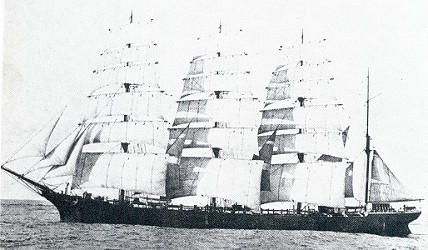 |
Poltalloch off the Colombia River, circa 1913. |
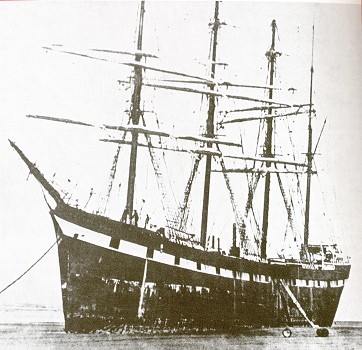 |
Poltalloch aground at Willapa Bay, circa 1900. |
| home | catalogue | history | references | appendix |