surfresearch.com.au
 |
surfresearch.com.au
slessor :
surf, all about
it, 1931
|
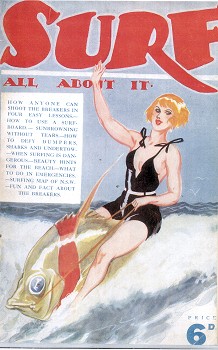
Kenneth Slessor : Surf,
All About It, [1931].
Extracts
from
(Slessor, Kenneth): Surf -
All
About It.
Sydney,[1931].
No author, editor or publishing
details
in evidence.
One copy noted with a pencil
annotation
on page seven
which appears to attribute copyright
to
"Slessor
26.2.31".
Introduction.
A jovial and enthusiastic promotional
work for surfbathing in a wide range of manifestations.
The surfriding and related surf centred
articles appear to lack an in-depth understanding of the art, for
example
contrast this work with the finely worded chapters by Harry Hay in
his
Swimming
and
Surfing, of the same year.
As such, these sections may not be the
work of an expert and might be based substantially on an
accumulation of
beach knowledge, enhanced with access to some previously printed
accounts.
No author, editor or publishing
details
are in evidence.although the copy in the Mitchell Library,
Sydney, has
a pencil annotation on page seven which appears to attribute
copyright
or contribution to
"Slessor 26.2.31".
The work is included in papers held
by
the National Library of Australia. see below.
The only articles with by-lines are
simply
identified as "Medico" and "Eve", the later
advising on Beauty
and the Beach, pages 27 to 29.
Profusely illustrated with black and
white
illustrations (some of high quality) and cartoons, the later the
only apt
description for the Surfing Map on page 49.
Probably the work of several artists,
the finest illustrations accompany a poem, Jan'tzen Josie,
and a
song, Bluebottle Blues, on pages 37 and 40 respectively.
Slessor, Kenneth / Papers
(National
Library of Aus.)
...
Series 4: Slessor's publications
Items 1-367
Books by Slessor in this series
are
Thief
of the moon, Earth visitors, Darlinghurst nights, Portrait
of Sydney, Australian
profile, The grapes are growing, The story of Australian
wine, and Canberra.
Also included are copies of the
index
of first lines to One hundred poems 1919-1939 and a
small book by
Slessor about surfing called Surf; all about it.
http://findaid.library.uwa.edu.au/cgi-bin/nph-dweb/dynaweb/findaid/slessor1/@Generic__BookTextView/335;cs=default;ts=default
Australian Dictionary of
Biography,
National Centre of Biography, Australian National University
http://adb.anu.edu.au/biography/slessor-kenneth-adolf-11712
Slessor joined the idiosyncratic
Smith's
Weekly in 1927 and remained there until 1940, serving as
an editor
from 1935.
He enjoyed its unconventionality,
interest
in film and humour, and, probably, its 'knock-'em-down'
vulgarity; he later
described the period as 'the happiest chapter of my
existence'.
During these years he wrote most
of
his major poetry, the bulk of his light verse (which was
published in Smith's,
with illustrations principally by Virgil Reilly), numerous
articles and
film reviews.
Slessor's 'Five Visions of
Captain Cook'
was included in a booklet, Trio (1931), with poems by
Harley Matthews
and Colin Simpson.
In 1932 he published his third
major
collection, Cuckooz Contrey, a collection of
illustrated light verse.
Darlinghurst Nights (1933)
and
a collection of children's verse, Funny Farmyard
(1933), followed.
In 1939 the small paperback Five
Bells:
XX Poems appeared.
Norman Lindsay again provided
drawings
for Cuckooz Contrey and Five Bells, but
Slessor's work increasingly
seemed to belong to another world from that of Lindsay.
The elegy 'Five Bells', a
meditation
prompted by the death from drowning of Joe Lynch in Sydney
Harbour in 1927,
is generally agreed to be his finest poem.
It placed him among Australia's
foremost
poets.
...
Select Bibliography
A. K. Thomson (ed), Critical
Essays
on Kenneth Slessor (Brisb, 1968)
D. Stewart, A Man of Sydney
(Melb, 1977)
A. Taylor, Reading Australian
Poetry
(Brisb,
1987)
G. Dutton, Kenneth Slessor (Melb,
1991)
A. Caesar, Kenneth Slessor (Melb,
1995)
P. Mead (ed), Kenneth Slessor
(Brisb,
1997)
Southerly, 31, no 4, 1971
D. Haskell, 'Sheer Voice and
Fidget
Wheels', Australian Literary Studies, 13, no 3, 1988,
p 253
Sydney Morning Herald, 25
Jan
1919, 2 Apr 1940, 25 Feb, 3 Mar 1944, 5 Nov 1953, 1 Jan 1959,
30 Dec 1967,
17 Sept 1971
Slessor papers (National Library
of
Australia)
SP109/3,
item
392/17, and resignation of Mr Kenneth Slessor, A5954, item
609/3 (National
Archives of Australia).
Haskell,
Dennis,
'Slessor, Kenneth Adolf (1901–1971)', Australian Dictionary of
Biography,
National Centre of Biography, Australian National University,
http://adb.anu.edu.au/biography/slessor-kenneth-adolf-11712/text20935,
accessed
23 May 2012.
Kevin
Patrick:
Comics Down Under
...
Reilly was
also
an accomplished book illustrator, providing artwork for two
collections
of poetry by Kenneth Slessor: Darlinghurst Nights
(Frank Johnson
Publications, 1933/Reprinted in 1974) and Backless Betty
from Bondi
(Angus & Robertson, 1983).
Kevin Patrick:
Comics
Down Under
http://comicsdownunder.blogspot.com.au/2006/12/virgil-reilly-from-pin-ups-to-punch.html
This article
originally
appeared in the March 2004 edition of Collectormania magazine
A821.3/SLE
(Nowra
Stack)
Kenneth
slessor:
a biography
Dutton,
Geoffrey,
1922-
Ringwood, Vic.
:
Viking, 1991
Page
Thirty-four
(in highlighted
box)
Duke
Kahanamoku's Style
SLOW-MOTION
pictures
of the famous Hawaiian swimmer, Duke Kahanamoku, in the surf,
reveal several
points of interest to
Australian
surfers.
Kahanamoku
prepares
to take off when the wave is about ten yards away from him.
He glides one
arm out in front, and paddles himself along with the other,
thus building
up some impetus before the breaker reaches him.
He then
catches
the crest gracefully, and rushes off to the beach, swaying
from side to
side.
Page
Fifteen
How
to Use a Surf-Board
Any surfer
can
learn to use a board. - Australians as good as Hawaiians.
- Short
boards.
- Safety outside the breaker-line. - Taking the board
out.
- Catching a
wave. - Standing up.
IF there is
anything
more graceful or more beautiful than a human being poised
upright on a
breaker, as it rushes to the beach, nobody, with the
possible exception
of Pavlova, has yet discovered it.
Between
this glorification
of surf-shooting and the ordinary method of riding a wave,
there is as
much difference as between a limousine and a bicycle.
Yet,
strangely
enough, few of the thousands of surfers who think nothing of
spending a
day in the farthest line of breakers venture to climb aboard
that de luxe
express train of the Pacific, the
ordinary
surfboard.
No doubt,
much
of this reluctance is due to the supposition that the art of
riding a board
calls for some abnormal talent in the surfer.
Others again
are under a false-idea of the dangers and difficulties
attendant upon doing
so.
Both of
these
popular delusions are entirely wrong.
It is no
harder
for a moderately skilful surfer to learn the use of the
board than it was
for him to learn the art of shooting.
And the risk
of danger is certainly no more.
Many
authorities,
indeed, are prepared to argue that it is considerably less.
Surfboards
appear
to have been invented by the superb swimmers of that St.
Andrews of the
surf, Waikiki Beach.
To-day, it
could
be claimed that Australians have learnt to ride surfboards
even more successfully
than the Hawaiians.
In support
of
this, numerous experts have pointed out that the Waikiki
rollers offer
a far easier passage to the board than the shorter, and
generally fiercer,
breakers of the Australian coast.
Hawaiians,
for
instance, are able to enjoy a much longer period on the
board before reaching
the beach.
Despite this
handicap, any impartial critic must agree that Australian
surfboard users
have attained just as high a degree of perfection as the
Hawaiians.
Remember,
therefore,
that if you can shoot a breaker, there is no earthly reason
why you should
not pass on into the brotherhood of the board.
And the
first
thing you must do is to acquire a suitable surfboard.
No
explanation
need be wasted on the use of the "short boards."
These are
really
more for the assistance of the beginner, who is learning the
feel of the
surf.
When
practising
the in-shore glide (see Lesson One, page 7), you will notice
the enormous
assistance
derived
by holding one of these little boards extended in front of
you.
Let us take
it
that you have secured a smooth and nicely balanced "long
board."
Once again,
it
is necessary to repeat that three-quarters of the battle is
won if you
have CONFIDENCE.
Cast your
fears
aside as you walk down the beach.
Remember
these
three comforting facts:-
Page
Sixteen
No shark
has
ever yet attacked a swimmer with a surfboard.
The big
brutes
are frightened of anything unusual.
You are
actually
safer OUTSIDE the breaker-line than you are inside.
For one
thing,
the sea is much smoother.
Don't
imagine
you are in danger of being carried out to sea.
As a
matter
of fact, you could paddle several miles on the board.
First thing
you
must do is to notice whether any special atea has been set
aside for surfboards.
If not, do
your
board-riding close to where the ordinary surfing is going
on, but not close
enough to run the risk of colliding with anybody.
Remember
that
a blow from a moving board can inflict a very serious
injury.
Now, are
you ready?
Right.
Carry your
board
down to the water and slide it in.
The first
thing
you've got to learn is how to manoeuvre yourself and your
board safely
out to the big stuff.
Wait till
there
is a momentary lull in the breakers, launch the board, and
waste as little
time as
possible in
the
shallows.
The board is
twice as difficult to handle here as farther out.
And take
care
you don't get bumped by it.
Push it,
DON'T
TOW IT, through the breakers.
But,
although
you're pushing it from the back, don't make the mistake, if
it is swept
out of your control, of trying to recover it from the
shore-side.
Approach it
from
the direction of the breakers, so that there is no chance of
it being flung
on top of you.
Go right
out.
You'll
probably
have to start swimming as you approach the farthest
breaker-line.
Keep on
pushing
the board, righting its direction every time you are
buffeted.
Once past
the
line where the waves are breaking you'll find the sea much
easier.
Halt just
on the
other side of the breakers.
Lift
yourself
smoothly on to the board, lying face-down, with your legs
and knees just
over the sides. Now you will have to pick out your wave.
Just as in
Lesson
Two, on the art of surf-shooting, the importance of properly
timing the
breaker cannot be over-emphasised.
Having
selected
the right wave, move the board in front of it by paddling
till it overtakes
you.
Never try to
mount a wave that is in the act of breaking.
Catch it
immediately
before.
Once the
breaker
has reached your board, you will feel yourself gliding
rapidly with it.
The
principle
of putting weight in front of a wave you are in danger of
losing must be
again applied.
If the
breaker
shows signs of leaving you behind, pull your body further up
in the direction
of the front of the board, and concentrate your weight
there.
Endeavour
to lie
as still as possible, and balance yourself in the exact
middle.
You are
bound
to roll off during your first few attempts, but stick at it
without fear.
It won't be
long
before you taste the intoxication of whizzing in to the
beach on your trusty
steed. Once you've done it, you'll want to live on your
board.
Of course,
care
must be taken if you fall off not to let the board strike
you.
If, at the
moment
the wave breaks, the board dives vertically, simply let
yourself go down
with it, slide over the top, ...
Page
Seventeen
... avoid
it falling
on you, and try again.
Make
yourself
a master of horizontal board-shooting before you try to
stand up.
By that
time,
you'll have a much finer sense of balance, and your
confidence in the board
will have greatly increased.
You may find
that standing on the board is a more difficult thing in its
early stages.
Balance and
timing
are again the essentials.
Combine
these
with constant practice and you will triumph.
As before,
catch
the wave before it breaks.
Lie
face-down
on the board, exactly the same way, until it has gathered
speed, and the
wave has burst.
Then,
smoothly
and without changing the centre of balance, rise to a
stooping, all-fours
position, facing across the board, side-on to the beach.
Stand up
very
gently, sliding your legs wide apart, and adjusting your
balance so that
your weight is distributed centrally.
You may
have to
try dozens of experiments in the art of balance till you
have found the
position that suits the board and the wave.
But it's
great
fun- even falling off!
Don't think
you
can't succeed.
It's just a
matter
of patience, practice and confidence.
And once
you've
learnt to stand up on a breaker, you may consider you have
won your final
degree in the university of the surf.
Page
Forty-seven
Follows Where
to
Surf Around Sydney, pages 46 and 47, that detail Bondi,
Bronte,
Coogee, Clovelly, Cronulla, Manly and Maroubra Beaches.
...
Famous
Foam in Foreign Lands
A
surfer's-eye
tour of the world. - Romantic Honolulu. - Two-mile shoots !
- Waikiki
Beach.
- Ricksha-boys of Durban. - Pink pyjamas on the Lido.
- East,
West,
Australia's Best.
FEW other
countries
have taken to the surf as eagerly, and in such
anoverwhelming fashion,
as Australia.
Few other
countries,
indeed, can boast such a splendid sweep of breaker-beaches
as those that
stretch almost continuously from Southport, up in
Queensland, to Cottesloe
in West Australia.
But the
surfer
who is fortunate enough to be able to travel to other oceans
or other coasts
will find
an absorbing
interest in the bathing- fashions and surfing-peculiarities
of the celebrated
beaches whose fame has spread across the sea.
Outside
Australia,
easily the most noted beaches are those of Hawaii, swept by
the same old
Pacific that knocks at Manly's door.
St.
Andrew's.
the shrine of golf, is a name of no greater veneration than
WAIKIKI to
the surfer.
WAIKIKI:
Only
a fortnight's travel from Sydney, by luxurious liners,
Waikiki, the cradle
of surf-riding, flaunts all the tropical splendors of blue
and scarlet,
golden sand and green palm-trees, hibiscus and frangipanni
blossoms, in
profusion enough to make a painter sob into his palette.
At first
sight,
the famous beach seems rather surprisingly small to
Australians accustomed
to the huge half-moons of the eastern coast.
But what
Waikiki
lacks in vastnest-, it gains in the nature of its surf.
It is
possible
to swim out, and secure shoots, two miles from the shore!
More
attractive
still to the cautious surfer, the sea around Waikiki Beach
is quite free
from sharks. The breakers bank up slowly, and their crest
does not form
until they have come close inshore. There is not the same
degree of curl
about them as with Australian waves, and their long, flat,
rolling formation
is ideally suited for surfboard-rilflng.
The nearest
Australian
equivalent to Waikiki would, perhaps, be some such beach as
Freshwater,
in a light southerly breeze.
DURBAN,
South
Africa's most famous bathing-beach, stretches along the
shore of Durban
Bay in Natal.
The surf,
though
rather weak, is warm and inviting, and there is a system of
nets and ropes,
for the assistance of the novice and the prevention of
sharks.
A pier
extends
into the water, and there are many attractions on land,
including, of course,
the gaily dressed ricksha-boy and his carriage.
THE LIDO,
Europe's
most famous bathing-place, is not, of course, a surf- beach,
but its waters
are none the less distinctive, as much for their warmth and
beauty as for
the colorful people who splash the hours away in them.
The Lido is
next-door
to Venice, and all the romance and charm of Italy seem to
converge on the
rainbow- painted beach.
The sands
teem
with exotic bathers: dukes jostle American millionaires;
pyjamas and peignoires
of every conceivable tint and pattern swarm on the terraces.
The beach is
lined with a double row of gaily colored bathing-boxes, and
forests of
blue and white poles protrude from the sea.
Sun-bathing
on,
the sand is as popular as in Australia: many enthusiasts
live almost entirely
on the beach, in nothing but bathing-costumes or pyjamas.
There is a
pier
running into the sea, on which more crowds of bathers sit at
blue tables,
siopping orange drinks.
All sorts of
fantastic amusements are pursued in the water- the sports
range from water-bicycles
to gymnastics.
But, alas,
there
is never a sign of a good Australian breaker and the water
is warm, shallow,
and cloudy, with none of that invigorating sting which adds
zest to the
Australian surf.
Page
Fifty-one
(Inside back cover).
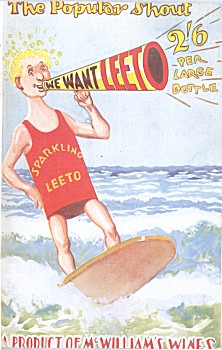
Advertising:
The
Popular Shout
WE
WANT LEETO
2/6
PER LARGE
BOTTLE
SPARKLING
LEETO
A
PRODUCT OF
McWILLIAM'S WINES
Surf - All About It.
Sydney,1931, page 51.
|
|
|
Slessor, Kenneth:
Surf - All About It.
Sydney,1931.
No author, editor, artist or
publishing
details in evidence.
|
surfresearch.com.au
Geoff Cater (2007) : Kenneth
Slessor
: Surf- All About It, 1931.
http://www.surfresearch.com.au/1931_Surf_All_About.html