 |
surfresearch.com.au
kennedy : ellice islands, 1930 |
| home | catalogue | history | references | appendix |
|
| Kennedy,
Donald Gilbert: Field Notes on the Culture of
Vaitupu, Ellice Islands. The Journal of Polynesian Society Volume 39 Number 1. No. 153, March 1930, pages 111 to 113. New Plymouth, New Zealand. Printed for the Society by Thomas Avery. |
Kennedy,
Donald Gilbert: Field Notes on the Culture of
Vaitupu, Ellice Islands. The Journal of Polynesian Society Volume 38 Number 4. No. 152, December 1929, Plate 14 Figure 68 and Plate 15 Figure 69. New Plymouth, New Zealand. Printed for the Society by Thomas Avery. |
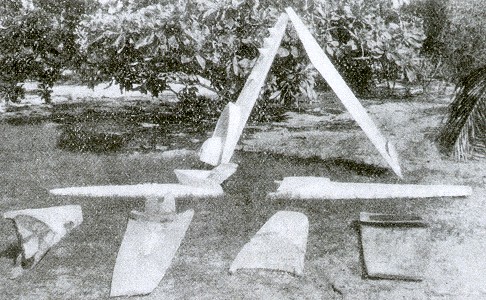 |
Vaitupu type bow and stern covers (the stern covers are on the left). |
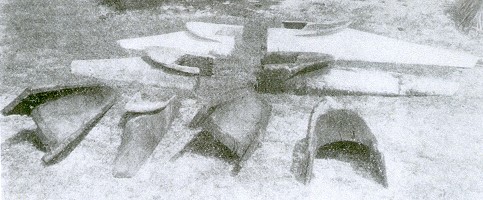 |
Namumea type bow and stern covers (the stern covers are on the left). |
 |
Gilbert
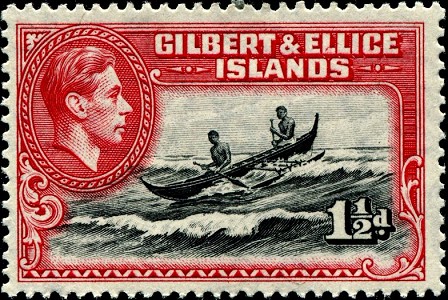
and Ellice Islands Postage Stamp [SG 45], 1939-1965. , who noted: SG 45 was printed by De La Rue and depicts a native canoe crossing a reef. The Gilbert and Ellice Islands, in the Pacific Ocean, were a British protectorate from 1892 and a colony from 1916 to 1976. Since independence the Gilbert Islands have been part of Kiribati, and the Ellice Islands are now known as Tuvalu. This gorgeous set of engraved definitive stamps was first issued in January 1939 and the same designs (with George VI later replaced by Elizabeth II) remained in use until 1965, when they were replaced by much less attractive lithographed designs. The stamps were engraved by very talented anonymous staff engravers. The set was engraved and printed by the three main British Empire/Commonwealth stamp printers: Bradbury Wilkinson, Waterlow, and De La Rue. Engraved Stamp Beauties, viewed 17 may 2014. http://www.stampboards.com/ |
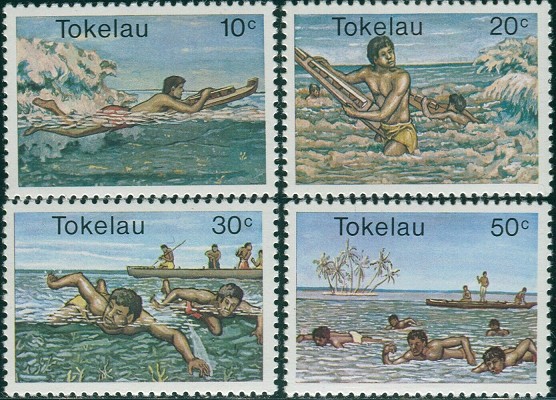 |
Postage Stamp Noted by Hervé Manificat in the Surf Blurb, April 2019. Tokelau is a dependent territory of New Zealand in the southern Pacific Ocean.  Highly interesting illustrations with unusual prone surfboards, possibly a puke, the shaped bow-covering for a canoe. |
| home | catalogue | history | references | appendix |