
surfresearch.com.au
best : maori canoe, 1925
| home | catalogue | history | references | appendix |
|
surfresearch.com.au
best : maori canoe, 1925
|
Reprint of
1925 edition.
Best, Elsdon: The
Maori
Canoe
Bulletin Number
VII, 1925
Dominion Museum
, Wellington, New Zealand, 1925.
While Best doubts that felled logs of up to 60 feet could be splitt in two with stone age technology (page 117), he appears to accept that the method reported by Wallis in Tahiti (1767) was practised to split shorter lengths (page 118).
He gives a
detailed account of the manipulation of Maori canoes in the
surf zone, pages 381-382.
Although the
term "surfing" is not used in the text, the section on
page 381 (below) is listed as "Surf, how canoes are landed
through" (page 450).
Special
Note : Easter Island (Rapa Nui)
"La Perouse
remarked of the natives of Easter Island: 'They swim so well
that they will leave the shore to the distance of two
leagues in the roughest sea, and by preference, for the sake
of pleasure, land on their return at the place where the
surf beats the strongest.' "
- pages 204-205
Also note:
Best, Elsdon: Polynesian
Voyagers: The Maori as a Deep-sea Navigator,
Explorer, and Colonizer
Government
Printer, Wellington, New Zealand, 1975.
See: Best,
Elsdon: The Maori Canoe, pages
www.ethnomath.org/resources/best1925a.html
books.google.com/books/about/The_Maori_canoe.html
Part III
THE
CONSTRUCTION OF THE WAR-CANOE
(Pages 65 to
175)
Page 116
Page 117
... name for the rauawa, but apparently there is no corroboration of this.
The rauawa
is the plank secured to the top of the sides of the dug-out
hull in order to increase the height thereof.
The join was
a butted one, as in a carvel-built boat, and the plank was
procured in as long a length as possible, if more than one
piece had to be employed on a side, then the join was made
towards the end of the vessel, and not in or near the
middle.
The ends
were not lapped in any way, but butted together (tutaki
poro), and lashed in the usual manner.
The
hewing-out of a top-strake of, say, 60 ft. in length and
perhaps 15 in. in width was no light task with rude stone
implements, for it meant reducing the whole tree-trunk to
the thickness of a plank.
Two or more
trees would have to be felled in order to provide
top-strakes for our canoe.
Tuta
Nihoniho stated that in some cases a log was split through
the middle, so that two top-strakes were obtained from one
log. This may have been done in late times by using
blasting-powder, but after half a century's experience in
timber-working the writer is not prepared to believe that
the Maori, with rude implements consisting of wooden wedges
and a wooden beetle, could split large and long logs of kauri,
tatara, or rimu.
The
splitting of a white tawa (Beischmiedia tawa)
in order to manufacture bird-spear shafts he may easily have
accomplished.
As an old
timber-worker the writer has long been puzzled as to how the
Maori succeeded in splitting logs with wooden wedges or,
rather, to be precise, how he managed to enter the points of
his wooden wedges, for that would be a difficult part of the
process.
Page 118
The
following note, taken from the account of the sojourn of
Captain Wallis at Tahiti in 1767, explains an ingenious
method of entering such wedges that was probably known to
and employed by the Maori of New Zealand:
"The tree is
first felled with a kind of hatchet or adze, made of a hard
greenish stone, fitted very completely into a handle; it is
then cut into such lengths as are required for the plank,
one end of which is heated until it begins to crack, and
then with wedges of hardwood they split it down: some of
these planks are 2 ft. broad, and from 15 ft. to 20 ft.
long."
The small
entering-wedges (pipi) would be inserted in such
cracks.
Page 176
Part IV
FISHING AND
RIVER CANOES
(Pages 176 to
225)
Page 195
Rafts and
Floats
Basic rafts and
reed boats, pages 195 to 205.
Page 202
The above writer (Polack, an early trader at the Bay of Islands) also refers to the small type of float used by one person, and illustrated in Taylor's Te Ika a Maui: "In the absence of canoes, a quantity of dried bulrushes are fastened together, on "which the native is enabled to cross a stream by sitting astride and paddling with his hands .. They are extremely buoyant, and resist saturation for a long period." (See fig: 100.)
Page 204
Swimming-powers
of
the Polynesians.- This is not the place to describe
the astonishing powers of the Polynesian as a swimmer, but
his being so much at home in the water has ever been to him
one of his most useful accomplishments - as, for instance,
in the case of capsized or swamped canoes.
La Perouse
remarked of the natives of Easter Island: "They swim so well
that they will leave the shore to the distance of two
leagues in the roughest sea, and by ...
Page 205
... preference, for the sake of pleasure, land on their return at the place where the surf beats the strongest."
Page 226
Part V
METHODS OF
PROPULSION
(Pages 226 to
281)
Page 227
The long
steering-paddles are often described as hoe whakahaere
(controlling-paddles).
The kai-whakatere,
or steersman, sits in a small seat at the base of the taurapa,
or stern-piece of the canoe.
When a canoe
is being paddled one steersman is sufficient, but in the old
days of sailing it sometimes needed two and even three
steer-oars in a big canoe.
When
necessary a steersman would call upon another, or two
others, to assist him.
These two
would be stationed on the first thwart, just ahead of the
stern-seat, one at either side of the canoe, or one at the
bow and one at the stern.
Paddlers sat
on the thwarts of big canoes, but in small ones squatted or
knelt upon the flooring thereof, on which some fern would be
placed.
When heavy
waves are encountered by a canoe the vessel must not be so
steered as to face them directly, at right angles, or she
will dive headlong into the wave and be swamped; hence the
bow is in such cases kept a little off, with the result that
the canoe rides over the wave.
But great
care must be exercised in this operation, for if her head is
brought round too far (ka faro) she broaches to, and
disaster follows.
At such
times the steersman has to be extremely attentive and quick
in order to enable the canoe to kayo nga pu tai, as
a native puts it - to ward off or avoid the seas - all of
which is done by means of a dexterous turn of the paddle.
Should an
adept at the bow note that the bow is swerving off in a
dangerous manner, ...
Page 228
... he at
once plunges his paddle deep down and uses it as a
steering-paddle to swing the canoe back on to its course.
To do this
he holds the paddle obliquely, which causes the bow to
swerve round.
The
steersman at the stern does the same, but on the other side
of the canoe.
With one
steersman at the stern and one at the bow a big canoe was
managed in a remarkable manner.
Page 282
Part VI
CANOES OF
THE PACIFIC AREA
(Pages 282 to
384)
Page 381
(DEEP-SEA VESSELS MENTIONED IN MAORI TRADITION; MANAGEMENT OF SAME; THE DOUBLE OUTRIGGER)
When, in
encountering a head sea, it was desirable to mount the waves
at a slight angle instead of at right angles, the same form
might be used, or that of "Kia tapae te ihu o te waka."
In time of
danger an expert at the bow would, by means of arm gestures,
show paddlers their course of action.
The amotawa,
or sea experts, who directed operations at sea in rough
weather, were adepts at canoe navigation and handling. Their
duties were very different from those of the leader and
fugleman (hautu, kai hautu, and tapatapa)
who controlled paddlers in uneventful coastal trips.
In rough
weather at sea two such adepts were sometimes employed, one
attending to the bow and dangers ahead, the other to the
stern of the vessel and any danger threatening from that
quarter.
One of the
duties of a directing expert was to warn the crew of
approaching conditions, that they might prepare for the
proper action.
Thus, when
he cried "He wharau te ngaru," or "He whare te
ngaru," it was known that a curling wave with
overhanging crest, a "comber," was advancing on the vessel,
and that action must be taken to prevent it breaking on
board.
The call of
"He huka te ngaru" meant a broken form of wave, a
less dangerous form to encounter.
The ngaru
tapuku, or rounded billow, was not dreaded.
If running
on the course of the vessel, an endeavour was made to
balance the canoe upon it, whereupon the smooth swell would
carry it swiftly forward on its way.
This was the
method adopted in landing on a surf-beaten coast when the
dreaded tai maranga, or heavy sea, was abroad.
At such a
time, when the canoe reached the summit of the swell, her
bow projecting somewhat, there came the command "Kia
aronui te hoe," and at once every paddle was held with
blade vertical in the water, handle hard gripped against the
gunwale.
This action
holds a canoe on the swell-crest.
The order "Korewa
te
hoe" caused all paddles to be firmly held with the
blades flat in the water; it was heard in various
contingencies, as, when a canoe was slipping back off a
swell-crest, the change in position of the paddles would
cause her to forge ahead.
"Whakaara
te hoe" is a command to the two men manipulating the
long hoe whakaara at the bow to act in a similar
manner. "Taupuru te hoe" called upon the steersmen
at the stern to act likewise.
"Kumea te
hoe" was a call for strenuous ...
Page 382
exertion on
the part of the paddlers.
"Tiaia Ie
hoe" was a cry of welcome to weary paddlers, as it
means "Go easy."
It meant
that no danger threatened- that the steersmen had merely to
hold the vessel to her course while the paddlers plied an
easy stroke.
Page 424
(NAMES OF PARTS OF MAORI CANOE)
Kopapa .. .. .. 1. Small canoe of tiwai class. 2. surfboard.
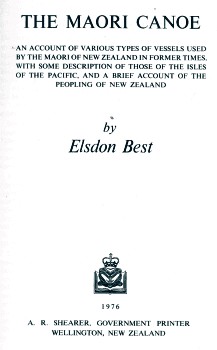 |
A. R. Shearer, Government Printer, Wellington, 1976. Reprint of 1925 edition. |
| home | catalogue | history | references | appendix |