| home | catalogue | history | references | appendix |
|
The account specifies:
1. the importance
of selecting suitable surfriding condtions.
2. the activity
was enjoyed by the whole community, either as participants or audience.
3. the surfriders
included women.
4. canoe surfing
was liable to mis-adventure, with "wipe-outs" a "great amusement of
the crowd of onlookers".
Critically, Skinner's closing comment, "Alas! that we were to witness such a scene ever again", emphatically implies that the canoe surfing he observed in 1884 is no longer in evidence, undoubtedly like many other indigenous practices.
For other reports of Maori canoes and surfriding, see Source Documents:
1838-1843 Ensign Best : Norfolk
Island and New Zealand.
Best, Ensign: The
Journal of Ensign Best, 1837-1843.
R. E. Owen, Government
Printer, Wellingon, New Zealand, 1966.
1847 George Angas
: New Zealand Canoes.
Extracted from Savage
Life And Scenes In Australia And New Zealand.
Smith, Elder and
Co., London, 1847.
1921 S. Percy
Smith: Surfriding in New Zealand.
Extracts from The
Journal of Polynesian Society Volume XXX Number 1. No. 117, March 1921.
SURF-RIDING
BY CANOE.
By W.H. SKINNER.
DURING the Summer
of 1884 the writer was engaged upon the survey of the costal lands lying
between the Mokau and Awakiuo rivers - Auckland-Taranaki Coast.
A small native
settlement, called Te Klturi, was situated on the north bank of the Mokau,
adjacent to the ferry route over that river, and here resided what was
left, about thirty, of that portion of the once numerous body of the Ngati-Maniapoto
tribe that occupied the fertile strip of costal lands between the two rivers
mentioned, during the first half of the 19th century, and the generations
beyond.
The large number
of strongly posted old pas, long deserted, and now only traceable
by their deep fosses and protective works, bears ample testimony to the
large popluation that once occupied this country, an occupation that went
back to the Tangata-Whenna, who were settled here and to the south, long
prior to the coming of the"Tainui," with the ancestors of the present native
occupiers.
The active head of Te Kauri village was Wetere Te-Rerenga, but the elder brother, Te Rangi Tuataka Takeri,* was the real chief of the little settlement, and his final word was law in all matters of ancient Maori rite and custom.
One beautiful
day in January, 1884, I had come in from my camp to confer with Te Rangi.
The Kauri village
was deserted by all but a few old women, who informed me that the people
were on the sea beach, a short distance away.
On arriving there
I found the whole population gathered, taking part in, or watching and
encouraging the contending parties, in a most exhilarating sport, or pastime,
that was proceeding at the mouth of the river (Mokau).
The leader in
this animated scene was Te Rangi, a man at this time about sixty years
of age, well set up and preserved.
The sport engaged
in was "surf-riding" in canoes, something quite new to me.
Two small handy
canoes, varying in length from eighteen to twenty-five feet, were being
used, in each of which were two paddlers, the steersman, and one in the
prow.
The position
chosen for the "surf-riding " was ideal for the purpose, and here, ...
... doubtless
for generations past, the old time Maori had indulged in this sport.
This canoe running
had to be taken at a certain time of the tide - about three-quarter
flood - to fit in with the locality chosen (or similarly situated positions).
The condition
of the sea, too heavy, or insufficent break, also had to be considered.
This in fact
was essential.
On the occasion
I am writing about - January, 1884 - the day was beautifully fine, the
tide about three-quarter flood, and the sea compartively smooth outside,
with an accompanying light break or rollover the bar, a quarter to one-third
of a mile seaward.
The bar had the
effect of breaking up and reducing the ocean roll to a negotiable size
for the small canoes to ride on, by the time the wave reached the "surfing"
course which ran along abreast of the sand spit, forming the north side
of river bank in this locality.
I arrived on the
scene just in time to witness Rangi and his partner launch out for a "run."
Having got his
canoe into the desired position, he awaited a suitable oncoming roller,
just keeping a slight forward movement on the craft until the roll had
approached within a few yards of the stern of the canoe, when the steersman
gave a short word of command, and the two plunged their paddles into the
tide, and with a few powerful strokes got the required "way" on to enable
it to be taken up by the roller as it caught the stern of the canoe.
The rest was
left to the action of the wave, and the steersman.
The canoe, if
properly handled, was now rushing through the tide, keeping just roughly
a little short of its own length in advance of the wave, with a cascade
of water thrown off from either side of the prow, its expert hellsman as
rigid as one cast in bronze, watching intently the gradual curling of the
roller (the bowman inactive, with paddle drawn in), until at the moment
he judges the time has come, with a swift twist or turn of his paddle (a
movement so deft and graceful that it could scarce be detected by those
watching close at hand) the canoe was turned sharply to the right, the
wave breaking as it passed beneath its keel, and riding gracefully down
the outter slope of roller, turned seaward to repeat the manouvre.
Had the steersman
misjudged his time for turning by a fraction of time, disaster would have
followed, and herein lay the skill of the surf-canoer.
Rangi never made
a mistake in this respect, but time and again the other less skilIful gamesters,
some of whom were women, misjudged the time when the wave would break,
and running on just a fraction too long, were driven prow under and swamped,
or caught on the turn by the breaking wave and capsized, in either case
the occupants of canoe receiving a thorough ducking, to the great amusement
of the crowd of onlookers.
The swamped canoe
was brought ashore, bailed and refitted, and set off again with another
pair of "surfers" to try their skill, or luck, in this exciting game.
Page 37
The most lasting impression made on my mind in this surfing incident , was that of the poise and skill of Te Rangi Tuataka Takere, the high-born rangitara, as he sat statue like, steering - paddle firmly grasped, his fine muscular figure and clean cut tattooed features, reproducing, with the general surroundings, a grand picture of pure Maoridom as it had been for centuries prior to A.D. 1884.
Alas! that we were to witness such a scene ever again.
![]() |
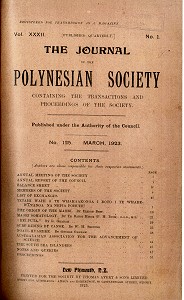
The Journal of Polynesian Society Volume XXXII Number 1. No. 125, March 1923, pages 35 to 37. New Plymouth, New Zealand. Printed for the Society by Thomas Avery. |
| home | catalogue | history | references | appendix |