Agatha Christie : Torquay, Muizenberg, and Waikiki,
1922. Extracts from
Christie, Agatha: An
Autobiography.
Harper Collins, 77-85 Fulham Place
Road, London,W6 8JB, 1997.
and
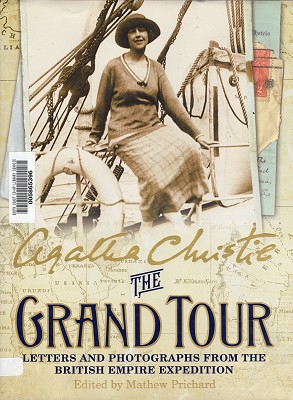
Christie, Agatha: The Grand Tour. Letters and Photographs from the
British Empire Expedition Edited by Matthew Prichard
Harper Collins, 77-85 Fulham Place
Road, London,W6 8JB, 2012.
Introduction. Biographic
Overview:
Agatha Mary
Clarissa Miller, born 15th September 1890.
Married Royal
Flying Corps pilot Archie Christie 24th December 1914.
Only daughter,
Rosalind, born in 1918.
Divorced from
Archie Christie in 1928.
In 1930, Christie
married archaeologist Max Mallowan.
Died 12th January
1976.
Literary
Works.
Often noted as
the best-selling author of books of all time, her output was
prodigious, writing approximately 90 novels (8 under pen
names), 160 short stories and 17 plays.
First novel, The
Mysterious
Affair at Styles, published in 1920.
Many of the
novels have been adapted for film and television.
First film
adaptation, The Coming of Mr. Quinn, released in 1928.
Bathing and
Surfboard Riding.
These reports
provide a unique personal account of sea bathing in England
and surfboard riding in Muizenberg, South Africa, and Waikiki
in the early 20th century.
Agatha Miller
spent her teenage years on the south coast of England around
Torquay where sea bathing was a common practice, initially
with the use of bathing machines.
Christie
describes her experiences with these contraptions, the gradual
acceptance of mixed bathing, changes in swimming attire, and a
near drowning experience.
Foreshadowing
later experiences, she notes "In fact, on a rough day I
enjoyed the sea even more", page 145.
Following
World War I, her husband, Archie Christie, was offered the
position of financial advisor to Major Ernest Belcher, who was
organising a world tour of "the Colonies" to promote the
upcoming British Empire Exhibition, to be held in London in
1924.
Archie and
Agatha embarked on the "Exhibition Expedition" on 20th January
1922, leaving their newborn daughter in the care of Agatha's
mother and sister.
They arrived
at Cape Town, South Africa, on the 6th February and
immediately took to sea bathing at Durban, and were introduced
to prone surfboard riding at Muizenberg.
Also see Source
Documents: 1921 Lord
Hamilton : Surfriding
at Muizenberg, South Africa.
and
Postcards: South Africa, circa
1925, below.
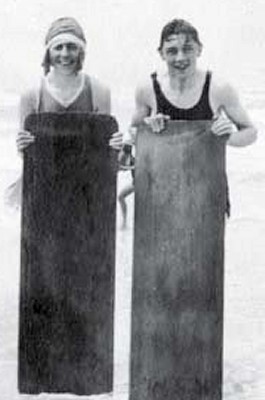
Eric Rosenthal
notes: "Surfboards
were used at Muizenberg in 1904. They were
made by H.W. Porter, a local boat builder, from 2.2 cm (1
in.) pine shelving. The
dimensions were 1.5 m (5 ft.) long by 45 cm (18 in.) wide."
- Rosenthal,
Eric, Total South Africa (Pty) Limited: Total Book of
South African Records.
Delta Books,
1982, page 141.
The party left
South Africa in May 1922 for an extensive tour of Australia
and New Zealand before arriving in Honolulu on 5th August.
Hawaii
Following their
experiences in Muizenberg, the couple enthusiastically took to
surfboard riding at Waikiki, athough the significantly larger
boards and surf proved a rigorous test of their new skills.
As well as
these difficulties, they were affected by a bad case of
sunburn, lacerated feet from the coral, and the
near-destruction of Agatha's silk bathing dress by theWaikiki
surf.
To protect
their feet they purchased soft leather bootsand
Agatha's silk costume was replaced by "a wonderful,
skimpy, emerald green wool bathing dress, which was the joy
of my life, and in which I thought I looked remarkably well",
page 299.
The couple
persisted with the sport, encouraged by the local beach boys
who would tow them out through the break, select a suitable
wave, and retrieve lost boards.
After numerous
sessions, they "learned to become expert, or at any rate
expert from the European point of view", Agatha
reporting a "moment of complete triumph on the day that I
kept my balance and came right into shore standing upright
on my board!", page 299.
After a
lengthy say in the Hawaiian Islands, the "Exhibition
Expedition" arrived in Ottawa, Canada, in October 1922.
Errata
Several
corrections have been made to original upload, following
suggestions by Peter Robinson, Museum of British Surfing, July
2011, many thanks.
Peter also noted:
"Agatha
Christie also wrote about surfing in South Africa in her novel
The Man in the Brown Suit, published in 1924. This would
have been based on her 1922 visit.
For the surfing
passage see The Man in the Brown Suit
(1924) page 150, extract below. Autobiography
Part 1: Sea Bathing at Torquay, circa 1900-1906, pages 142
to 147. Chapter IV: Flirting, Courting, Banns Up,
Marriage.
Page 142
Bathing was
one of the joys of my life, and has remained so almost until
my present age; in fact I would still enjoy it as much as
ever but for the difficulties attendant on a rheumatic
person getting herself into the water, and, even more
difficult, out again. A great
social change came when I was about thirteen. Bathing as I
first remember it was strictly segregated. There was a
special Ladies' Bathing-Cove, a small stony beach, to the
left of the Bath Saloons. The beach
was a steeply sloping one, and on it there were eight
bathing machines in the charge of an ancient man, of
somewhat irascible temper, whose non-stop job was to let the
machine up and down in the water.
You entered
your bathing machine - a gaily-painted striped affair - saw
that both doors were safely bolted, and began to undress
with a certain amount of caution, because at any moment the
elderly man might decide it was your turn to be let down
into the water. At that
moment there would be a frantic rocking, and the bathing
machine would grind its way slowly over the loose stones,
flinging you about from side to side. In fact the
action was remarkably similar to that of a Jeep or Land
Rover nowadays, when traversing the more rocky parts of tIle
desert.
The bathing
machine would stop as suddenly as it had started. You then
proceeded with your undressing and got into your
bathing-dress. This was an
unaesthetic garment, usually made of dark blue or black
alpaca, with numerous skirts, flounces and frills, reaching
well down below the knees, and over the elbow. Once fully
attired, you unbolted the door on the water side. If the old
man had been kind to you, the top step was practically level
with the water. You
descended and there you were, decorously up to your waist. You then
proceeded to swim. There was a
raft not too far out, to which you could swim and pull
yourself up and sit on it. At low tide
it was quite near; at high tide it was quite a good swim,
and you had it more or less to yourself. Having
bathed as long as you liked, which for my part was a good
deal longer than any grown-up accompanying me was inclined
to sanction, you were signalled to come back to shore - but
as they had difficulty in getting at me once I was safely on
the raft, and I anyway proceeded to swim ...
Page 143
... in the
opposite direction, I usually managed to prolong it to my
own pleasure. .
There was
of course no such thing as sunbathing on the beach. Once you
left the water you got into your bathing machine, you were
drawn up with the same suddenness with which you had been
let down, and finally emerged, blue in the face, shivering
allover, with hands and cheeks died away to a state of
numbness. This, I may say, never did me any harm, and I was
as warm as toast again in about three-quarters of an hour. I then sat
on the beach and ate a bun while I listened to exhortations
on my bad conduct in not having come out sooner. Grannie, who
always had a fine series of cautionary tales, would explain
to me how Mrs Fox's little boy ('such a lovely creature')
had gone to his death of pneumonia, entitely from disobeying
his elders and staying in the sea too long. Partaking of
my currant bun or whatever refreshment I was having, I would
reply dutifully, 'No, Grannie, I won't stay in as long next
time. But
actually, Grannie, the water was really warm.'
'Really
warm, was it indeed? Then why are
you shivering from head to I foot? Why are your
fingers so blue?'
The
advantage of being accompanied by a grown-up person,
especially Grannie, was that we would go home in a cab from
the Strand, instead of having to walk a mile and a half. The Torbay
Yacht Club was stationed on Beacon Terrace, just above the
Ladies' Bathing-Cove. Although the
beach was properly invisible from the Club windows, the sea
around the raft was not, and, according to my father, a good
many of the gentlemen spent their time with opera glasses
enjoying the sight of female figures displayed in what they
hopefully thought of as almost a state of nudity! I don't
think we can have been sexually very appealing in those
shapeless garments.
The
Gentlemen's Bathing-Cove was situated further along the
coast. There the
gentlemen, in their scanty triangles, could disport
themselves as much as they pleased, with no female eye able
to observe them from any point whatever. However,
times were changing: mixed bathing was being introduced all
over England.
The first
thing mixed bathing entailed was wearing far more clothing
than before. Even French
ladies had always bathed in stockings, so that no sinful
bare legs could be observed. I have no
doubt that, with natural French chic, they managed to cover
themselves from their necks to their wrists, and with lovely
thin silk stockings outlining their beautiful legs, looked
far more sinfully alluring than if they had worn a good old
short- ...
Page 144
... skirted
British bathing dress of frilled alpaca. I really
don't know why legs were considered so improper: throughout
Dickens there are screams when any lady thinks that her
ankles have been observed. The very
word was considered daring. One of the
first nursery axioms was always uttered if you mentioned
those pieces of your anatomy: 'Remember, the Queen of Spain
has no legs.' 'What does
she have instead, Nursie?' 'Limbs,
dear, that is what we call them; arms and legs are limbs.' All the
same, I think it would sound odd to say: 'I've got a spot
coming on one of my limbs, just below the knee.' ... Bathing-dresses
continued
to be very pure practically up to the time I was first
married. Though mixed
bathing was accepted by then, it was still regarded as
dubious by the older ladies and more conservative families.
But progress was too strong, even for my mother. We often
took to the sea on such beaches as were given over to the
mingling of the sexes. It was
allowed first on Tor Abbey Sands and Corbin's Head Beach,
which were more or less main town beaches. We did not
bathe there - anyway - the beaches were supposed to be too
crowded. Then mixed
bathing was allowed on the more aristocratic Meadfoot Beach. This was
another good twenty minutes away, and therefore made your
walk to bathe rather a long one, practically two miles.
However, Meadfoot Beach was much more attractive than the
Ladies' Bathing-Cove: bigger, wider, with an accessible rock
a good way out to which you could swim if you were a strong
swimmer. The Ladies'
Bathing-Cove remained sacred to segregation, and the men
were left in peace in their dashing triangles.
Page 145
As far as I
remember, the men were not particularly anxious to avail
themselves of the joys of mixed bathing; they stuck rigidly
to their own private preserve. Such of them
as arrived at Meadfoot were usually embarrassed by the sight
of their sisters' friends in what they still considered a
state of near nudity.
It was at
first the rule that I should wear stockings when I bathed. I don't know
how French girls kept their stockings on: I was quite unable
to do so. Three or
four vigorous kicks when swimming, and my stockings were
dangling a long way beyond my toes; they were either sucked
off altogether or else wrapped round my ankles like fetters
by the time I emerged. I think that
the French girls one saw bathing in fashion-plates owed
their smartness to the fact that they never actually swam,
only walked gently into the sea and out again to parade the
beach.
A pathetic
tale was told of the Council Meeting at which the question
of mixed bathing came up for final approval. A very old
Councillor, a vehement opponent, finally defeated, quavered
out his last plea: 'And all I
say is, Mr Mayor, if this 'ere mixed bathing is carried
through, that there will be decent partitions in the bathing
machines, 'owever
low.'
With Madge
bringing down Jack every summer to Torquay, we bathed
practically every day. Even if it
rained or blew a gale, it seems to me that we still bathed. In fact, on
a rough day I enjoyed the sea even more.
Very soon
there came the great innovation of trams. One could
catch a tram at the bottom of Burton Road and be taken down
to the harbour, and from there it was only about twenty
minutes' walk to Meadfoot. ...
Page 146
... Jack and I
nearly drowned ourselves one summer. It was a
rough day; we had not gone as far as Meadfoot, but instead
to the Ladies' Bathing-Cove, where Jack was not yet old
enough to cause a tremor in female breasts. He could not
swim at that time, or only a few strokes, so I was in the
habit of taking him out to the raft on my back. On this
particular morning we started off as usual, but it was a
curious kind of sea - a sort of mixed swell and chop - and,
with the additional weight on my shoulders, I found it
almost impossible to keep my mouth and nose above water. I was
swimming, but I couldn't get any breath into myself. The tide was
not far out, so that the raft was quite close, but I was
making little progress, and was only able to get a breath
about every third stroke.
Suddenly I
realised that I could not make it. At any
moment now I was going to choke. 'Jack,' I
gasped, 'get off and swim to the raft. You're
nearer that than the shore.' 'Why?' said
Jack. 'I don't want to.' 'Please -do
-' I bubbled. My head went
under. Fortunately,
though Jack clung to me at first, he got shaken off and was
able therefore to proceed under his own steam. We were
quite near the raft by then, and he reached it with no
difficulty. By that time
I was past noticing what anyone was doing. The only
feeling in my mind was a great sense of indignation. I had always
been told that when you were drowning the whole of your past
life came before you, and I had also been told that you
heard beautiful music when you were dying. There was no
beautiful music, and I couldn't think about anything in my
past life; in fact I could think of nothing at all but how I
was going to get some breath into my lungs. Everything
went black and -and - and the next thing I knew was violent
bruises and pains as I was flung roughly into a boat. The old
Sea-Horse, crotchety and useless as we had always thought
him, had had enough sense to notice that somebody was
drowning and had come out in the boat allowed him for the
purpose. Having
thrown me into the boat, he took a few more strokes to the
raft and grabbed Jack, who resisted loudly saying, ...
Page 147
... 'I
don't want to go in yet. I've only
just got here. I want to
play on the raft. I won't come
in!' The assorted
boatload reached the shore, and my sister came down the
beach laughing heartily and saying, 'What were you
doing? What's all
this fuss?' 'Your sister
nearly drowned herself,' said the old man crossly: 'Go on,
take this child of yours. We'll lay
her out flat, and we'll see if she needs a bit of punching.'
I suppose
they gave me a bit of punching, though I don't think I had
quite lost consciousness.
'I can't
see how you knew she was drowning. Why didn't
she shout for help ?'
'I keeps an
eye. Once you
goes down you can't shout - water's comin' in.'
We both
thought highly of the old Sea-Horse after that.
Autobiography Part 2: Surfboard riding at
Muizenberg, South Africa, February 1922, pages 292 to 293.
Chapter VI:
Round the World.
Page
292
We
went to Johannesburg, of which I have no memory at
all; to Pretoria, of which I remember the golden
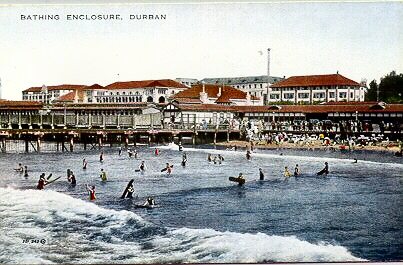
stone of the Union Buildings; then on to Durban,
which was a disappointment because one had to bathe
in an enclosure, netted off from the open sea. The
thing I enjoyed most, I suppose, in Cape Province,
was the bathing. Whenever
we could steal time off - or rather when Archie
could - we took the train and went to Muizenberg,
got our surf boards, and went out surfing together.
Page
293
The
surf boards in South Africa were made of light, thin
wood, easy to carry, and one soon got the knack of
coming in on the waves. It
was occasionally painful as you took a nose dive
down into the sand, but on the whole it was easy
sport and great fun. We
had picnics there, sitting in the sand dunes. I
remember the beautiful flowers, especially, I think,
at the Bishop's house or Palace, where we must have
been to a party. There
was a red garden, and also a blue garden with tall
blue flowers. The
blue garden was particularly lovely with its
background of plumbago.
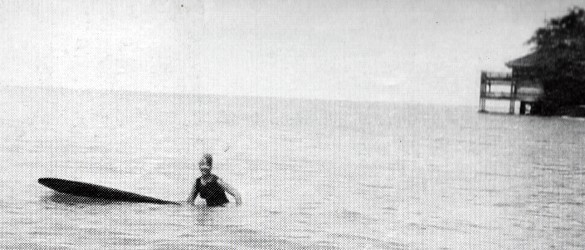
Agatha
Christie and a young naval attaché named
Ashby stand on Muizenberg Beach, South Africa,
following surf bathing,
Jan.-March 1922.
Letters
Page 54: Mount Nelson Hotel, Cape Town,Tuesday 7
February 1922. In the afternoon, I met Archie
at the station and we went to Muizenberg, and surf
bathed with planks!
Very difficult.
We can t do it a bit yet.
But it was lovely there, with a bay of great mountains
coming right down to the sea.
I had no idea there were so many mountains.
And the sea is really hot, the only sea I have ever
known that you don't shiver when you first put your
toes in.
.
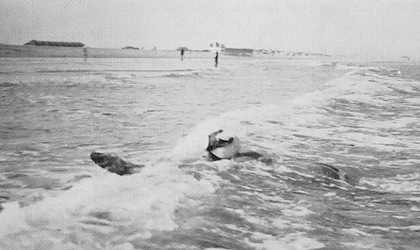
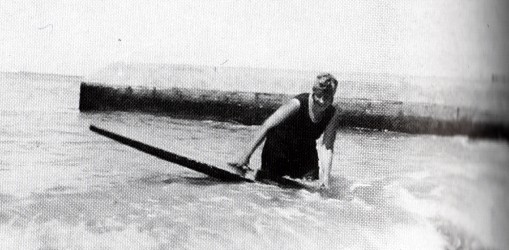
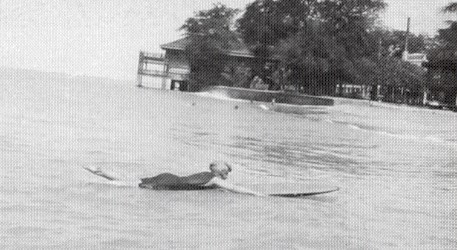
Agatha surfing
at Muizenberg.
Page 61: Mount
Nelson Hotel, Cape Town, Thursday 9 February 1922.
Today is grey and cold.
The Hiams rejoice, but I regret the heat.
Sylvia, I, and the Naval Attache (Ashby) went off to
Muizenberg.
High tide and shelving beach.
I didn't tilt my board up enough,and consequently it stuck in
the sand, and jolted me violently in middle!
I at once loathed surfing!
But recovered shortly.
Ashby was rather good for a first attempt.
Sylvia doesn't bathe, in case she should get sticky!
She snapped us both as we came out 'resting on our boards',
and suddenly a perfectly strange young man bust up, raised his
hat, said to me: 'may I have the pleasure also?' and before I
could reply, 'snapped' me neatly, murmered 'Many thanks' and
retreated again.
Archie came out after lunch, stayed in an hour, and got very
angry because he didn't get one good run!
It was awfully funny to watch him trying so hard, and wave
after wave passing him by.
Page
65: Saturday 11 February 1922. This
afternoon Archie and I went to a place beyond Muizenberg
called Fish Hoek, and bathed.
Its the only place one can swim round here, either its surf
bathing like Muizenberg, or else they have large tanks on the
beach washed by every tide in which you feel rather like a
fish in an aquarium!
This was a lovely little place ringed round with mountains,
white sand beach, and about six little white bungalows on the
mountain (page 66) side.
No bathing huts (and no cover!) but a kind young man offered
us a hutch where he kept fishing tackle, and we had a
delicious bathe.
Nevertheless, swimming is a little tame after surfing!
We are going to buy light curved boards (that don't jab you in
the middle) and absolutely master the art.
Archie loved Fish Hoek, of course, and would much prefer
staying here to going up to Rhodesia.
It is amusing after the crowded beaches in England to come to
a place where when there are ten people and three children on
the beach, you hear someone murmur: 'How terribly crowded it
is today!' Page 76:Friday 17
February 1922
In the afternoon more bathing at Muizenberg, and we bought
surf boards with curved ends - much easier and less painful,
and I believe one could have great fun with them at Paignton
on a rough day.
Page 80: Monday
20 February 1922. A most enjoyable lunch with the Admiral [Goodenough].
... We took some snapshots (page 81)
of the house from the garden and went down to the pier from
which they bathe, and Lady G. looking down into the water
said quietly: 'Ah, I see the Octopus has gone. Such a fine fellow - about 5ft across.' We bathed from the other side of the pier. I never care to bathe close to an octopus!
Page 88: Sunday 26 February 1922
Lunch with Sir Abe Bailey at his house at Muizenberg.
He is quite an old dear.
There were a lot of people there.
I sat next to one of the A.D.C.s and enjoyed myself very
much.
It is a very nice house - also built originally for Rhodes.
We met Mrs Blake afterwards and surfed!
Splendid waves. Autobiography Facing Page 286
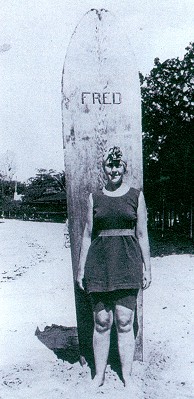
Archie
and myself with our surfboards at Honolulu.
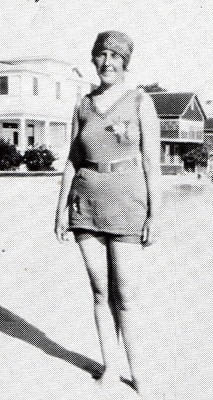
Agatha Christie
in her "wonderful, skimpy, emerald green wool bathing
dress, which was the joy of my life, and in which
I thought I looked remarkably well", page 299.
Autobiography Part 3: Surfboard Riding at
Waikiki, Oahu, August-September 1922, pages 298 to 300.
Chapter VI: Round the World.
Page 298
We had a lazy
voyage, stopping at Fiji and other islands, and finally
arrived at Honolulu. It was far
more sophisticated than we had imagined with masses of hotels
and roads and motor-cars. We arrived in
the early morning, got into our rooms at the hotel, and
straight away, seeing out of the window the people surfing on
the beach, we rushed down, hired our surf-boards, and plunged
into the sea. We were, of
course, complete innocents. It was a bad
day for surfing - one of the days when only the experts go in
- but we, who had surfed in South Africa, thought we knew all
about it. It is very
different in Honolulu. Your board,
for instance, is a great slab of wood - almost too heavy to
lift. You lie on it,
and slowly paddle yourself out towards the reef, which is - or
so it seemed to me - about a mile away. Then, when you
have finally got there, you arrange yourself in position and
wait for the proper kind of wave to come and shoot you through
the sea to the shore. This is not so
easy as it looks. First you have
to recognise the proper wave when it comes, and secondly, even
more important, you ...
Page 299
... have to
know the wrong wave when it comes, because if that catches you
and forces you down to the bottom, Heaven help you! I was not as
powerful a swimmer as Archie, so it took me longer to get out
to the reef. I had lost
sight of him by that time, but I presumed he was shooting into
shore in a negligent manner as others were doing. So I arranged
myself on my board and waited for a wave. The wave came. It was the
wrong wave. In next to no
time I and my board were flung asunder. First of all
the wave, having taken me in a violent downward dip, jolted me
badly in the middle. When I arrived
on the surface of the water again, gasping for breath, having
swallowed quarts of salt water, I saw tny board floating about
half a mile away from me, going into shore. I myself had a
laborious swim after it. It was
retrieved for me by a young American, who greeted me with the
words: 'Say, sister, if I were you I wouldn't come out surfing
today. You take a
nasty chance if you do. You take this
board and get right into shore now.' I followed his
advice.
Before long
Archie rejoined me. He too had
been parted from his board. Being a
stronger swimmer, though, he had got hold of it rather more
quickly. He made one or
two more trials, and succeeded in getting one good run. By that time
we were bruised, scratched and completely exhausted. We returned
our surf-boards, crawled up the beach, went up to our rooms,
and fell exhausted on our beds. We slept for
about four hours, but were still exhausted when we awoke. I said
doubtfully to Archie: 'I suppose there is a great deal of
pleasure in surfing?' Then sighing,
'I wish I was back at Muizenberg.' The second
time I took the water, a catastrophe occurred. My handsome
silk bathing dress, covering me from shoulder to ankle was
more or less torn from me by the force of the waves. Almost
nude, I made for my beach wrap. I had
immediately to visit the hotel shop and provide myself with a
wonderful, skimpy, emerald green wool bathing dress, which was
the joy of my life, and in which I thought I looked remarkably
well. Archie thought
I did too.
We spent
four days of luxury at the hotel, and then had to look about
for something cheaper. In the end
we rented a small chalet on the other side of the road from
the hotel. It was about
half the price. All our days
were spent on the beach and surfing, and little by little we
learned to become expert, or at any rate expert from the
European point of view. We cut our
feet to ribbons on the coral until we bought ourselves soft
leather boots to lace round our ankles.
Page 300
I can't say
that we enjoyed our first four or five days of surfing - it
was far too painful - but there were, every now and then,
moments of utter joy. We soon
learned, too, to do it the easy way. At least I did
- Archie usually took himself out to the reef by his own
efforts. Most people,
however, had a Hawaiian boy who towed you out as you lay on
your board, holding the board by the grip of his big toe, and
swimming vigorously. You then
stayed, waiting to push off on your board, until your boy gave
you the word of instruction. 'No, not this,
not this, Missus. No, no, wait -
now!' At the word
'now' off you went, and oh, it was heaven! Nothing like
it. Nothing like
that rushing through the water at what seems to you a speed of
about two hundred miles an hour; all the way in from the far
distant raft, until you arrived, gently slowing down, on the
beach, and foundered among the soft flowing waves. It is one of
the most perfect physical pleasures that I have known.
After ten days
I began to be daring. After starting
my run I would hoist myself carefully to my knees on the
board, and then endeavour to stand up. The first six
times I came to grief, but this was not painful - you merely
lost your balance and fell off the board. Of course, you
had lost your board, which meant a tiring swim, but with luck
your Hawaiian boy had followed and retrieved it for you. Then he would
tow you out again and you would once more try. Oh, the moment
of complete triumph on the day that I kept my balance and came
right into shore standing upright on my board!
We proved
ourselves novices in another way which had disagreeable
results. We completely
underestimated the force of the sun. Because we
were wet and cool in the water we did not realise what the sun
could do to us. One ought
normally, of course, to go surfing in the early morning or
late afternoon, but we went surfing gloriously and happily at
mid-day - at noon itself, like the mugs we were - and the
result was soon apparent. Agonies of
pain, burning back and shoulders all night - finally enormous
festoons of blistered skin. One was
ashamed to go down to dinner in an evening dress. I had to cover
my shoulders with a gauze scarf. Archie braved
ribald looks on the beach and went down in his pyjamas. I wore a type
of white shirt over my arms and shoulders. So we sat in
the sun, avoiding its burning rays, and only cast off these
outer garments at the moment we went in to swim. But the damage
was done by then, and it was a long time before my shoulders
recovered. There is
something rather humiliating about putting up one hand and
tearing off an enormous strip of dead skin. Letters Page 287:
Donna Hotel Honolulu Saturday 19 August 1922 Dear Mrs Miller I hope you will like the enclosed which I
made mainly for your benefit. The photographs are not very good but I am
sure you will recognise your long lost child. We are having a great time here, bathing
whenever possible. The water is so hot that I shall freeze
when i try and bathe in England again. Quite a relief not to be on the move and
not to be packing and unpacking every day or so. Yours affectionately Archie Christie.
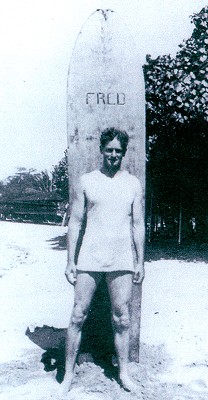
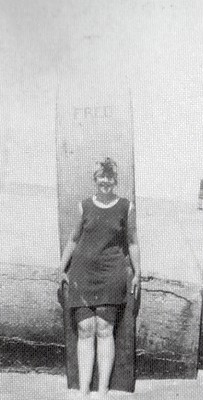
Page 290 This is my faithful board "Fred"
Page 292
I must
introduce you to my
Hawaiian instructor in the art.
Surfing is very easy. You just push your board out
to sea.
Page
291
Sit on it till
a wave comes ... till a wave comes.
And then come in on the wave.
Page 292
And let you into a secret
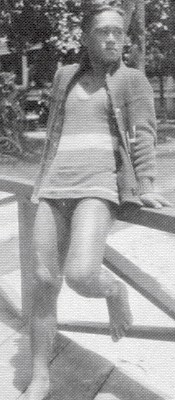
- this is my new surf suit
Page 293: Donna Hotel, Honolulu Undated,
1922
My darling Mum
Still enjoying ourselves, though we've had our
troubles!
The first days bathing so burnt us that we were in
real agony!
Archie was much the worst.
His skin came up in huge blisters all over his back
and shoulders and the backs of his legs.
He could hardly bear his clothes rubbing against it.
There's such a cool breeze all the time you don't
realise the heat of the sun.
But the pavements and roads are red hot, if you have a
hole in your shoe or very thin soles you soon find you
are giving an imitation of ancient Anglo Saxons
walking over the red hot ploughshares.
We have tried all remedies - annointing ourselves with
coconut oil, whitening, peroxide cream etc. Finally A.
has taken to bathing in pyjamas, to the intense
amusement of the natives who roll about in ecstasies
of mirth!
We now bathe only in the early morning and about 4.
The water is lovely, so hot, you could stay in all day
and never feel cold.
Some days there are no breakers at all, and they are
never very big.
Most of the surfers go out to a place where there is a
break in the reef and get the waves there.
I've been out once, towed by an H.G. (abbreviation of
Hawaian Gentleman).
Literally 'towed' - he goes on a board ahead and holds
your board with his toes and pulls it along! Then when
you get out there, he pushes you when a wave is
coming.
It's awfully hard to start yourself.
Our jolly(page 295)friend St Aubyn (an awfully nice lad) cant do it and no more
can Archie, they go out for hours and lie on their boards and
paddle desperately and come back physical wrecks drooping with
fatigue!
Page 293: Donna Hotel, Honolulu, Tuesday
29 August 1922. Darling Mum Just the same old life to talk about. The surf was good the beginning of the week and I took a
'boy' out one day to push me off and got several good runs
standing up like a Hawaian. We have joined the Country Club and had some golf the
other evening, a tremendous shower of'liquid sunshine came
down from the mountains and wet us to the skin - and Archie
has got a bad cold! Also he stayed in the sea too long the beginning of the
week and he's all blistered up and peeled again - back and
shoulders nearly raw again. And I have got a sort of neuritis or strain in my left
arm, can hardly move it and aches terribly. I haven't surfed the last two days it's disappeared
again. You 'paddle' with your arms very vigorously when you
surf, and that does it, I suppose. Our friends the Luckies, also Mrs Minnett and Miss Morton
left on Saturday on the return of the Mazussi for Sydney. We shall miss them. We've had rather fun in the sea together. Really no news, lots of love to you all. Love Agatha
Christie, Agatha:
An Autobiography.
Harper Collins,
77-85 Fulham Place
Road,
London,W6 8JB,
1997.
Christie, Agatha: The
Grand Tour.
Letters and Photographs
from the British Empire Expedition Edited by Matthew Prichard
Harper Collins,
77-85 Fulham Place Road,
London,W6 8JB, 2012.
Extract
from Agatha Christie's
The Man in the Brown Suit (1924)
Page 150
(The novel's heroine, Anne Beddingfeld, follows
several suspicious persons from England to South Africa.
Leaving Cape Town by train, she travels to Muizenberg for, what
she anticipates, is a recreational interlude.)
I put on my best hat (one of
Suzanne's cast-offs) and my least crumpled white linen and
started off after lunch. I caught a fast train to Muizenberg
and got there in about half an hour. It was a nice trip. We wound slowly round the base of
Table Mountain, and some of the flowers were lovely. My geography being weak, I had never
fully realized that Cape Town is on a peninsula, consequently I
was rather surprised on getting out of the train to find myself
facing the sea once more. There was some perfectly entrancing
bathing going on. The people had short curved boards
and came floating in on the waves. It was far too early to go to tea. I made for the bathing pavilion, and
when they said would I have a surf board, I said "Yes, please." Surfing looks perfectly easy. It isn't. I say no more. I got very angry and fairly hurled
my plank from me. Nevertheless, I determined to return
on the first possible opportunity and have another go. I would not be beaten. Quite by mistake I then got a good
run on my board, and came out delirious with happiness. Surfing is like that. You are either vigorously cursing or
else you are idiotically pleased with yourself.
Christie, Agatha: The
Man in the Brown Suit.
Harper Collins,
77-85 Fulham Place
Road,
London,W6 8JB,
2007.
Fascimile edition, first
published in 1924.
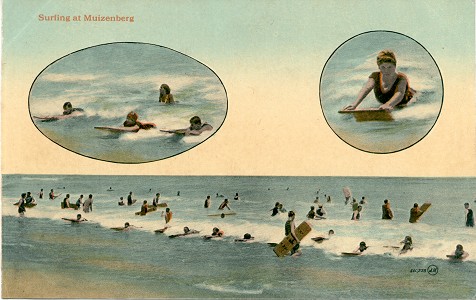
Postcards: South Africa, circa 1925.
Surfing at
Muizenberg, circa 1925.
Valentine and Sons Publishing
Ltd.
PO Box 1685, Cape Town.
British manufacture.
Hand
tinted.
Timber
prone boards, Muizenberg, South Africa.
Bathing Enclosure, Durban, circa
1925.
Valentine
& Sons Publishing Co. (S.A.)
P.O.
Box 1685 Cape Town.
Hand
tinted.
Timber
prone boards, Durban, South Africa.
One
example noted with handwritten message:
"This
is where we going surfing on boards during the
summer time at our Beach. Note the way the
surfboards are put flat on the water & the
force of the waves pushes it along until you
strike the sandy shore. Love from Vi, 1926."