 |
surfresearch.com.au
duke kahanamoku : freshwater 1914 |
| home | catalogue | history | references | appendix |
|
There are surfboards
in the Honolulu Museum - narrow ones, 20ft. in length, and hoary
with age. (7)
But the Hawaiian
of today enjoys what is. perhaps, the most exhilira-ating (sic) and
exciting water sport known with the assistance of a much shorter aid -
one about eight or nine feet long, 2ft. across, and weighing , perhaps
68lb.
The board used
by Kahanamoku weighed 78lb, and was sugar pine.
He would have
preferred redwood , but a properly seasoned piece of that particular timber
, sufficiently long, could not be procured in Sydney.
The necessary
shape is almost that of a coffin lid, with one end cut to very nearly a
point.
The surf riding
board is thicker at the bottom than at the top, tapering all the way. (8)
Kahanamoku's control
of the improvisation was wonderful, he handled it like a toy and went out
fully a quarter of a mile, riding some breakers and dashing through others
with such speed that he completely mystified Messers. W. W. Hill and Hoy
(8a), who entered the water with him.
Mr Hoy can throw
a 100 yards behind in little more than a minute.
Not at any time
in the race seaward did either of the swimmers hold the islander for a
moment, and he soon away by himself. (9)
The Duke lay
flat upon the board, and with arms widespread, paddled his own canoe vigorously.
(10)
Unfortunately
the water was not favorable.
Kahanamoku would
have preferred a long roll.
He had to face
a very short one.
"I'll do my best,
anyhow," said he, and despite that the board was new to him , and he had
never before essayed the task in Australian waters, (11) our visitor gave
an exhibition which won the admiration of spectators who thoroughly understood
the skill of it. (12)
It was a thrilling
spectacle at times.
This finely-built
Hawaiian, with his powerful frame showing elastic muscles, as better and
more enduring than those of a knotty nature, caught the breaker he
wanted , and paddling along for a while rose to one knee first, then became
gradually erect (13.) and reached the crest to shoot foreword with astonishing
speed and marvellous balance considering the troubled condition (14) of
the motive power.
When the force
beneath him was spent, he plunged into the sea, and picking up his board
went off to try again.
Always was the
nose of the raft (10), if it might be so called, kept tilted upwards, whether
while shooting or forced against the breakers.
When the surf
rider found his board hanging he stooped and paddled till it darted forward
once more. (15)
Twice he managed
to traverse 100 yards or more, and several times 20 or 30 yards were covered.
(16)
It could easily
be understood what a display surf riding must be in the ocean which laves
(sic) Waikiki Beach at Honolulu, where a long roll can almost be
depended upon.
There 300 and
400 yards shoots are common.
Kahanamoku does
not profess to be a champion when in his island home, but he is, he says
as good as the very best there. (17)
The ease and
grace of his shooting might be equalled, but it certainly could not be
excelled.
As showing how
much second nature it was to him, Kahanamoku stood on his head a couple
of times, and even turned his back to the direction in which he was going,
and posed. (18)
Lying flat on
the board, the Hawaiian caused it to describe a half-circle or turn completely
round without spoiling the shoot. (19, 20)
2. Reporter
W. F. Corbett joined
The Referee, (a Sydney sporting paper) in 1888,
where he reported boxing, swimming, lawn bowls and both codes of rugby.
He moved to the
Sydney Sun in 1913. (Source -Rabbitoh Warren)
After a journalistic
career of 37 years, he died in 1923, aged 67.
(Source -the Bulletin,
Sydney, 1 November, 1923)
3. The opening
sentence implicitly criticized NSW Swimming officials who prevented the
demonstration scheduled for the previous day, much to the disappointment
of an a crowd estimated between 2000 - 3000 people.
See Corbett's report,
The
Sun, December 23, 1914, page 5.
4. Only a small number of obsevers were present, compared to the large crowds reported, and shown in photographs, of later demonstrations.
5. The demonstration was with the board only, apparently enthusiasts were also anxious to see Duke Kahanamoku's body surfing skills.
6. The ancient origins of board riding is noted, information probably provided (and emphasised) by Duke Kahanamoku.
7. The boards
reported as held by the Bishop Museum probably refers to those ridden at
Wakiki in the 1830's by high chief Abner Paki and eventually restored by
Tom Blake in the late 1920's.
See #502
8. The
specifications appear very close to being correct, unlike many subsequent
versions.
Note the misreporting
of specifications in SMH report of 25th December.
The weights of the
Freshwater board and Duke Kahanamoku's reported Hawaiian board appears
reasonable.
The Freshwater board
was made from imported sugar pine, which had some use for surfboard construction
in Hawaii in this period.
8a. Hoy, possibly a printers error for Harry Hay.
9. Demonstrated a surfboard's paddling superiority over swimming.
10. Several
various terms are used - board, surf riding board,
canoe and raft.
The term surf
board is not used
11. This demonstration
is noted as Duke Kahanamoku's first test of board and Australian waves.
Doubt that Hawaiian
boardriding was possible in local waves had been previously expressed by
Australian swimming and/or surfing officials .
Evidently, Duke
Kahanamoku did not.
It would also seem
unlikely that he had not body surfed in Australia before this date.
12. The reporter
demonstrates some surf knowledge, particularly in noting the unsuitability
of the conditions.
More importantly
he notes the knowledge of the spectators "who thoroughly understood
the skill of it."
13. The importance of wave choice and rudimentary take-off instructions.
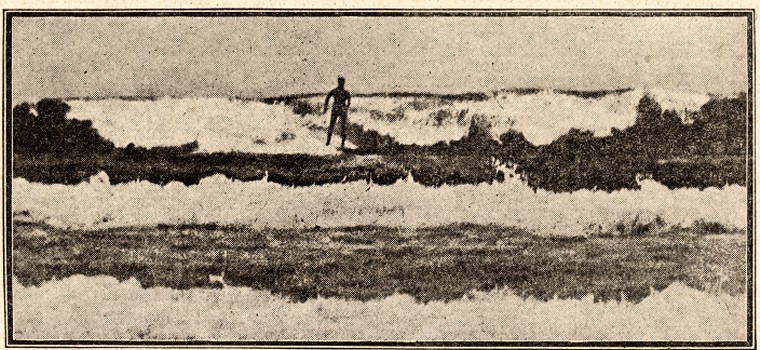
14. Probably
refers to a uneven swell or even choppy surface conditions, as indicated
by photograph by the Daily Telegraph, 25th December, 1914.
Image below.
There is no estimation
of wave height.
15. Further
rudimentary instructions...
- the dismount
- keeping the nose
elevated when paddling and riding.
- adjusting stance
to maintain trim
16.
Appears to indicate cutting- that isangling across the wave,
as opposed to riding straight towards the beach.
Rides of 100 yards
are considered substantial by modern standards.
17. While aware of his own abilities, Duke Kahanamoku indicates that his skills are not exceptional and are attainable by others.
18. A spectatular demonstration of skill.
19. The manoeuvre
"Lying
flat on the board, the Hawaiian caused it to describe a half-circle or
turn completely round without spoiling the shoot." appears
to describe a prone spinner, a manoeuvre popularized by Boogie boarders,
circa 1980.
Possibly performed
in the white water (wave of transition), and also noted in the SMH
report of 25th December. is not mentioned in any other contemporary accounts
of surfing.
"He turned
completely round, then lying flat on the board, he raised himself on his
hands and swung the board from front to back and back to front, finally
again standing straight up." .
.
20. Although
often noted in later reports, there is no mention of tandem riding, Isobel
Letham or the Manly surfboat.
The
Daily Telegraph
Friday
25 th December 1914 page 7.
Kahanamoku
entered the water with the board accompanied by Mr. W. W. Hill (Secretary
of the
Australian Swimming
Union) and some members of the Freshwater Surf Club. Lying flat on the
board
and using his
arms like paddles the champion soon left the swimmers far behind.
When he was about
400 yards out he waited for a suitable breaker, swung the board round and
came
in with it.
Once fairly started,
Kahamamoku knelt on the board, and then stood straight up, the nose of
the
board being well
out of the water.
But the force
of the breakers never carried him more than 50 yards.
On a couple of
occassions he managed to shoot fully 100 yards and then he cleverly demonstrated
what could be
done.
He turned completely
round, then lying flat on the board, he raised himself on his hands and
swung
the board from
front to back and back to front, finally again standing straight up.
If the condition
of the water is favourable when Kahanamoku makes his public appearance
in
surfboard riding
in Sydney it is sure to be keenly appreciated.
2. This demonstration
is noted as the first. It appears to be a test of Australian waves, board
and rider, and was
not greatly publicised.
There have may been
some doubt by Australian swimming and/or surfing officials that Hawaiian
boardriding was possible in local waves. Evidently, Duke Kahanamoku did
not.
3. The reporter demonstrates some surf knowledge, particually in noting the unsuitablity of the conditions.
4. The difference
in weight between the Freshwater board and Duke Kahanamoku's reported Hawaiian
board
is questionable,
unless the latter was of Koa, a lightweight native timber.
The Freshwater board
was made from imported sugar pine, which was in use that for surfboard
construction in Hawaii in this period.
5. Demonstrated a surfboard's paddling superioity over swimming.
6. The manoeuvre
"He turned completely round, then lying flat on the board, he raised himself
on his hands
and swung the board
from front to back and back to front, finally again standing straight up."
is unclear but
seems to describe
a prone spinner, a manoeuvre popularized by Boogie boarders, circa
1980.
Possibly performed
in the white water (wave of transition), it is not mentioned in any other
comtemporary accounts of
surfing.
7. There is
no mention of tandem riding, Isobel Letham or the Manly surfboat.
The
Referee
30
December 1914, page 16.
Record entries
have been received for the year's State championships.
Two are to be
decided at the initial carnival, which is to be held at the Domain Baths
next Saturday afternoon, namely the 100yds and 880yds.
The Olympic champion,
Duke Kahanamoku, and his brilliant travelling companion, George Cunha,
are competing in the former event.
It will be their
first public appearance in competition.
Incidentally,
it will consitute the first occasion that an overseas champion has ever
raced in Australia.
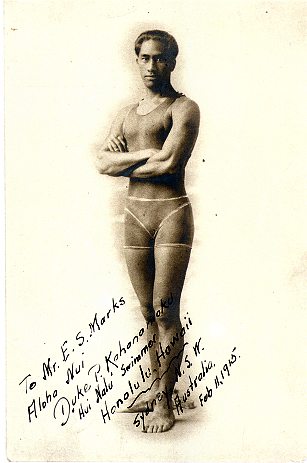 |
E. S. Marks was prominant in Sydney sports. Sydney's premier athletic track is named The E.S. Marks Field. Postcard reproduced from private collection. |
| home | catalogue | history | references | appendix |