 |
surfresearch.com.au
newspapers : 1914 |
| home | catalogue | history | references | appendix |
|
ACCIDENTS AT YAMBA
Although
two
minor accidents occurred at Yamba, during the holidays, it
is pleasing
to know that no accidents with accidents with fatal
results happened.
Miss
Blaxland,
a young Grafton lady, was the victim of a nasty accident.
While
playing
on the rocks in the vicinity of the beach she fell and
sustained a nasty
cut on the hand.
She was
taken
to the resuscitation room of the Life Saving Brigade, where
a stitch, was
inserted and the wound dressed by Dr Deithelm, of Grafton,
who, fortunately,
happened to be surfing at the time of the accident.
The doctor
spoke
most highly of the Life Saving rooms and was very pleased to
see such a
valuable collection of first aid materials, all of which
were absolutely
necessary and effective
Mr. Busch,
South
Grafton manager of the Bank of Australasia, was also the
victim of a painful
accident, sustaining a nasty cut on the cheek bone, which,
it is believed,
was inflicted by a surf board in the surf on Saturday last.
This case
was
treated in the town and materials necessary for such were
given by the
Life Saving Brigade.
Surf boards,
especially when used amongst such a crowd as was surfing
during the holidays,
are a most undesirable menace to surfers, beside being one
continual menace
to the safety of those who do not use them.
-"Advocate."
Trove
1914 'ACCIDENTS
AT YAMBA.', Northern Star (Lismore, NSW : 1876 - 1954), 1
January, p. 8,
viewed 4 June, 2012,
http://nla.gov.au/nla.news-article72284684
SWIMMING.
SATURDAY'S
EVENTS.
DEE
WHY SURF CARNIVAL.
MANLY
WlÑS BIG EVENT.
The Dee Why
Lifesaving
and Surf Club held its first annual carnival on Saturday at
Dee Why Beach.
There was in
attendance of about 3000.
Nine clubs
were
represented in the grand parade and march past which was a
very creditable
display.
Cronulla
Club
was awarded the prize.
The
principal
event was the rescue and resuscitation competition for the
Gardiner Cup
held by the Manly Lifesaving Club but handed to that body to
Deewhy for
competition.
Five teams
entered
and Manly Club retained it with 432 (?) points.
The surf
relay
race was won by North Steyne represented by I. Solomons and
L. V. Hind
North Steyne
also won the novice surf race and several of the beach
events.
Only two
competitors-
Miss Leatham and Miss Abrahams- started in the ladies surf
race.
The latter
however
gave up before the shore was reached, and had to be rescued.
Another
sensational
incident occurred in the surf race.
One of the
competitors
(C. Knight of Deewhy Club) was rescued and brought lo shore
in an exhausted
state, and several minutes lapsed before animation was
restored
Results -
...
Ladies Surf
Race-
Miss Leatham (Freshwater) 1, Mrs Abrahams (Brookvale) also
started.
SWIMMING RACES SURPRISE MANY
The
swimming events
at Honolulu Saturday morning resulted in one great surprise,
and that was
the defeat of Champion Duke Kahanamoku in the 50-vard -race
by Bob Small,
of California.
Duke,
however,
"delivered the goods", in the long distance races, Miss Ruth
blacker won
out in the race for women, and Miss Legros, also of
Honolulu, came in second.
Following
were
the principal events and the results:
440-yard:
Duk
e Kahaiiamoku (H. N.), first; Lincoln Johnson, (unattached),
second; F.
Kruger (H.), third.
Time 5 min.
46
2-5 sec.
100-yard: D
u
ke Kahannmoku (H. N.), first; E. R. Small (unattached),
second; Geo. Cunha,
third.
Time 54 4-5
seconds.
Lowered
Hawaiian
record by two fifths of a second.
50-yard: E.
R.
Small (unattached), first; Duke Kahanamoku (H. N.), second;
Geo. Cunha
(H.), third.
Time 23 2-5
sees.
Equals
world's
record.
880 yard:
Walter
Pomroy (O. C.), first; G. Keaweamahi (H. N.) second; Fred B.
Arnold (H.
NJ, third.
Time: 13
min.
24 sees.
220 yard:
Duke
Kahanamoku (H. N.), first; George Cunha (H.) second; Lincoln
Johnson, (Y),
third.
Time 2 min.
35-15
sec.
50-yard (for
women): Ruth Stacker (H. A.), first; Lucille LeGros (U.),
second; Miss
Lane third.
Time 31 1-5
sec.
1 mile:
Walter
Pomeroy (O), first; George Keaweamahi, (H. N.). second;
George Hushnell,
(H.), third.
Time 26 min.
49 1-5 sec.
Lowered
Hawaiian
record by 55.45 secs.
440-yard
relay:
Hui Nalu team, Hustace, Kaupiko, Holstein and Kahanamoku;
first; Healani
team, F. Kruger, Wodehouse. H. Kruger
and G. Cunha
second: Pacific only Coast team, McWood, Leary, ociiuitz and
Small, third.
Time 4
min. 5 3-5 sees.
The Garden
Island.
(Lihue, Kauai, H.T.) 1902-current, February 24, 1914, Image
1
Image and text
provided
by University of Hawaii at Manoa; Honolulu, HI
Persistent
link:
http://chroniclingamerica.loc.gov/lccn/sn82015411/1914-02-24/ed-1/seq-1/
LATEST
OUTSIDE NEWS
BY
MAIL AND WIRELESS
Page 8
Continued from page 1.
HAWAII LOSES IN RELAY
The Garden
Island.
(Lihue, Kauai, H.T.) 1902-current, July 07, 1914, Image 1
Image and text
provided
by University of Hawaii at Manoa; Honolulu, HI
Persistent
link:
http://chroniclingamerica.loc.gov/lccn/sn82015411/1914-07-07/ed-1/seq-1/
The Garden
Island.
(Lihue, Kauai, H.T.) 1902-current, July 07, 1914, Image 8
Image and text
provided
by University of Hawaii at Manoa; Honolulu, HI
Persistent
link:
http://chroniclingamerica.loc.gov/lccn/sn82015411/1914-07-07/ed-1/seq-8/
SWIMMING.
KAHANAMOKU'S
VISIT.
PATRIOTIC
HANDICAP.
The large
entry
for the association's patriotic handicap on Saturday
necessitated seventeen
heats, even though more than thirty entrants had previously
notified their
intention of not starting.
The result
showed
that ii. M'Ghlo (Sydney) had been very liberally treated by
the handicapper.
He has only
competed
in two races this season, and has won both, and his rapid
improvement foretells
greater achievements in the future.
M'Ghie
presented
the amount of the first prize to the association's patriotic
fund.
The
afternoon,
therefore, showed a profit to the fund of £10 entry
fees and
£2 10s, the donation of first prize, while the trophies,
totalling
£5 3s, were presented by Mr. James Taylor, president of the
association.
The swimming
generally was remarkable for the fact that the trudgeon
stroke was only
nei-n iB «bout tbrojp Instancif, wbj__e Ljie number o,
exponents
of the "Kahanamoku" kick were numerous.
Some of the
handicap
men gave the back-markers surprises, and it was not unusual
for the scratch
man's time to be beaten by swimmers to whom he was conceding
a start.
A. W. Barry
was
tho speediest performer with 24 4-5s. ,
The Sydney,
Manly,
and Woolwich clubs held events on Saturday afternoon, but
the majority
of the organisations postponed their fixtures.
The
premiers'
furlong handicap for the W. W. Hill cup provided some
excellent racing,
in which handicapper Barry, nicely gauged the competitors.
The fine
showing
of the sprint champion, together with Thomas, Lovy, and
Duff, added interest
to the race, the final going to the last named after a most
spirited contest.
Manly
carried
out a popular race relay handicap, the entry fees of which
are to be handed
to the Association's Patriotic Fund.
The
programmes
for the three-days State championship carnival on January 2,
6, and 9 have
been issued.
The 300
yards
and haft mile championships will be contested the first
day, 440
yards (free style), and 220 yards breast stroke at the
second meeting,
and the 100 yards teams race, 220 yards, and diving at the
final gala.
Several
diving
competitions from the high and low spring-boards and high
tower, and intérclub
handicaps, enter for all classes of swimmers.
The occasion
will provide the first appearance of D. P. Kahanamoku, and
the council
of the association ís leaving no stone unturned in arranging
for
what is expected to bo the greatest day in the history of
the sport in
this country.
A paid
assistant
organiser is to be employed, under the instructions of
the executive,
several members of which have had wide experience in
promoting such functions.
The members
of
the association have been invited to send suggestions in to
headquarters
for consideration.
The scheme
includes
some new features for swimming carnivals, while the comfort
of the spectator
is to be studied in every possible way.
With that
end
in view- the City Council has been approached in regard to
increased seating
accommodation, a better carriage approach to the entrance,
and the lowering
of the raill for the gallery, which is rather awkwardly
situated for front-row
patrons.
A special
free
display is to be given to school children during
Kahanamoku's visit, and
already the patronage of many prominent citizens is assured.
Besides
appearing
in the early January functions, the famous visitor will also
show at various
other centres after his return from Brisbane.
However, the
three occasions mentioned will be his last appearances at
the Domain Baths.
An
arrangement
is being completed by which opportunity will be given to
surf patrons to
view his work with the board on our ocean beaches.
It is
proposed
that he should appear at Newcastle, Goulburn, Forbes,
"Parramatta, and
Drummoyne.
Mr. F.
Cummins,
selector of the Metropolitan District Harris Cup team,
notifies that a
test race will be hold al the Domain Baths. Clubs eligible
to send representatives
are Sydney, Y.M.C.A., Palace Emporium.
SWIMMING
(By
Cecil Healy)
Kahanamoku
and the Dominion.
The New
Zealand
Association has arranged a tour of the Dominion for Duke
Kahanamouku.
Definite
assurances
to that effect have been cabled (to) Mr. W. W. HllI, the
hon. secretary
of Australian Union.
It was also
advised
in this message that the required guantees had been
forwarded per mail.
The
financial
responsabilities of New South Wales and Queensland will, of
cause, be considerably
lightened in consequence of the itinerary being made to
embrace Maori-land.
This in
itself
would be cause enough to rejoice.
But I think
we
should be even more delighted to know that the sport in that
part of the
world will stand the same excellent chance of being advanced
in popularity
and prestige as it will here.
For the same
reason it cannot but occasion us sincere regret to meditate
upon the disappointing
attitude so far taken up by the administrators of the sport
in Victoria
and South Australia as regards this unique opportunity,
particularly in
the case of the former State, for raising organised swimming
from the slough
of despond into which it has sunk in the course of the last
year or two.
The
experience
they have gone through down south, no doubt, was calculated
to damp enthusiasm.
When it is
remembered;
however, that Queensland and New South Wales conjointly
agreed to reduce
the liabilities involved to a minimum, one cannot help being
impressed
with the fact that the negotiations have revealed, on the
part of the controlling
officials, a more than justified lack of enterprise and
pluck.
Presuming,
for
the sake of argumment, their pessimistic estimation of the
celebrated Hawaiian's
ability to arouse interest, say, only sufficient to enable
them to partially
refill their depleted exchequer, is not an exaggeration of
the position
of affairs, it is difficult to imagine how it wijj ever be
possible for
them to liquidate their debts.
It is, at
any
rate, comforting to be aware that hope has not yet been
abandoned that
some means will be found of ensuring Kahanamoku's appearance
in Melbourne
and Adelaide.
CUNHA ANOTHER SPEEDY MAN.
Our
thoughts have
been so much occupied with the "Duke" that it has quite
escaped attention
that provision has been made for him to be accompanied by,
as the stipulation
reads, "a swimming companion," in addition to a manager.
This role is
almost certain to be filled by another Hawaiian, who, it is
somewhat of
a relief to know, does not lay claim to any such fearsome
and difficult-to-be-pronounced
surname as his famous fellow-countryman.
He is a
performer
of some repute, and his name is Cunha.
He has made
a
trip or two to America as one of the Duke's entourage, and
has distinguished
himself by finishing second to his compatriot in numerous
events.
His
speediest
effort in public over the hundred appears to be 57sec, and
he consistently
swims 50yds in the vicinity of 25sec.
Cunha, like
the
Duke, is a natural swimmer, and it therefore goes without
saying he will
be thoroughly at home under our open-water conditions.
Although, as
I have already stated, I believe Longworth will be seen to
the very best
advantage from 220yds onwards, I do not expect that either
he or Barry
will break 58sec in the race for the hundred yards
premiership.
Longworth
has
a championship swim of 56 4-5sec to his credit, but he was
sprinting exceptionally
well that year.
Albert
Barry,
the present holder of both State and Australasian titles and
Commonwealth
record (56 3-5sec) , has never yet bettered the figures
quoted in an actual
struggle for supremacy.
A
two-seconds-less-than-the-
minute pertormance has mostly been what was demanded to win
the honors.
That being
so,
I am prepared to maintain that the probability is Cunha will
be runner-up
in the contests over sprint distances.
Cunha should
be especially useful for exhibition purposes at places where
the Duke performs
and there is no local talent available capable of making any
sort of showing
against him.
Kahanamoku,
World's Swimmer
Expected
in Sydney Next Week : By CECIL HEALY
Before our
next
issue appears the ship conveying Duke Paoa Kahanamoku and
travelling companion
is expexted to enter Sydney Heads.
The
prospective
visit of the celebrated Hawaiian has been the chief topic of
discussion
amongst swimmers for months past.
During the
course
of negotiations followers of the sport were confused
by successive
conflicting and doubtful situations.
Great was
their
relief, therefore, when it was known definitely that he
would be leaving
Honolulu on the 30th.
Their
chagrin
immediately changed into an all-engrossing curiousity, and
speculation
as to what this natatorial Paladin is really like has since
been aggitating
their thoughts.
As the due
date
of his arrival (Monday next) draws nigh, so does the excited
state of enthusiasts'
feelings become more apparent.
The
circumstances
vividly recall Stockholm, and the perturbations members of
the Olympic
team underwent as the s.s. Finland, with the "Duke"
and other American
representatives on board, hurried in the direction of that
port.
We knew,
instinctively
or otherwise, that Kahanamoku was the individual we had most
cause to fear.
A name is
not
supposed to be of any significance, but we were not then
familiar with
the Hawaiian nomenclature and I rather think this was a
factor in keeping
him in our dread as an opponent.
It had been
rumored
time and again that the Finland had reached her destination,
and we began
to greet such anouncements with the same contempt as war
scares nowdays.
But I
recollect
one or other of our party one afternoon suddenly bursting
into the room
with the startling infirmation, "He's here! I've seen him!"
There was no
necessity for any further explanation as to whom the
reference applied.
Where we
were
staying was only a short distance from the "Swim Gladeon",
as it was called,
and when our informant told us the Duke was still in the
water when he
left, we immediately rushed off in hopes of catching a
glimpse of him.
He was
standing
on the side of the enclosure just about to take a plunge.
The first
thought
that occured to me, after I caught sight of him, was that he
was not as
pleasant-featured a man as Alick Wickham, nor was there
anything prepossessing
about his physique.
He was tall
and
somewhat lanky in build.
No sooner
had
he entered the water, however, than we were spellbound with
admiration
of the fish-like rapidity with which he cleaved the element.
He worked
his
feet - which we had not failed to observe were unusually
large - after
the style of propellers.
The
disturbance
made by his leg movement increased the likeness.
When we came
to study his action more critically we noticed he placed his
arms in rather
an unattractive way.
But this
imperfect
was forgotten, almost as soon as noted, because we were
unconiously impressed
with the fact that in this instance, as regards any
aesthetic flaw it might
be possible to detect in his stroke, it was a case of
handsome is that
handsome does.
DUKE'S ATTRACTIVE PERSONALITY.
On closer
aquaintance
we found the Duke, as we soon began to to term him, a very
friendly man.
He was
particualy
obliging in the matter of giving exhibitions for our special
edification
or illustrating any feature of his stroke.
He speaks
English
well, with American mannerisms of a mild description.
One of the
first
things we were anxious to find out was whether the title
"Duke" was an
aristocratic appendage, or merely a term of endearment.
We
discovered
he had not inherited the distinction, but that his pals had
conferred it
upon him, probably because they considered him a prince of
good fellows.
Kahanamoku
quickly
installed himself a general favorite.
This
reputation
was confirmed as the competition progressed.
After the
first
couple of rounds of the 100 metres, it was realised the
result was a forgone
conclusion, and his fame was firmly established.
Although he
was
the cynosure of all eyes, and was attracting far more
attention than any
of the great exponents who were displaying their prowess
there, his notoriety
never had the slightest effect on the Duke's deportment, his
demeanor being
invariably modest and unconcerned.
A Mr.
Darnell,
of London, a liberal donor to the Royal Life-Saving Society,
who came across
with Mr. William Henry, carried away by wonderment of the
marevellously
fast performances the Duke was registering, and as an
incentive for him
to strive to the full extent of his powers offered to
present kahanamoku
with a 25-guinea cup in the event of him touching 60sec for
the said distance.
That the
suggestion
was not preposterous was shown by his having covered the
course at Hamburg,
a few days subsequent to the Games, in 61 3-5sec, which now
consitutes
the existing world record.
Sixty-two
three-fifths
was acually the closest he got to the mark at Stockholm.
The task
set for
him by Mr. Darnell was responsible for the Duke swimming a
badly-judged
race in the final, which enabled me to get much nearer to
him at the finish
than would have otherwise happened.
I overheard
the
manager of the American team, Mr. Otto Wahlde, remark to
Kahanamoku, on
the way to the post:
"Now, Duke,
this
is the last chance you've got for the Englishman's trophy."
As a result
of
this admonition, no doubt, the Hawaiian started off at a
terrific pace.
He shot away
from the rest of us like a hydroplane.
I saw a
streak
of foam disappearing over my horizon.
That was
enough.
I
concentrated
my worries elsewhere.
But after
the
motorist had traversed about 90yds he ran short of petrol,
and his form
loomed up again in my vision.
This
occurrence
simply electrified me, and minimised my own impending
tiredness.
There was
another
incident that that occupies a conspicuous niche in my memory
of what took
place on that historical occasion.
It was
enacted
on the starting platform.
The King and
Queen of Sweden and other members of the Royal family were
in attendance.
The sale of
tickets
had been stopped by the police.
Every
available
inch of space was filled by by the expectant crowd.
As can be
imagined,
the moment was one of intense excitement.
We had been
allotted
our stations, and the spectators duly advised of our
identity and the countries
we represented.
Just as we
were
about to assume a crouching attitude, Bretting, the German
representative,
left his post, at the opposite end of the line to where
Kahanamoku and
myself were placed.
Not a a few
of
his countrymen, it might be mentioned, had unbounded
confidence in his
ability to seriously dispute the issue with the Hawaiian.
Bretting
walked
straight up to the Duke, shook hands with him, turned to me
and did likewise
(he had picked up the crawl from seeing me swim in Hamburg
six years previously),
and, retraced his steps.
I had not
yet
recovered from my astonishment at this proceedure when the
Duke's voice
broke in:
"Say, Healy,
he must think he is going to deliver the goods."
The comment
struck
me at the time as being immensely funny, and an involuntary
peal of laughter
escaped me before I collected my wits sufficiently to make
the rejoiner:
"Then
blessed
is he who expecteth nothing."
KAHANAMOKU AND PARTY
Mr. W. W.
W. Hill,
hon. secretary of the Australian Swimming Union, has
received a cable from
Mr W.T. Rawlins, president of the Hawaiian Amateur Athletic
Union, stating
that Duke Paoa Kahanamoku, Francis Evans and George Cunha
left on Honolulu
on the Ventura on November 30.
Francis
Evans
is evidently the manager of the party, and has taken Mr
Rawlin's place
as it was expected that the enthusiasts had done most in the
development
of Kahanamoku would come in charge of the team.
George Cunha
is also famous as sprint swimmer and has secured many
seconds to his companion.
He has
covered
the hundred yards in 57 seconds and the 50 yards in 24
seconds, and it
is quite possible that both first and second place may go to
the visitors
in the hundred yards championship.
KAHANAMOKU.
CHAMPION
SWIMMER ARRIVES
WILL
TAKE PART IN STATE CHAMPIONSHIPS.
Duke Paoa
Kahanamoku,
the world's champion swimmer over 100 metres arrived here
from Honolulu
by the R.M.S. Ventura yesterday.
He was
accompanied
by Mr. Francis Evans as manager, and Mr. George Cunha, an
American resident
of Honolulu, who is also a splendid performer in the water.
Kahanamoku,
who
is a native of Honolulu, is 26 years of age.
He is a
splendid
specimen of manhood standing, 6ft 1in. and weighing 12st
8lb.
He is the
undoubted
sprint champion of the world.
At the
Olympic
Games at Stockhom in 1912 he won the 100 metres championship
in 61 3-5s
establishing a world's record that has never since been
equalled.
Australia's
best
time for a similar distance is 64 4-5s.
Kahanamoku,
though
a sprinter, swims all distances up to 440 yards.
In his
stroke,
his arm work is similar to that in Austialia, but his "kick"
or "foot-
work" differs from ours.
He has a
special
"kick" of his own ; one that has won him renown, and has
been called "the
Kahanamoku kick."
The feet
revolve
like the blades of a steamer's propellor, and the champion
gets up wonderful
speed. In fact, he has been called "the flash," for he
streaks through
the water over the shorter distances at a tremendous pace.
Kahanamoku
has
arrived here to take part in the State championships on
January 2,
6, and 9 next, in the Domain baths, when among his opponents
will be Longworth
and Barry, two Sydney swimmers who have already astonished
Australasia.
Both have
splendid
records, and by beating them Kahanamoku will have beaten our
best.
After the
Sydney
swimming carnival, the champion goes to Queensland, where he
will appear
at several towns.
Then he
returns
to Sydney, and will give a second display.
On this
occasion
the Swimming Union will probably in arrange for a surf
display, when the
champion will be seen on the surf-board.
Matters in
this
direction have not yet been finally arranged.
Then the
champion
will proceed to the Dominion.
Victoria, on
the score of expense, has declined a visit.
Duke
Kahanamoku
has arrived here early, so as to acclimatise himself, and
thoroughly train
for the championships.
He will make
no public appearance nor take part in any events, until
January 2, when
he will be seen at his best.
George
Cunha is
credited with 57s for 100 yards, our best being but
two-fifths faster.
Any
performer
who can do this will always be a dangerous opponent in the
water.
Yesterday
afternoon
a large gathering met at the Hotel Australia to give the
visitors a hearty
welcome. Mr. J. Taylor, president of the union, presided.
In proposing
the health of the visitors, the chairman said Kahanamoku was
the first
Olympic champion to visit our shores.
The
association
for many years had endeavoured to bring to Australia
champions of other
countries to measure blades, as it were, with our own
swimmers in our own
water, and under our own conditions.
Though they
had
sent teams to the Olympic Games, and also to contest the
English championships,
it had remained to Kahanamoku to be the first champion to
come here and
measure his strength with our champions.
He expressed
the hope that the visitors' stay would be a pleasurable one.
They could
rest
assured of fair-play in all their contests, and
he felt sure
they would get the same treatment from the champion.
(Cheers.)
Mr. H. Y.
Braddon
said it was a good thing for these events to take place.
Because of
the
terrible struggles they were engaged in, there had been an
inclination
to put off such events, but they all meant work for someone
or another,
and personally, he thought it a good thing to hold them.
Mr. C. W.
Oakes
also spoke.
Mr. Evans
conveyed
the best wishes of the Hawaiian swimmers to the Australians
for their kindly
invitation.
Their
reception
had been only such as befitted the greatest sport-loving
country of the
world.
When their
visit
was over, it would be said the best man had won.
Duke
Kahanamoku
said he had been looking forward to this visit for the last
two or three
years.
He was glad
to
see many faces he had seen at the Olympic Games at
Stockholm.
He would do
his
best to win ; that was all be could do.
Mr. Cunha
also
replied.
The
Duke Reaches Sydney
Impressed
by Baths : Distance Events : The Surf Board : By Cecil
Healey
The Duke is
here.
The
celebrated
Hawaiian and companions reached Sydney by the Ventura on
Monday.
A big
gathering
of prominent swimmers and officials awaited the steamer's
arrival at the
wharf.
Many others,
however, myself included, who were anxious to be present to
greet the visitors
when the stepped ashore, were misinformed as to the time the
ship was due,
and thus prevented from carrying out that intention.
The party
consists
of Kahanamouku, Mr. Francis Evans, manager, and Cunha,
another swimmer
or repute.
To the
suprise
of all, Cunha is not an Hawaiian native as was thought, but
a white man.
He was born
at
Honolulu and is of Portuguese-Irish descent.
Both he and
Mr.
Evans are short, slightly built men.
They look
small
by contrast alongside the Duke, who stands over 6ft.
The
tourists were
officially welcomed at the Hotel Australia at 5 o'clock on
Monday afternoon.
Followers of
the sport congregated in great force.
It was the
largest
and most representative assembly of natatorial enthusiasts
ever seen in
Sydney.
The guests
were
recorded a magnificent reception, the hero of the occasion,
Duke, of course,
being specifically signalled out.
The
president
of the N.S.W.A.S.A., Mr. James Taylor, who presided, in
proposing the health
of the visitors, remarked thatthe controlling body had
endeavored unsuccessfully
in the past to secure the presence of champions from other
parts of the
world to measure blades, as it were, with Australians under
their own conditions.
It had
remained
for the Olympic champion, Duke Kahanamoku, to be the first
accredited International
swimmer to visit these shores.
The toast was supported by Messrs. H. Y. Braddon and C. W. Oakes, and drunk with enthusiasm and cordiality.
In
replying, Mr.
Evans conveyed the best wishes of the Hawaiian sportsmen to
Australians
for their kindly invitation..
He stated
that
Mr. Rawlins was extremely sorry at not being able to
undertake the journey.
He explained
that Mr. Rawlins had recently been elected a member of the
legislature
and he was debarred on that account from making the trip.
Their
reception
had been such as only benefited the greastest sports-loving
country in
the world.
The
chairman's
announcement of the Duke's name was responsible for a great
burst of cheering,
which continued after he had risen to his feet.
Kahanamoku
did
not portray signs of self conciousness.
He faced his
audience calmly, and spoke deliberately.
He said he
had
been looking forward to visiting Australia for the last two
or three seasons,
and felt sure he was in for a good time.
Cunha also
made
a few observations.
None of the
party,
as a matter of fact, revealed a perchant for public
speaking.
All my
glowing
impressions of the Duke (as a man) were re-established.
I had
managed
to get a chance to shake hands and have a chat with him.
He is a
splendid
dispositioned fellow, and I cannot concieve the thought of
anyone taking
other than an instant liking for him.
I make bold
to
predict that he will have ingratiated himself into the
affections of a
large number of Australians before departing on his homeward
voyage.
I could not
detect
any alteration in his appearance.
He says he
feels
well, and his looks do not belie him.
The Ventura
struck
it pretty rough about 24 hours before she entered the
harbour, but the
travellers weathered the storm without suffering any dire
consequences.
THE DUKE HAS IMPRESSIONS.
They found
time
since landing to have a dip at the Domain Municipal baths.
"What do you
think of them, Duke?" I enquired.
"Gee!
They're
just fine, and the water's great," was the prompt rejoiner.
I then asked
: "Do you intend to compete beyond the quarter-mile?"
This
interrogation
made the Hawaiian's big black eyes expand and sparkle, and
he answered,
with an accompanying broad smile : "I want to look the bunch
over first
before deciding."
He told me
he
had partcipated in a few, but not a great many, lengthy
races the past
year or two.
He
apparently
does not plan to be a long-distance champion.
THE SURF BOARD FOR THE BEACHES.
We had
begun to
get reminiscent about Stockholm, when I recollected
something I was particualy
anxious to know.
Simultaneously,
I
exclaimed : "Oh! Did you bring your surf board with you?",
to which he
replied:
"Why no, we
were
told the use of boards was not permitted in Australia."
Evidently
noticing
the look of keen disappointment on my face, he quickly
added:
"But I can
easily
make one here."
This information, I am sure, both swimmers and surfers will be delighted to be acquainted with, as holding out prospects of the acquirement of the knack of manipulating them.
I have not
as
yet seen Cunha in the water, but Longworth, who I consider
an excellent
judge, assures me he is a flyer; at least, that is the
estimation he formed
of him after watching him play about in the element for a
while on Monday.
Cuhuna is
not
at all unlike Percy McGillivary, who, next to the Duke, was
perhaps the
most prominent member of the American Olympic team.
I enquired
of
Mr. Evans if the voyage across in the Ventura was
uneventual.
"Not
altogether,"
was his comment; "we lost a propeller," which made me
anxiously question,
"Not one of the Duke's, surely?"
Mr. Evans
was
happy to state the Duke was still of the twin-srew variety.
Bye the bye,
Mr. W. W. Hill enlightens me as to how Kahanamoku came to be
called "Duke."
His birth
corresponded
with the visit of the Duke of Cummerland to Honolulu, and he
was christened
so in honour of that event.
The visitors
were located at the Oxford Hotel.
 |
 |
|
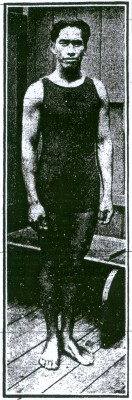
The fastest swimmer in the world, photographed at the Sydney Domain Baths two hours after his arrival in Sydney. |
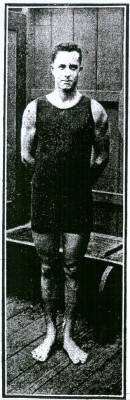
He secured second place in most of the Pacific Coast Championships, and can do 100yds in 57sec. He is one of the Honolulu party now in Sydney. |
SWIMMING.
KAHANAMOKU'S
ARRIVAL.
GOOD
LOCAL FORM.
It was
demonstrated
on Saturday, in the club events, that our champions will be
at the best
condition to meet the famous Hawaiian visitor.
Albert Barry
probably put up the best swim of his career over ??? metres
by covering
the distance in 64 4-5s, (Australasian record).
Owing to the
large crowd at the Domain Baths, the water was disturbed,
and Barry was
interfered with by the spectators and competitors during his
swim.
He should
still
do better, and Kahanamoku will meet him at his best.
Longworth
also
showed excellent form in winning the 200 yards event at Rose
Bay in the
fast time of 2m. 14 4-5s.
The late
Barney
Kieran's best over this distance was 3m. 11s.
It will be
seen
that the swim was full of merit.
Three
carnivals
will be held tonight.
Randwick and
Coogee will hold the Harris Cup 800yds teams' race at Coogee
baths; and
William Longworth wiII defend his title in the Eastern
District 880yds
championship against S. Smith, who is swimming particularly
well just now.
The chief
event
at the Abbotsford carnival will be the Western District
Championship, and
Woolwich club will hold its first gala in aid of the
Patriotic Fund of
the district.
The
Melbourne
club is sending what is practically a Victorian
representative team of
swimmers to meet the Sydney club in the annual contests at
the Domain baths
on Saturday.
In the
breast-stroke
they have always been successful.
The
quarter-mile
event promises to be a very open swim between T. W.. Mason
(ex-champion
of Victoria), L. and F. Grieve (representing Melbourne), and
L. Boardman,
C. Thomas, and G. Levy, who will appear on behalf of the
local club.
The diving
contestants
will be N. Griffith (champion of Victoria), A. Sauter (who
will represent
Melbourne), and L. Boardman, L. McCarthy, and A. V. Barry,
of Sydney.
Included in
the
Sydney Club's programme is the 880yds President's Cup
handicap, and the
entrants are notified that the heats will take place
to-morrow night, at
the Domain baths, at 8 p.m., and the final on Saturday.
A special
meeting
of the council of the A.S.A. will be hold on Friday evening
to discuss
the question of diving at the Kahanamoku carnivals.
Previously,
at
State championship carnivals, displays have been arranged by
the best divers,
but on this occasion the committee have arranged for a
competition to be
held each day.
Only two
entries
have been received for the A grade polo competition, and
three for the
B grade.
The
disappointing
response to the association's efforts led the polo committee
to make a
recommendation for the cancellation of the competitions this
year, but
it has been decided, by a very close vote, to go on with the
arrangements.
...
The arrival
of
Kahanamoku and party by the Ventura last Monday has formed
the completing
a link in the great swimming celebrations, which are to take
place in Sydney
on January 2, 6 and 9.
It is the
first
time that Australia has entertained an international
swimmer, and as as
the present visitor is the world's best exponent, it makes
the occasion
the more memorable.
Duke Paoa
Kahanamoku
will find greater opposition in Sydney than any other part
of the globe,
and the entertainment at the Domain Baths should compare
favourably with
any other swimming function that has been held elsewhere.
George
Cunha,
who is accompaning Kahanamoku as swimming companion, is a
performer of
very high merit over distances from 50 to 220 yards, and has
he has covered
the 100 yards in 57 s, it is just possible that is possible
that he may
also outclass our best exponents in the sprint championship.
Francis
Evans
is manager, and has acted on several occasions with Mr
Rawlins on tour
with the Hawaiian teams in America.
They are
members
of the Hui Nalu Club, and the party will attend the Randwick
and Coogee
gala to-night, and Sydney- Melbourne contest on Saturday.
SWIMMING.
SURF
DISPLAY BY KAHANAMOKU.
The New
South
Wales Swimming Association has arranged for a display by
Duke Paoa Kahanamoku
at Freshwater on Wednesday morning, at 11 o'clock.
The famous
swimmer
will give an exhibition of breaker shooting and board
shooting.
DISTRICT NEWS
The fourth
annual
carnival under the auspices of the Yamba Surf Life-saving
Brigade is to
be held at Yamba on New Year's Day.
A unique and
interesting programme bas been arranged, which includes
championship swimming
events, etc.
An
exhibition
of shooting the breakers with the aid of a board is to be
given by Mr.
T. Walker, who has had considerable experience on other
well-known beaches.
Trove
1914 'DISTRICT
NEWS.',
Clarence and Richmond Examiner (Grafton, NSW : 1889 - 1915),
22 December,
p. 2, viewed 9 June, 2012,
http://nla.gov.au/nla.news-article61640169
KAHANAMOKU CARNIVALS
The fine
swimming
in the Sydney Melbourne club contests forecasts a strenuous
and exciting
time in connection with the Kahamamoku carnivals.
...
Next Tuesday
the association will hold an exhibition for school-children
throughout
the metropolitan area.
The city
council
has granted them the free use of the gallery and 5000
tickets have been
issued to the schools.
The program
will
include exhibitions by Duke Paoa Kahanamoku and George Cunha
(Hawaii),
Ivan Steadman (Victoria), and our best local exponents
Kahamamoku
has
decided not to compete in the longer distances.
He is not a
distance
or middle distance swimmer.
However, on
this
tour he has agreed to swim in all championships up and up to
and including
the quarter-mile; and will appear in the hundred yards on
January 2,
440 yd. on January 6 and 220 yd. on January 9.
His
companion,
Geo. Cunha, will swim in the 100 yards and the 220 yards
events on the
two Saturdays, and will swim in the first-class handicap on
the mid week
gala.
Probably an
attempt
will be made on the 50 yards or 75 yards record, or a teams
relay race
over 220 yd., two men each racing 110 yards, will be
arranged.
The matter
will
be settled within the next day or so by the executive of the
A.S.A.
The second
is
the termination of the Melbourne club to compete at the
carnivals is gratifying....
The
Australian
Swimming Union received a cable message from the
secretary-treasurer of
the Amateur Athletic Union of United States, through the
Hawaiian Athletic
Association, vouching for the amateur standing of George
Cunha and the
Duke Kahamamoku, and granting them permission to compete in
Australia.
A similar
statement
asked for by the United States Athletic Union regarding the
understanding
of the Australian swimmers, was cabled.
FAST-
SWIMMING.
KAHANAMOKU
DID NOT SHOW.
100
YARDS CHAMPIONSHIP
(BY W. F.
C.
CORBETT.)
The
swimming authorities
have heard that through the publication of a paragraph
yesterday to the
effect that Kahanamoku would give an exhibition in the surf
at Freshwater,
Manly, some 2000 or 3000 people who assembled there to watch
the show were
disappolnted.
The famous
Hawaiian
did not put in an appearance, and he was not expected to do-
so by those
controlling his visit to this country.
The
association
wishes it to be made knownn that the "Duke's" first
appearance in publlc
will take place on the openlng day (January 2) of the
championship carnival
at the Municlpal Baths, Domain.
The
announcement
of any other arrangement with Kahanamoku as the central
flgure has not
that body's authority.
Longworth,
Barry,
and Cunha (Kahanamoku's companion) put up some speedy
performances In the
Municipal Baths, Domain, yesterday.
Longworth
covered
440 yards in 5min. 30sec., Barry got over 110 yards in 1min.
2sec., which
is only 3-5 seconds slower than Kahanamoku's world's 100
metres (slightly
less than 110 yards) record,
accomplished
at the Olympic Games held in Stockholm, two years ago.
Barry, it
might
be mentloned, is being trained in gymnasium work by Mr.
Snowy Baker, for
the forthcoming contests which are sure to excite world-wide
interest.
Cunha's
contribution
to the swimming sensations of yesterday was 100 yards in
57sec.
Entrles for
the
several events In connectlon with the approaching
championship meetlng,
have closed, and are unusually numerous.
Mr. Hay, the
association organiser for the carnival, spent the whole day
Monday and
the greater part of the night receiving them.
Those who
will
compete for the 100 yards honors are:- Duke Paoa Kahanamoku,
George Cunha,
W. Longworth. A. Barry, L.O. Solomons, H. M. Hay, G. Wyld,
J. Huie, Tas
Jones, E. G. Finlay, J. Stedman. B. G. Page.
WONDERFUL
SURF RIDING
KAHANAMOKU
ON THE BOARD.
A
THRILLING SPECTACLE
(BY
W. F. CORBETT.) (2)
One could
hear
, in the imagination the roars of applause with which
thousands of Australians
might have greeted Kahanamoku 's display at Freshwater,
Manly, this morning,
had the fact that it was to take place been made public. (3)
As it was
there
were only a few pressmen, some members of the New South
Wales Amateur Swimming
Association, and the casual Freshwater bathers present. (4)
The Hawaiian
confined his show to riding the breakers with the aid of a
board (5), such
as been used in his native islands from time immemorial. (6)
There are
surfboards
in the Honolulu Museum - narrow ones, 20ft. in length,
and hoary
with age. (7)
But the
Hawaiian
of today enjoys what is, perhaps, the most
exhilira-ating (sic) and
exciting water sport known with the assistance of a much
shorter aid -
one about eight or nine feet long, 2ft. across, and
weighing, perhaps,
68lb.
The board
used
by Kahanamoku weighed 78lb, and was sugar pine.
He would
have
preferred redwood , but a properly seasoned piece of that
particular timber
, sufficiently long, could not be procured in Sydney.
The
necessary
shape is almost that of a coffin lid, with one end cut to
very nearly a
point.
The surf
riding
board is thicker at the bottom than at the top, tapering all
the way. (8)
Kahanamoku's
control
of the improvisation was wonderful, he handled it like a toy
and went out
fully a quarter of a mile, riding some breakers and dashing
through others
with such speed that he completely mystified Messers. W. W.
Hill and Hoy
(8a), who entered the water with him.
Mr Hoy can
throw
a 100 yards behind in little more than a minute.
Not at any
time
in the race seaward did either of the swimmers hold the
islander for a
moment, and he soon away by himself. (9)
The Duke lay
flat upon the board, and with arms widespread, paddled his
own canoe vigorously.
(10)
Unfortunately
the
water was not favorable.
Kahanamoku
would
have preferred a long roll.
He had to
face
a very short one.
"I'll do my
best,
anyhow," said he, and despite that the board was new to him
, and he had
never before essayed the task in Australian waters, (11) our
visitor gave
an exhibition which won the admiration of spectators who
thoroughly understood
the skill of it. (12)
It was a
thrilling
spectacle at times.
This
finely-built
Hawaiian, with his powerful frame showing elastic muscles,
as better and
more enduring than those of a knotty nature, caught
the breaker he
wanted , and paddling along for a while rose to one knee
first, then became
gradually erect (13.) and reached the crest to shoot
foreword with astonishing
speed and marvellous balance considering the troubled
condition (14) of
the motive power.
When the
force
beneath him was spent, he plunged into the sea, and picking
up his board
went off to try again.
Always was
the
nose of the raft (10), if it might be so called, kept tilted
upwards, whether
while shooting or forced against the breakers.
When the
surf
rider found his board hanging he stooped and paddled till it
darted forward
once more. (15)
Twice he
managed
to traverse 100 yards or more, and several times 20 or 30
yards were covered.
(16)
It could
easily
be understood what a display surf riding must be in the
ocean which laves
(sic) Waikiki Beach at Honolulu, where a long roll can
almost be
depended upon.
There 300
and
400 yards shoots are common.
Kahanamoku
does
not profess to be a champion when in his island home, but he
is, he says
as good as the very best there. (17)
The ease and
grace of his shooting might be equalled, but it certainly
could not be
excelled.
As showing
how
much second nature it was to him, Kahanamoku stood on his
head a couple
of times, and even turned his back to the direction in which
he was going,
and posed. (18)
Lying flat
on
the board, the Hawaiian caused it to describe a half-circle
or turn completely
round without spoiling the shoot. (19, 20)
2. Reporter
W.
F. Corbett joined
The Referee, (a Sydney sporting paper) in 1888,
where he reported boxing, swimming, lawn bowls and both codes
of rugby.
He moved to the
Sydney Sun in 1913. (Source -Rabbitoh Warren)
After a
journalistic
career of 37 years, he died in 1923, aged 67.
(Source -the
Bulletin,
Sydney, 1 November, 1923)
3. The
opening
sentence implicitly criticized NSW Swimming officials who
prevented the
demonstration scheduled for the previous day, much to the
disappointment
of an a crowd estimated between 2000 - 3000 people.
See Corbett's
report,
The
Sun, December 23, 1914, page 5.
4. Only a small number of obsevers were present, compared to the large crowds reported, and shown in photographs, of later demonstrations.
5. The demonstration was with the board only, apparently enthusiasts were also anxious to see Duke Kahanamoku's body surfing skills.
6. The ancient origins of board riding is noted, information probably provided (and emphasised) by Duke Kahanamoku.
7. The
boards
reported as held by the Bishop Museum probably refers to those
ridden at
Wakiki in the 1830's by high chief Abner Paki and eventually
restored by
Tom Blake in the late 1920's.
See #502
8.
The
specifications appear very close to being correct, unlike many
subsequent
versions.
Note the
misreporting
of specifications in SMH report of 25th December.
The weights of
the
Freshwater board and Duke Kahanamoku's reported Hawaiian board
appears
reasonable.
The Freshwater
board
was made from imported sugar pine, which had some use for
surfboard construction
in Hawaii in this period.
8a. Hoy, possibly a printers error for Harry Hay.
9. Demonstrated a surfboard's paddling superiority over swimming.
10.
Several
various terms are used - board, surf
riding board,
canoe and raft.
The term surf
board is not used
11. This
demonstration
is noted as Duke Kahanamoku's first test of board and
Australian waves.
Doubt that
Hawaiian
boardriding was possible in local waves had been previously
expressed by
Australian swimming and/or surfing officials .
Evidently, Duke
Kahanamoku did not.
It would also
seem
unlikely that he had not body surfed in Australia before this
date.
12. The
reporter
demonstrates some surf knowledge, particularly in noting the
unsuitability
of the conditions.
More
importantly
he notes the knowledge of the spectators "who
thoroughly understood
the skill of it."
13. The importance of wave choice and rudimentary take-off instructions.
14. Probably
refers
to a uneven swell or even choppy surface conditions, as
indicated
by photograph by the Daily Telegraph, 25th December,
1914.
Image below.
There is no
estimation
of wave height.
15. Further
rudimentary
instructions...
- the dismount
- keeping the
nose
elevated when paddling and riding.
- adjusting
stance
to maintain trim
16.
Appears
to indicate cutting- that isangling across the
wave,
as opposed to riding straight towards the beach.
Rides of 100
yards
are considered substantial by modern standards.
17. While aware of his own abilities, Duke Kahanamoku indicates that his skills are not exceptional and are attainable by others.
18. A spectatular demonstration of skill.
19. The
manoeuvre
"Lying
flat on the board, the Hawaiian caused it to describe a
half-circle or
turn completely round without spoiling the shoot."
appears
to describe a prone spinner, a manoeuvre popularized by
Boogie boarders,
circa 1980.
Possibly
performed
in the white water (wave of transition), and also noted in the
SMH
report of 25th December. is not mentioned in any other
contemporary accounts
of surfing.
"He
turned
completely round, then lying flat on the board, he raised
himself on his
hands and swung the board from front to back and back to
front, finally
again standing straight up." .
.
20. Although
often
noted in later reports, there is no mention of tandem riding,
Isobel
Letham or the Manly surfboat.
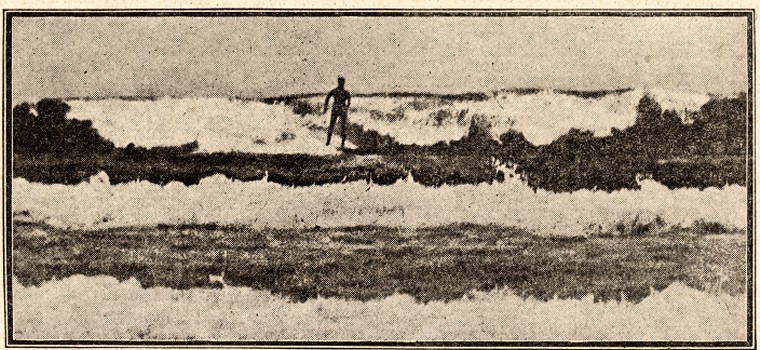
ACROBATICS IN THE SURF.
SURF-
BOARD RIDING.
KAHANAMOKU'S
DISPLAY
At the invitation of the N.S.W Amateur Swimming Association a number of newspaper representatives, accompanied some of the officials to witness an exhibition of surf-board riding by Duke Paoa Kahanamoku, the world's champion sprint swimmer, at Freshwater yesterday (Thursday 24th December 1914).
It was
Kahanamoku's
first attempt at surf-board riding in Australia, and it must
be admitted
it was wonderfully clever.
The
conditions
were against good surfboard-riding.
The waves
were
of the 'dumping' order and followed closely one on top of
another.
According to
the champion, board-riding on the Waikiki Beach, Honolulu,
is a pleasure
and there it is possible to shoot in over a quarter of a
mile.
Then too,
Kahanamoku
was at disadvantage with the board.
It weighted
almost
100lb, whereas the board he uses as a rule weighs less than
25lb.
But, withal,
he gave a magnificent display, which won the cordial reponse
of the onlookers.
Kahanamoku
entered
the water with the board accompanied by Mr. W. W. Hill and
some
members of the Freshwater Surf Club. Lying flat on the board
and using
his arms like paddles the champion soon left the swimmers
far behind.
When he was
about
400 yards out he waited for a suitable breaker, swung the
board round and
came in with it.
Once fairly
started,
Kahamamoku knelt on the board, and then stood straight up,
the nose of
the board being well out of the water.
But the
force
of the breakers never carried him more than 50 yards.
On a couple
of
occassions he managed to shoot fully 100 yards and then he
cleverly demonstrated
what could be done.
He turned
completely
round, then lying flat on the board, he raised himself on
his hands and
swung the board from front to back and back to front,
finally again standing
straight up.
If the
condition
of the water is favourable when Kahanamoku makes his public
appearance
in surfboard riding in Sydney it is sure to be keenly
appreciated.
2. This
demonstration
is noted as the first. It appears to be a test of Australian
waves, board
and rider, and was
not greatly
publicised.
There have may
been
some doubt by Australian swimming and/or surfing officials
that Hawaiian
boardriding was possible in local waves. Evidently, Duke
Kahanamoku did
not.
3. The reporter demonstrates some surf knowledge, particually in noting the unsuitablity of the conditions.
4. The
difference
in weight between the Freshwater board and Duke Kahanamoku's
reported Hawaiian
board
is
questionable,
unless the latter was of Koa, a lightweight native timber.
The Freshwater
board
was made from imported sugar pine, which was in use that
for surfboard
construction in Hawaii in this period.
5. Demonstrated a surfboard's paddling superioity over swimming.
6. The
manoeuvre
"He turned completely round, then lying flat on the board, he
raised himself
on his hands
and swung the
board
from front to back and back to front, finally again standing
straight up."
is unclear but
seems to
describe
a prone spinner, a manoeuvre popularized by Boogie
boarders, circa
1980.
Possibly
performed
in the white water (wave of transition), it is not mentioned
in any other
comtemporary accounts of
surfing.
7. There is no mention of tandem riding, Isobel Letham or the Manly surfboat.
(Advertising)
FOURTH
ANNUAL
GRAND
AQUATIC CARNIVAL AT YAMBA, NEW YEAR'S DAY,
YAMBA SURF
LIFE
SAVING BRIGADE.
SWIMMING.
Trove
1914
'SWIMMING.',
Clarence and Richmond Examiner (Grafton, NSW : 1889 - 1915),
29 December,
p. 7, viewed 4 June, 2012,
http://nla.gov.au/nla.news-article61640449
Clarence
and Richmond
Examiner and New England Advertiser.
Grafton,
Tuesday
7 September 1880
THE
CLARENCE
ELECTORAL DISTRICT, 1880
...
Walker
Samuel,
Chatsworth
Walker
William,
Yamba
Walker
Charles,
Chatsworth
Trove
1880 'THE
CLARENCE
ELECTORAL DISTRICT, 1880.', Clarence and Richmond Examiner and
New England
Advertiser (Grafton, NSW : 1859 - 1889), 7 September, p. 4,
viewed 4 June,
2012, http://nla.gov.au/nla.news-article62117648
SWIMMING
: Kahanamoku in 100yds Championship
:
by CECIL HEALY
KAHANAMOKU
AND SURF BOARD
Representatives
of
the Press were invited to witness a private exhibition of
surf-board
riding by Kahanamoku at Freshwater on Thursday.
It was to
have
been the previous day, but the intention accidentally became
public property,
and as several thousand people were attracted to the
vicinity, Association
officials decided to postpone it.
Business
considerations,
unfortunately, prevented the writer from being present.
Freshwater
enjoys
the reputation of being, on the whole, the best beach for
shootable breakers,
but the conditions, I understand, were far from being ideal
on that particular
day.
The waves,
for
instance, were breaking too lose to the shore to permit of a
good "run'
being obtained, and, moreover, were of the "dumping"
variety; also the
board itself, which was made locally, was not exactly what
was required.
It weighed
in
the neighbourhood of 100lb, whereas those in use at Honolulu
are only a
quarter that weight.
However,
despite
the disadvantages mentioned, the Duke succeeded in assuming
the perpendicular,
and negotiating several shoots in his familiar poster
attitude.
One one
occasion,
whilst laying flat on the board, with a deft movement he
swung the board
right about, and proceeded backwards for a while before
repeating the action
and facing shorewards again.
A number of
our
leading surfers were spectators of the display, and from
what I can gather
the general impression amoungst them was that he did
wonderfully well under
the circumstances, but they feel sure it merely amounted to
an indication
of what he is capable of doing under more favorable
conditions.
They have no
doubt that when he has the opportunity to adapt himself to
the vagaries
of our surf, and strikes a suitable day, he will be able to
do things of
a really sensational nature.
The dextrous
manner in which he handled the heavy board when taking it
out through the
breakers would appear to have greatly suprised the Sydney
men.
Record
entries
have been received for the year's State championships.
Two are to
be
decided at the initial carnival, which is to be held at the
Domain Baths
next Saturday afternoon, namely the 100yds and 880yds.
The Olympic
champion,
Duke Kahanamoku, and his brilliant travelling companion,
George Cunha,
are competing in the former event.
It will be
their
first public appearance in competition.
Incidentally,
it
will consitute the first occasion that an overseas champion
has ever
raced in Australia.
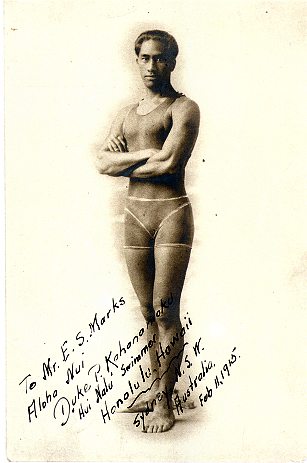 |
E. S. Marks was prominant in Sydney sports and was a member of the Manly Surf Club in 1910. S and G Champion (2000) page 134. Sydney's premier athletic track is named The E.S. Marks Field. Postcard reproduced from private collection. |
| home | catalogue | history | references | appendix |