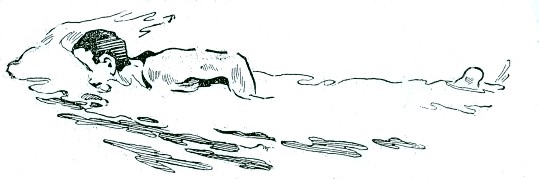
pods
for primates : a catatogue of surfboards in australia since 1900
 |
surfresearch.com.au
healy : tuppa tup-pala,
1913
|
|
Cecil Healy : Tuppa
Tup-pala, 1913
Extract
from
Healy, Cecil: Tuppa Tup-pala - Otherwise
Known as the Crawl Stroke.
The Sunday Times, Sydney, 1913,
page?.
Introduction.
An authorative and
eridite analysis of the development of the Crawl technique that repudiates
the contention that the stroke was "invented" by Western exponents, principaly
members of the Cavill family in Australia circa 1900.
For an earlier exposition
of the Trudgeon stroke, see:
1902 J. A. Jarvis : The
Trudgen Stroke.
Extracts from The Art of Swimming,
Hutchinson and Co., Paternoster Row, London, 1902.
This document was provided courtesy of Ray Moran at the Australian Surfing
Museum and Manly SLSC.
Page
?
TUPPA
TUP-PALA
OTHERWISE KNOWN
AS THE CRAWL STROKE.
A STYLE OF SWIMMING
PECULIAR TO THE SOUTH SEAS.
A
NEW AND STARTLING VERSION OF ITS ORIGIN.
FOR THE "SUNDAY
TIMES" BY CECIL HEALY.
Mr. Cecil Healy,
who gives his opinions here for the "Sunday Times" readers, is the man
most qualified in the whole world to speak on the theory and practices
of the crawl stroke.
He is one of
the pioneers of it in Australia, and has been the means of introducing
it and producing champions in Germany, belgium, France, Italy and all over
the Continent, as well as in Australia, and for six years was un-beaten
over the 100 yards in this continent.
It is with reluctance
that I give my opinions on the origin and developmentof the crawl stroke.
In my opinion
there is not the slightest shadow of doubt that the Cavill family were
the first to demonstate the potentialities of it as a means of attaining
speed in the water, and they were the first to introduce it into competitive
swimming and bring it under the notice and attention of the civilised world.
But I cannot
be reconciled to the idea that they were the actual inventors of the principle
of swimming in this fashion because there is ample evidence to prove that
it was
IN VOGUE
AMOUNGST THE SOUTH SEA ISLAND NATIVES
as far back as the
memory of some of the oldest traders will take them, and in all probability
has been used by them in more or less crude form for generations past.
In any discussion
of the the subject, the first thing to arrive at what really is the difference
between the "crawl" and, say, the "trudgeon" stroke.
To my mind it
merely applies to the leg movement, and the position in which the body
is held, and that the method of using the arms does not affect the fundamental
principle of any stroke at all.
Now, for instance,
in
THOUSANDS
OF DIFFERENT WAYS,
or, rather, variations,
in the way of using the arms in the "trudgeon," or double overarm, or,
for that matter, any other stroke.
In fact it might
be said that no two swimmers in the world actually swim any given stroke
alike in every particular.
Yet they all
come under the one heading, and rightly so, because althoughthe details
are different, the principle nethertheless is the same in each case.
Arguing on this
basis, I maintain that the stroke which others and myself swim to-day over
short or long distances, although it differs in many respects from the
way Dick Cavill swam, is undoubtedly of the same "specie," and cannot be
classed other than the same category.
The crawl stroke,
to-day, in its perfected form is perhaps as much unlike the style of the
Cavills in the early days as the modern motor is to the first car turned
out.
Alec Wickham,
the well know and popular Rubiana native, who, as anyone who has anything
to do with him will agree, is an intelligent and truthful natured boy,
not given to romancingor handling the truth carelessly, has often assured
me that all boys and girls, including his brothers and sisters in the Solomon
Islands, swim in the same way that he does - that is to say, they "crawl."
His father, a
retired trader, has also informed me that it is called there "Tuppa-tup-pala,"
and as long as he can remember the stroke was always used amoungst tribes
who inhabit that part of the world.
In fact they
do not know any other way to swim except by means of the breast stroke.
When in Stockholm
I questioned Kahanamoku, the marvelous Hawaiian, as to how he came to swim
in the way he does.
"Did anyone teach
you?" I asked, and he seemed amused at the enquiry.
He distinctly
told me that he had never received tuition at anyone's hands, and, moreover,
it had come quite natural to him.
I watched him
scores of times in the water, and never detected him using any other method.
I should not
at all been suprised if he is unable to kick scissor fashion, or "Trudgeon-wise."
This information
can be easily verified in other quarters, and as far as I can see it practically
does away with the belief that the Cavills were the "inventors" of the
method of propulsion known throughout the civilised world to-day as the
"crawl" stroke.
I certainly admit
that they were the "discoverers" in the same sense that Fred. Williams
discovered how to "shoot the breakers" by watching a South Sea native do
it, or that Captain Cook discovered Australia for the white men.
They never invented
their new found things anymore than did the Cavills, in swimming in the
way they did, hit upon something unknown to mankind previously.
I do not think
we can get away from the fact, much as it "hurts" that the crawl stroke
is really
NOTHING MORE
THAN A "GLORIFIED DOG PADDLE."
It is to the "dog
paddle" what baseball is to the old game of rounders.
Another arguement
against the theory that the principle of the stroke was concieved in the
brains of the Cavills is the fact that the first time most youngsters are
put in the water their limbs prescribe their movements.
Many children
who are not properly instructed swim "doggy" all their lives.
But, as everyone
knows, the idea of swimming in this way was denounced and ridiculed, and
children were "spanked" by their parents if they were not able to get out
of doing it.
This was before
the Cavills "discovered" and populatised the improved and up-to-date edition,
and gave a practical demonstration of its possibilities.
The whole history
of its origin, growth, and development amounst whitemen supplies another
instance of "nothing succeeds like success."
Alick Wickham's
brother, who was a pupil at Newinton College, swam the stroke over in Balmain
at least 17 years ago, Alick tells me.
But he had not
the "hall mark" of a champion.
He was unknown
to the public.
He had no reputation
in their eyes.
Therefore he
was allowed to go his way, unheeded, just the same way as other natives
who came over here in sailing ships and dived and swam about the harbour
ocassionally were (sic)
No one bothered
their heads about what particular way they swam.
it was quite
a different matter, however, when the Cavills adopted anything with which
the general public were not familiar.
The limelight
gleamed upon them.
They were the
heroes ot the natatorial world, and set the fashion in the way of strokes,
and so when Dick utilised it in a championship and scored a sensational
finish it straightaway brought the stroke into prominance.
It started a
"rush," like a new find on a goldfield.
And all and sundry
commenced to pracicse it, and literally fell over themselves in their eagerness
to adopt the principle.
Other brains
were brought to bear on it, and just as two heads are generally better
than one, so did improvements and developments make their appearance in
rapid succession, until we find its range and effectiveness as a speed
stroke in salt water increased from a few yards to three miles, as witness
Longworth's triumph last year, when he established a record for this latter
distance.
HOW I CAME TO
LEARN IT.
In the late nineties
(1890s) nearly all my spare time was spent in Farmer's Woolloomooloo
Baths.
I was a protege
of that great enthusiast and instructor, George Farmer.
I well remember
him hailing me from the platform one morning, and saying "Cec, try Cavill's
new splash stroke."
I asked him what
it was like, and he thereupon illustrated it with his arms.
He had seen it
used once, and then for a matter of a few yards only, but was struck with
the idea.
I recollect I
thought it a "funny" way of swimming, and more of a joke than anything
else, used to splash my way back to the steps after taking a dive from
the board, every now and then receiving some word of enouragement from
Farmer to persevere.
As a matter of
fact, it was months after the time I am speaking about that I acually saw
Dick Cavill using it.
Then I devoted
all my energy, thought, and perserverance to finding out some way to overcome
the breathing difficulty; and one day hit on the knack.
Until I could
breathe regularly I argued with myself that it was only a freak stroke
and unnatural, despite the fact that the great Dick swam with his head
submerged for several strokes before replenishiing his lungs.
A little previous
to this, Alick Wickham had made his appearance, and, lo and behold! he
was a finished "crawler."
His method and
action were much neater and graceful.
His legs were
kept under water more, and he kicked slightly differently, but still on
the same principle.
Who taught him?
The Cavills?
Certainly not.
He could only
speak a word or two of English at this time, and was exceedingly shy.
He was atrue
son of nature, and
SWAM ONE
OF NATURE'S STROKES
handed down to
him from his forefathers, viz., the "crawl".
He did not know how
to take a header then, and we had to teach him both that and hot to "trudge."
Judging according
to the presumptive and other evidence bearing on thye subject, I am forced
to the conclusion that the application for "Patent Rights," made out on
their behalf, cannot be entertained; a fact which I, as Australian born
and bred, deeply regret.
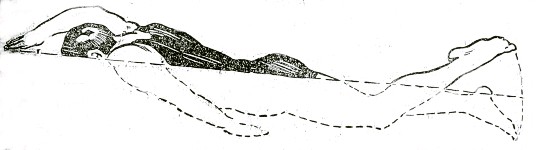
THESE TWO DIAGRAMS
BY MR. BEN JORDAN, GIVE THE GENERAL PRINCIPLES
OF THE CRAWL
STROKE.
THE TOP ONE SHOWS
THE RIGHT ARM AND LEFT LEG READY TO STRIKE.
THE BOTTOM PICTURE
SHOWSTHE LEFT ARM AND THE RIGHT FOOT JUST COMING UP OUT OF THE WATER AT
THE COMMENCEMENT OF THE STROKES.
Healy, Cecil: Tuppa Tup-pala -
Otherwise Known as the Crawl Stroke.
The Sunday Times, Sydney, 1913,
page?.
surfresearch.com.au
Geoff Cater (2007) : Cecil Healy
: Tuppa Tup-pala, 1913.
http://www.surfresearch.com.au/1913_Healy_Tuppa_Tup_pala.html