surfresearch.com.au
 |
surfresearch.com.au
young :
real hawaii, 1898
|
Lucien Young : The Real Hawaii, 1898.
Extracts from
Young, Lucien, U.S.N. The Real Hawaii
Doubleday
& McClure Co., New York,1898.
Also
Young, Lucien :
The Boston at Hawaii or,
the Observations and Impressions of a Naval Officer During a
Stay of Fourteen Months in Those Islands on a Man-of-War
Gibson Bros.,
Washington D.C., 1898.
Internet Archive
https://archive.org/details/bostonathawaiior00youn
Introduction.
A U.S. Navy
officer on the cruiser Boston describes the reign
of Lili'uokalani, her overthrow, the Provisional
Government and the Republic. Includes chapters on games,
religion, land tenure, etc.
http://www.hawaii.gov/hidocs/annexation.html
Lucien Young had a long and distinguished
career in the United States Navy.
He eventually
rose to the rank of ???
While in Hawaii,
Commander Lucien Young USN led the occupation of the Arlington
Hotel
grounds in Honolulu in January 1893.
This was the
childhood home of Queen Liliuokalani who the Americans under the
guise of ''protecting American lives'' would illegally aid
American businessmen in Honolulu to overthrow.
Image : Hawaii State Archives, Record
Group: 36-3, Historic Events: Overthrow; file: 259
http://www.k12.hi.us/~waianaeh/waianhi/whsarch2.html
Other
Publications by Lucien Young
Young, Lucien :
Elements of Navigation
John Wiley and
Sons, New York. 1898.
Chapman and
Hall, London.1898. 248 pages
Young,
Lieutenant Lucien (and William H Carlson and Mr E J
Balbin) :
Annual
Reports of the War Department for the Fiscal Year Ended June
30, 1900.
Part 12
Report of the Military Governor of Cuba on Civil Affairs
Two Volumes
Four Parts
Washington:
Bureau of Navigation, Navy Department, 1888.
Government
Printing Office, 1901.
Lieut
Commander Lucien Young, Captain of port of Habana (Volume
II Part 2 , 12 of 149 pages)
Page 85
CHAPTER VI.
NATIVE GAMES AND SPORTS.
The native Hawaiians are natural sportsmen, and some of
their games would favorably compare with those of
civilized races. One of their most popular and
delightful sports was surf-riding.
Familiar with the sea from birth, they have no dread of it,
and are as much at home in the water as on dry land.
On these occasions they use a board generally six to ten
feet long and rather more than a foot wide, sometimes flat,
but more
frequently convex on both sides.
The natives choose a place where the deep water reaches
to the beach and where the surf breaks violently.
They take their boards and pushing them ahead swim perhaps a
quarter of a mile or more to sea, dodging the billows or
diving under them as they roll towards the shore.
Arriving far enough out, they adjust themselves on the rear
end of the board, lying fiat on their faces, and upon the
approach of
the largest billow, paddle with their hands and feet toward
the shore.
The breaker catches up with them, and by skillful manipulation
it is made to bear the board forward upon its face at an angle of 30 or 40 degrees, with the
speed of an express train, to within a few yards of the beach,
when, by a quick movement, they slide off the board, and
grasping it in the middle dive under the water while the wave
Page 86
breaks on the shore.
Sometimes the swimmer assumes a sitting or standing position
on the board in the midst of the foam, balancing himself in a
way
that would prove fatal to even the best American swimmer.
The larger the waves, in their opinion, the better the sport.
They have a variety of games, and gambol as fearlessly in the
water as the children of the United States do on their
playgrounds.
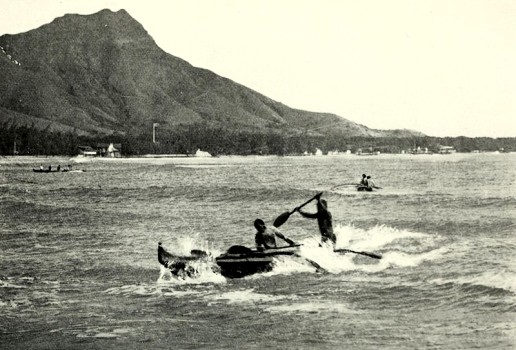
Occasionally a light canoe, holding from one to half a dozen
people, is used instead of a board.
This is less difficult than board-riding, and is one of the
favorite amusements afforded tourists at the Waikiki beach, a
few miles from Honolulu.
In the olden times all ranks and ages were equally fond of
this sport, but when the king or queen or any high chiefs were
plaving in the surf none of the common people were allowed to
approach the place.
|
Facing page 86.
Canoe surfing, Waikiki.
|
Page 115
The importance attached to the supply of fish food caused
canoe-making to be one of their greatest industries, which,
like all other works of a similar nature, was accompanied by
superstitious incantations and ceremonies.
When completed the canoe was christened, not by the breaking
of a bottle of wine over the bow, but by sacrifices to a
particular god of the sea.
In the case of a large canoe for some noted chief a human
sacrifice was necessary to insure its safety and lucky
voyages.
These canoes w r ere low, narrow and light, drawing but little
water and made out of a single tree.
Some of them were upwards of fifty feet long, one or two feet
wide, and sometimes more than three feet deep.
The body of the canoe was generally covered with a black
paint, made of various
Page 116
earthy and vegetable materials, in which the bark and oil of
the kukui tree were the principal ingredients.
On the upper edge of the gunwales was neatly sewed a
wash-board or small strip of hard white wood about six inches
wide. These wash-boards met and closed over stem and stern.
The tackling was very simple, consisting of a stub mast
supporting a sail made of mats in the shape of a sprit.
The paddles were large and strong, with an oval-shaped
blade and round handle, and were made of the same hard wood
employed in building the canoe.
Neither the canoe nor paddles were carved or ornamented, but
were nevertheless very neat.
To give the canoe greater stability and steadiness, curved
outriggers extended to one side and supported a narrow float,
giving the whole the appearance of a catamaran.
In these canoes the natives would go through any kind of surf,
with a velocity that would excite the apprehension of any
man-of-war's-man, were he even in a good whale-boat.
Should they capsize, the natives swim around, right the canoe,
and get in as though no accident had occurred.
surfresearch.com.au
Geoff Cater (2006-2016) : Lucien Young
: Waikiki Surfriding, 1898.
http://www.surfresearch.com.au/1898_Young_Real_Hawaii.html