 |
surfresearch.com.au
greenwood : tahiti and hawaii, 1863 |
| home | catalogue | history | references | appendix |
|
http://hdl.handle.net/2027/uc1.b3426244
One (1) illustration,
page 96. Woodcut and design by Harden S. Melville.
Engraved by Newsom
Woods.
Conversely, the illustration
at the beginning of the chapter is titled "Surf Swimming off the Coast
of Hawaii", detailed below.
Publication Details
In 1864, Beeton's issued a "Second series,"
that is a second voume, later titled ?
A third edition, in two volumes. was published
in 1865.
Another edition was published by John
Camden Hotten in 1869.
It was subsequently
published as
The Wild Man
at Home: or, Pictures of Life in Savage Lands.
Ward, Lock, and
Co.,Warwick House, Dorset Buildings, Salsbury Square, E.C. circa 1885.
Given the diverse
references to , it appears the vast majority of this book is not based
on first person observations.
It is unlikely that
Greenwood travelled to the South Seas, either Tahiti or Hawaii, in the
1800s.
The relevant chapter,
The report of surf-riding
is credited to "Ellis", proably the noted polynesian commentator, the Rev.William
Ellis.
Note that the report
does not correspond to the 1830 account by the Rev.William Ellis : Surf-riding
at Waimanu (Hawaii).
The specified location,
The account bears several similarities with that of James Morrison in1788, Surfriding in Tahiti.
The original source
is possibly:
Ellis, Rev. William:
Polynesian
Researches, During a Residence of Nearly Eight Years in the Society and
Sandwich Islands.
Volumes I to III.
Fisher, Son and
Jackson, London, 1829. pages 223 or 305.
Noted in Dela Vega
et al. (2004) page 18.
The commentary for
the entry notes:
"Ellis describes
surf riding in Tahiti and compares them to Hawaiians:
'Their surf-boards
are inferior to those of the Sandwich islanders, and I do not think swlmming
in the sea as an amusement, whatever it might have been formerly; is now
practiced so much by the natives of the South, as by the North.'
Noted the Tahhltian
surf God was named Huaourl.
Does not Include
Hawaiian text." (Ellis, 1830 : Surf-riding
at Waimanu)
The possible decline
in Tahitian surfriding suggested here by Ellis may appear somewhat at odds
with the account in Greenwood which records surfriders numbering "from
fifty to a hundred persons of all ages."
Also see James Morrison,1788:Surfriding in Tahiti
Page 110
Faahee (1), or surf-swimming,
is another favourite pastime with these people.
According to Ellis, "individuals
of all ranks and ages and both sexes follow this sport with great avidity.
They usually selected the openings
in the reefs or entrances of some of the bays, where the long heavy billows
rolled in unbroken majesty upon the reef or the shore.
They used a small board, which they
called papa faahee- swam from the beach to a considerable
distance, sometimes nearly a mile-
watched the swell of the wave, and when it reached them, resting their
bosoms on the short, flat-pointed board, they mounted on its summit, and
amid the foam and spray rode on the crest of the wave to the shore; sometimes
they halted among the coral rocks, over which the waves broke in splendid
confusion.
When they approached the shore,
they slid off the board, which they grasped with the hand, and either fell
behind the wave or plunged towards the deep and allowed it to pass over
their heads.
Sometimes they were thrown with
violence upon the beach, or among the rocks on the edges of the reef.
So much at home, however:, do they
feel in the water, that it is seldom any accident occurs.
" I have often seen along the border
of the reef forming the boundary line to the harbour of Fare in Huahine,
from fifty to a hundred persons of all ages, sporting like so many porpoises
in the surf that has been rolling with foam and violence towards the land;
sometimes mounted on the top of the wave, and almost enveloped in spray,
at other times plunging beneath the mass of water that has swept like mountains
over them, cheering and animating each other; and by the noise and shouting
they made rendering the roar of the sea and the dashing of the surf comparatively
imperceptible."
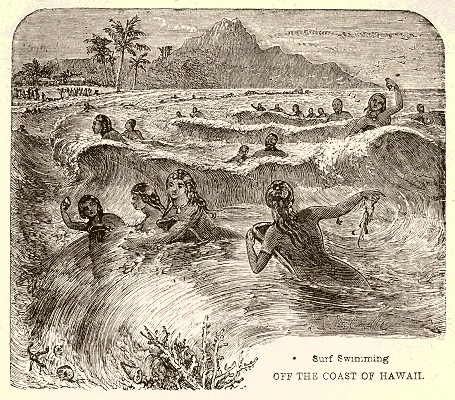 |
Woodcut and design by Harden S. Melville. Engraved by Newsom Woods. Greenwood, James:
|
1. "Faahee"
This term is not found in any other account
and may be an error in transcribing from the original text.
| home | catalogue | history | references | appendix |
1849, English, Book, Illustrated edition: Sketches in Australia and the adjacent islands : selected from a number taken during the surveying voyage of H.M.S. "Fly" and "Bramble" under the command of Capt. F.P. Blackwood ... 1842-46 / by Harden S. Melville. Melville, H. S. (Harden S.)
http://hdl.handle.net/2027/uc1.b3426244
Curiosities of savage life, by James
Greenwood
London, S.O. Beeton, 1863.
Note: A "Second series" was issued
in 1864.
Physical Description: xiv, 418
p. col. front., illus., col. plates. 22 1/2cm.
S.O. Beeton. London., 1865. 3rd edition.
Two volumes.
John Camden Hotten., 1869.
James Greenwood (1832 - 1929) was a British social explorer, journalist and writer.