surfresearch.com.au
 |
surfresearch.com.au
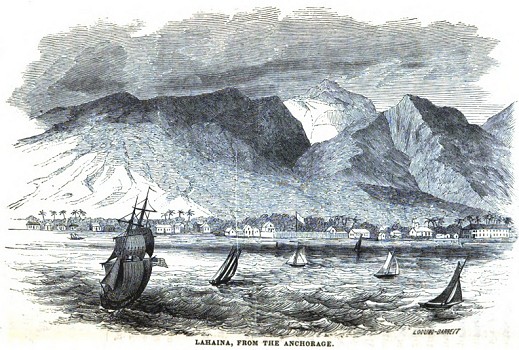
bates : surf-riding, lahaina,
1854
|
George W. Bates : Surf-riding
at Lahaina, Maui, 1854.
Introduction.
The
book was published as two works, one attributed to Bates and
anonymously as A. Haole (a white visitor).
Although he travelled to Waikiki (page 93), apparently there
was no surf-riding in evidence.
The account is
notable for the description of the Hawaiian surfers
negotiating their way
out through the breaking surf, "as they proceed seaward,
they dive,
like ducks", a manoeuvre currently known as duck-diving.
For other 19th
century
reports from Lahaina, Maui, see:
1824 Charles
Stewart : Surf-riding
at
Lahaina, Maui.
1850 Lt. Henry
Wise : Surfriding at
Lahaina
1851 Rev. Cheever
: Surfriding at
Lahaina.
Page
93
Within a mile of the crater's base is the old village of
Waikiki.
It stands in the centre of a handsome cocoa-nut grove,
among whose feathery foliage the soft winds from the ocean
produce a gentle, murmuring music.
There is a fine bay before the village, in whose waters
the vessels of Vancouver and other distinguished
navigators have anchored.
Waikiki was once the abode of that Hector of the
Hawaiians, Kamehameha the Great.
The old stone house in which the great warrior once lived
still stands, but it is falling into a rapid decay.
I could not help lingering for a time to notice the
objects scattered around.
There were no busy artisans wielding their implements of
labor; no civilized vehicles bearing their loads of
commerce, or any living occupant.
But beneath the cool shade of some evergreens, or in some
thatched house, reposed several canoes.
Every thing was as quiet as though it were the only
village on earth, and its tenants the only denizens.
A few natives were enjoying a promiscuous bath in a
crystal stream that came directly from the mountains, and
rolled, like another Pactolus, to meet the embrace of the
ocean.
Some were steering their frail canoes seaward.
Others, clad simply in Nature's robes, were wading out on
the reefs in search of fish.
Here in this quiet hamlet, once unknown to all the world,
Kamehameha I, surrounded by his chieftains, held his
councils for the safety and consolidation of his kingdom.
Page 291
Page
298
Of the
numerous
national games and amusements formerly practiced by the
Hawaiians, surf-bathing
is about the only one which has not become extinct.
Lahaina is the
only place on the group where it is maintained with any degree
of enthusiasm,
and even there it is rapidly passing out of existence.
In other days,
there was no amusement which more displayed the skill, or
bestowed a greater
physical benefit on the performer, than this.
Formerly it
was
indulged in by all classes of persons, of all ages and both
sexes, from
royalty to the lowest plebeian, at one time and in the same
place.
Even the huge
regent Kaahumanu, and others, by whose coffins I stood and
pondered in
the royal tomb at Honolulu, were in the habit of bathing in
the surf at
Lahaina.
At this day,
the sport is confined more to the youthful portion of the
community.
Surf-bathing
is
an exciting sport to the swimmer, and a
Page 299
cause for
excitement and astonishment on the part of an unaccustomed
spectator.
The swimmers
start out from the shore, taking with them their surf-boards.
These boards
are of dimensions suited to the muscular strength and capacity
of the swimmers.
As they
proceed
seaward, they dive, like ducks, underneath the heavy rollers,
and come
up on the other side.
This course is
pursued until the outermost roller is reached - sometimes
nearly a mile
from the shore. The higher the roller, the more exciting and
grand is the
sport.
Placing
themselves
on these boards, the bathers gradually approach the inward
current of the
roller as it sweeps over the reef, and, lying on the chest,
striding, kneeling,
or standing up on the board, they are borne on the foaming
crest of the
mighty wave - with the speed of the swiftest race-horse toward
the shore,
where a spectator looks to see them dashed into pieces or
maimed for life.
By a dexterous
movement, however, they slip off their boards into the water,
grasp them
in their hands, dive beneath the yet foaming and thundering
surge, and
go out seaward to repeat the sport. This they do for hours in
succession,
until a traveler is almost led to suppose they are amphibious.
This game
involves great skill; it is acquired only by commencing it in
the earliest
childhood.
A standing
position
on the swiftly-gliding surf-board is a feat of skill never yet
surpassed
by any circus-rider.
surfresearch.com.au
Geoff Cater (2007-2017) :
George W.
Bates : Surf-riding at Lahaina, 1854.
http://www.surfresearch.com.au/1854_Bates_Lahaina_Surfriding.html