 |
surfresearch.com.au
dana : before the mast, 1840 |
| home | catalogue | history | references | appendix |
|
| Dana, Richard Henry: Two Years Before the Mast - A Personal ... Harper and Brothers, New York, 1840 |
Dana,
Richard Henry: Two Years Before the Mast Thomas Nelson and Sons, London, 1947. |
Just before
sundown the mate ordered a boat's crew ashore, and I went as
one of the number.
We passed
under the stern of the English brig, and had a long pull
ashore.
I shall
never forget the impression which our first landing on the
beach of California made upon me.
The sun had
just gone down; it was getting dusky; the damp night-wind
was beginning to blow, and the heavy swell of the Pacific
was setting in, and breaking in loud and high "combers" upon
the beach.
We lay on
our oars in the swell, just outside of the surf, waiting for
a good chance to run in, when a boat, which had put off from
the Ayacucho just after us, came alongside of us,
with a crew of dusky Sandwich Islanders, talking and
hallooing in their outlandish tongue.
They knew
that we were novices in this kind of boating and waited to
see us go in.
The second
mate, however, who steered our boat, determined to have the
advantage of their
Page 53
experience, and would not go in first.
Finding at
length how matters stood, they gave a shout, and taking
advantage of a great comber which came swelling in, rearing
its head, and lifting up the stern of our boat nearly
perpendicular, and again dropping it in the trough, they
gave three or four long and strong pulls, and went in on top
of the great wave, throwing their oars overboard and as far
from the boat as they could throw them, and jumping out the
instant that the boat touched the beach, and then seizing
hold of her, and running her up high and dry upon the sand.
We saw at
once how it was to be done, and also the necessity of
keeping the boat stern on to the sea; for the instant the
sea should strike upon her broadside or quarter she would be
driven up broadside on and capsized.
We pulled
strongly in, and as soon as we felt that the sea had got
hold of us, and was carrying us in with the speed of a
racehorse, we threw the oars as far from the boat as we
could, and took hold of the gunwale, ready to spring out and
seize her when she struck, the officer using his utmost
strength to keep her stern on.
We were shot
up upon the beach like an arrow from a bow, and seizing the
boat, ran her up high and dry, and soon picked up our oars,
and stood by her, ready for the captain to come down.
Page 130
On one of
these expeditions we saw a battle between two Sandwich
Islanders and a shark.
"Johnny" had
been playing about our boat for some time, driving away the
fish, and showing his teeth at our bait, when we missed him,
and in a few moments heard a great shouting between two
Kanakas who were fishing on the rock opposite to us, and saw
them pulling away on a stout line, and "Johnny Shark"
floundering at the other end.
The line
soon broke; but the Kanakas would not let him off so easily,
and sprang directly into the water after him.
Now came the
tug of war.
Before he
could get into deep water one of them seized him by the
tail, and ran up with him upon the beach; but Johnny twisted
round, turning his head under his body, and showing his
teeth in the vicinity of the Kanaka's hand, made him let go
and spring out of the way.
The shark now turned tail and made the best of his way, by
flapping and floundering, towards deep water; but here
again, before he
Page 131
was fairly
off, the other Kanaka seized him by the tail, and made a
spring towards the beach, his companion at the same time
paying away upon him with stones and a large stick.
As soon,
however, as the shark could turn he was obliged to let go
his hold; but the instant he made toward deep water they
were both behind him, watching their chance to seize him.
In this way
the battle went on for some time, the, shark, in a rage,
splashing and twisting about, and the Kanakas, in high
excitement, yelling at the top of their voices; but the
shark at last got off, carrying away a hook and line, and
not a few severe bruises,
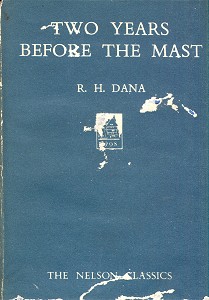 |
Two Years Before the Mast Thomas Nelson and Sons, London, 1947. First published in 1840 as Two Years Before the Mast - A Personal ... Harper and Brothers, New York, 1840 |
| home | catalogue | history | references | appendix |