 |
surfresearch.com.au
best : journal, 1838-1843 |
| home | catalogue | history | references | appendix |
|
On the 24th September 1838, at his instigation, Best experiences a "tremdous run" in large waves:
"Since the
morning a good deal of sea had got up & crossing the Bar
we got a tremendous run the boat being slew'd
completely round and the sea breaking over the boat I was
drenched to the skin.
Coming over
I had expressed my wish of having a good run, the Major
hoped we should have no such thing (I
wanted to see what a run was like) and the opinion of all
was that the coxwain who is a daring seaman
waited for a heavy sea in order to give me a specimen of
what a good run was; if so he got more than
he bargained for." - page 187.
The activity
was both exciting and liable to disaster.
On the 5th
March 1839 the long boat (the Fairlie) is capsized
returning to the beach and, although there are few injuries, "all
Guns &c went to the bottom" and the Fairlie "is
not worth repairing there is scarce a whole plank in her."
- page 201.
Also note that sea bathing is a regular, if not daily, activity for Best, "Bathed at eight there was a good deal of swell in the Bay" (page 186), and the presence of "the bathing house" (page 201) suggests that this was a common practice for the other officers.
Whereas Norfolk Island was used to discipline recalcitrant convicts from the penal settlement of Sydney and had a reputation for extreme cruelty, Best appears to have found his posting highly enjoyable.
In 1854 the
penal settlement on Norfolk Island was abandoned and its
convicts moved to Port Arthur in Van Dieman's Land (Tasmania),
a location of equal infamy for its cruelty towards the
inmates.
In 1856 it
became the new the home to some of the Bounty
descendants, who were relocated from Pitcairn Island.
These
descendants where the progeny of European sailors and Tahitian
women who on Pitcairn retained surfboard riding as part of
their Polynesian heritage and brought their skills to Norfolk
Island.
|
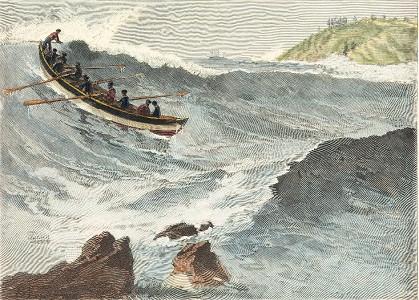
Frederick B. Schell: Landing Through the
Surf, Norfolk Island (1886).
An American artist, Frederick B. Schell (1838 - 1900) was active in Australia from 1886-1889. He was brought out to produce views for the Picturesque Atlas of Australasia, a comprehensive survey of Australia's colonial history published to mark 100 years of Australia’s settlement. Conceived and financed by American publishers under the name of the Picturesque Atlas Publishing Co Limited, Sydney and Melbourne, it used the best artists, the best paper, the finest printing engraving techniques, and was a financial failure. For an account of surfboard riding on Norfolk Island, see Source Documents: 1868 Mrs. Selwyn : Surfriding on Norfolk Island. Surfboard riding on Pitcairn Island was documented by two visitors, see: 1821 Dr David Ramsay : Surfriding on Pitcairn Island. and 1834 Frederick Bennett : Surfing on Pitcairn Island. |
 |
25th
(August)
In the
morning early awakened by the cry of "Land O!"
Went on deck
and could just distinguish something like a cloud right
ahead which the mate said was Phillip Island.
By eight
o'clock we saw it distinctly but we were not off the
settlement at Norfolk Island until past one.
The approach
to this Island from the sea is very striking the
Peak of Phillip Island rising abruptly from the sea to the
height of at least 1000 feet admirably contrasts its naked
grandeur with the cliffs of Norfolk Island clothed with
perpetual verdure to the waters Edge.
The
Settlement is situated on the only low piece of ground which
appears from the Sea and with its white buildings has a very
pleasing effect while innumerable lovely vallies run towards
the hills in every direction.
Norfolk
Island as I viewed it from the deck of the Brig was the
Loveliest spot I had ever seen.
NORFOLK ISLAND (1838-1839)
Saturday
August 25th
The boat
which we had seen putting off soon came alongside it
contained an Officer, Non. Com. a Guard of two Privates, the
Coxwain & crew of seven prisoners.
The Officer
boarded the brig enquired for the Mail & at the same
time informed us that the Commandant sent permission for any
Officer to land except the commander of the Guard.
Lugard &
myself had made up our minds not to go on shore that night
so we declined taking advantage of the Majors Kindness.
Shortly
after the boat reached the shore it again put off the
Coxwain bearing a special invitation from the Officers of
the Mess to Lugard & myself to come on shore; this we
could not refuse.
I went to my
cabin put on my uniform & got into the boat.
Half an
hours pulling brought us to the Bar (a reef running in front
of the Settlement with a passage in it, large enough to
admit a boat in fair weather) this we rapidly passed on the
crest of a wave in Island term we had a run & then found
ourselves on the beach where the Officers all of whom I was
acquainted with were waiting to recieve us.
The sun was
now down we adjourned to the Mess room (with the exception
of Lugard who had gone to Government house) and there spent
a very pleasant evening.
26th
Sunday.
Got up at
half past seven went to bathe.
Church in a
barrack room at ten.
In the
afternoon went out for a walk returned to dinner.
Mr & Mrs
McDonald came ashore during divine service & took up
their quarters at Government house.
Page 183
Monday 27th
Arose at
seven bathed & breakfasted.
The wind had
changed the brig was obliged therefore to go round to the
opposite side of the Island and layoff Cascade bay.
All the
Detachment except six & a Non Com. landed bringing with
them my four dogs.
Nettle I
immediately chained up the bull pup staid with her the two
others followed me to my room - or rather to the room of the
officer with whom I put up I was very busy all day, doing
nothing in the forenoon and after luncheon walking to the
Government farm at Long Ridge to shoot Pigeons.
There was a
small party at mess we did not disperse till late.
28th
Took my swim
at the usual hour.
The brig was
still at Cascade so we made a party to walk out & see
her.
A beautiful
walk it was through groves of Lime & Lemon trees in full
fruit interspersed with Guava shrubs the distance was about
three miles.
Having
satisfied ourselves that the brig was all right we returned
home.
Lugard,
Needham (61) & I dined with Major Anderson.
(Footnote) 61. Needham an Ensign & who I believe was at Sandhurst with me.
Page 186
20th
(September)
Bathed at
eight there was a good deal of swell in the Bay.
24th
Second week
off duty.
Major
Anderson sent in invite to us [sic] to
Page 187
make a
party for fishing and Phillip Island.
Lugard,
Knowles, Hill and myself were those who went leaving Capt
Gtinton and McDonald to take care of the Island.
It was a
calm day but no fish were to be caught we therefore pulled
on for Phillip and landed, the Major remaining in the boat
& returning to the fishing ground.
...
We shot
about ten couple of rabbits & saw plenty of tracks of
Pigs and Goats but not the substance & returned to
dinner, eat very heartily, got into the boat to return.
Since the
morning a good deal of sea had got up & crossing the Bar
we got a tremendous run the boat being slew'd completely
round and the sea breaking over the boat I was drenched to
the skin. Coming over I had expressed my wish of having a
good run, the Major hoped we should have no such thing (I
wanted to see what a run was like) and the opinion of all
was that the coxwain who is a daring seaman waited for a
heavy sea in order to give me a specimen of what a good run
was; if so he got more than he bargained for.
In the
Evening we sat up untilllate talking over our excursion.
Page 201
4th (March
1839)
Was down at
the bathing house by eight spent the day in my garden &
stockyard & writing to Orme.
...
5th
...
At 9 after
returning from bathing Lugard, Tyssen & Mr Turner the
new Commissary embarked in the Fairlie for Phillip Island.
I spent the
day much as the last & was dining with Arnold about five
when the servant came running in to say that the boat had
had a run & capsized I hastened to the beach and there
sure enough was the boat upset & all the people
scrambling out of the water the Coxwain & a Soldier were
the only people hurt & they not seriously.
No blame
could be attached to the former who laid off untill several
seas had passed but unfortunately just as he ran in on the
supposed last another came as he was endeavouring to turn
the comer caught her under the counter and over she went.
The sea was
like a mill pond but the bar very heavy from a ground swell.
A second
boat was in the water to pick up thanks to the foresight of
Mr Forster Supt of Convicts & was of great service.
Nothing was
saved but the men Officers & dogs, all Guns &c went
to the bottom.
After the
Fairlie had been carried out I inspected her & my
opinion is that she is not worth repairing there is scarce a
whole plank in her.
I returned
to Arnolds untill nine then sat with the Major a few minutes
& at 10 went to bed.
Page 205
22nd (March
1842)
Got up at
eight.
Went to
parade at 1/4 past nine.
Between ten
& eleven a sail was signalized from Pt Ross.
I went to my
garden from thence to the beach meeting by the way Major
Anderson & some more of the Officers with the Capt of
the Whaler which had left the sailor here.
We all
Lunched in the mess room & in the afternoon there was a
race between the Whalers boat & our new boat Victoria
which was won by the former as expected but the latter is a
fine boat in the water and gave great satisfaction.
New Zealand (1842)
9th
(December 1842)
At earliest
dawn we arose.
The morning
was fine, the wind fair, and long before sun rise we had
been to prayers for the Mauries commence and end every day
by addressing the "God of the White Men" eaten our breakfast
of fish and potatoes and were scudding over the waters.
Under all
sail the three canoes ran along side by side so close that
we laughed and joked and handed our fire stick from one to
the other.
As the Sun
rose in the heavens the wind became stronger and when off
Orong Orong (219) the Maurles decided on putting in.
This place
is about half way to Wyderop.
Wyderop was
the first to cross the surf next followed the large canoe
and
(Footnote) 219. Orongorongo River mouth.
Page 263
lastly
ours; as we approached one of the Mauri dogs jumped over
board and swam towards some rocks on which the surf was
breaking with tremendous force we all thought the poor
animal would be dashed to pieces but to our great delight he
percieved his danger changed his course and safely landed on
the sandy beach.
It was now
our turn we took in our sail then paddled in a little
further untill just outside the break of the surf in an
instant the canoe was head to sea several heavy surfs rolled
in and as soon as a lull offered away we went stern first
like lightening hardly had we touched the beach before we
were above high water mark for the Mauries who had already
landed rushed into the water and bore our canoe along like a
toy untill above the influence of the waters.
Page 396
24th (January 1843)
We were all
astir at dawn some food was hastily prepared and as speedily
demolished and then all was haste and excitement.
Every crew
ran to their respective Canoes the greatest emulation
prevailing as to which should be the first to cross the
surf.
Tai Pari sat
on a little sand hill attended by three or four old Chiefs
giving directions as to the grounds to be fished on that day
and observing the skill exhibited by the different Canoes.
One of the
lighter canoes now reaches the water they shove her
Page 397
in holding
her by the sides head to sea a race of heavy seas roll in
now there is a temporary lull they run her out until the
water is above their middles a roller is seen approaching
they bound into the canoe and paddle as if for their lives
they reach the roller just before it curls and dash over it,
standing on the thwarts of the canoe, a few more strokes and
they are without the curl of the breakers.
Such was the
scene we witnessed and most exciting it was and when any
awkwardness on the part of the steersman caused a canoe to
ship a breaker loud were the shouts of derision from his
more skilful companions.
The Canoes
having all crossed the surf spread their sails and ran away
in different directions to the banks most frequented by the
Taragehe. (492)
We now
returned to the Camp.
In the Evening
I returned to the fishing station, Ed Shortland did not
accompany me having gone to Katikati in the Pinace.
The Canoes
had returned having taken great quantities of fish which had
been sent to Mounga Tapu to be cured for winter stock
reserving sufficient for present consumption.
(Footnote) 492. Tarakihi (Dactylopagrus macropterus).
 |
The Journal of Ensign Best, 1837-1843. Edited with an Introduction and Notes By Nancy M. Taylor. R. E. Owen, Government Printer, Wellingon, New Zealand, 1966. A Turnbull Library monograph. |
| home | catalogue | history | references | appendix |