| home | catalogue | history | references | appendix |
|
http://books.google.com.au
An 1684
Payata, Colan. (Northern Peru)
Bark-Logs
The Indians of Colan are all
Fishermen : they go out to Sea and fish for Bark-logs.
Bark-logs are made of many round Logs
of Wood, in manner of a Raft, and very different according to the use that
they are designed for, or the humour of the people that make them, or the
matter that they are made of if they are made for fishing, then they are
only 3 or 4 Logs of light Wood, of 7 or 8 foot long, plac'd by the side
of each other, pinn'd fast together with wooden pins, and bound hard with
Withes.
The Logs are so placed, that the middlemost
are longer than those by the sides, especially at the head or fore part,
which grows narrower gradually into an angle or point, the better to cut
through the Water.
Others are made to carry Goods : the
bottom of these is made of 20 or 30 great Trees of about 20, 30, or 40
foot long, fastened like the other, fide tp fide, and so shaped: on the
top of these they place another shorter row of Trees across them, pinn'd
fast to each other, and then pinn'd to the undermost row : this double
row of Planks makes the ...
Page 142
... bottom of the Float, and of a considerable breadth.
Page 143
An 1684
Piura (northwestern Peru)
Single Bark Logs
The smaller sort of Bark-logs, described
before, which lie flat on the Water, and are used for Fishing, or carrying
Water to Ships, or the like (half a Tun or a Tun at a time) are more governable
than the other, tho' they have Masts and Sails too.
With these they go out at night by
the help of the Landwind (which is seldom wanting on this Coast) and return
back in the day time with the Sea-wind.
This sort of Floats are used in many
places both in the East and West-Indies.
On the Coast of Coromandel in
the East-Indies they call them Catamarans.
These are but one Log, or two sometimes
of a sort of light Wood, and are made without Sail or Rudder, and so small,
that they carry but one Man, whose legs and breech are always in the Water,
and he manages his Log with a Paddle, appearing at a distance like a Man
sitting on a Fish's back.
Page 468
An 1688
The New Hollanders not curious.
(West coast, Australia)
Page 469
At another time our Canoa being among
these Islands seeking for game, espy'd a drove of these Men swimming from
one Island to another; for they have no Boats, Canoas, or Bark-logs.
They took up Four of them, and brought
them aboard; two of them were middle aged, the other two were young Men
about 18 or 20 Years old.
To these we gave boiled Rice, and with
it Turtle and Manatee boiled.
They did greedily devour what we gave
them, but took no notice of the Ship, or ...
Page 489
... any thing in it, and when they were, set on Land again, they ran away as fast as they could.
They are very
dextrous active Fellows in their Proes, which are very ingeniously built.
They are narrow
and long, with Out-lagers on one side; the Head and Stern higher than the
rest, and carved into many Devices, viz. some Fowl, Fish, or a Man's Head,
painted or carv'd: And though it's but rudely done, yet the Resemblance
appears plainly, and shews an ingenious Fancy.
But with what
Instruments they make their Proes or carved Work, I know not; for they
seem to be utterly ignorant of Iron.
They have very
neat Paddles, with which they manage their Proes dextrously, and make great
way through the Water.
...
(4 March 1700)
As soon as we came near Cave's Island, some Canoas came about us, and made Signs for us to come ashore, as all the rest had done before; probably ...
Page 182
... thinking we
could run the Ship a-ground any where, as they did their Proes; for we
saw neither Sail nor Anchor among any of them, though most Eastern Indians
have both.
These had Proes
made of one Tree, well dug, with Outlagers on one side: They were but small
yet well shap'd.
We endeavour'd
to anchor, but found no Ground within a Mile of the Shore: We kept close
along the North-side, still sounding till we came to the North-East-end,
but found no Ground; the Canoas still accompanying us; and the Bays were
covered with Men going along as we sail'd: Many of them strove to swim
off to us, but we left them astern.
![]() |
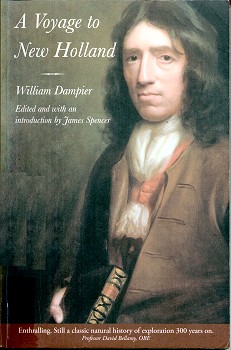
A Voyage to New Holland. Edited by James Spencer. Nonsuch Publishing,. The Mill, Brimscombe Port, Stroud, Gloucestershire, GL5 2QG. 2006. |
![]() |
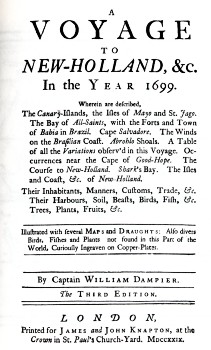
A Voyage to New Holland. James and John Knapton, Crown in St. Paul's Church-Yard, London. 1729. |
| home | catalogue | history | references | appendix |
Page 141
An 1684
Payata, Colan.
Bark-Logs
The Indians of Colan are all
Fishermen : they go out to Sea and fish for Bark-logs.
Bark-logs are made of many round Logs
of Wood, in manner of a Raft, and very different according to the use that
they are designed for, or the humour of the people that make them, or the
matter that they are made of if they are made for fishing, then they are
only 3 or 4 Logs of light Wood, of 7 or 8 foot long, plac'd by the side
of each other, pinn'd fast together with wooden pins, and bound hard with
Withes.
The Logs are so placed, that the middlemost
are longer than those by the sides, especially at the head or fore part,
which grows narrower gradually into an angle or point, the better to cut
through the Water.
Others are made to carry Goods : the
bottom of these is made of 20 or 30 great Trees of about 20, 30, or 40
foot long, fastened like the other, fide tp fide, and so shaped: on the
top of these they place another shorter row of Trees across them, pinn'd
fast to each other, and then pinn'd to the undermost row : this double
row of Planks makes the ...
Page 142
... bottom of the Float, and of a considerable breadth.
Page 143
An 1684
Piura
Single Bark Logs
The smaller sort of Bark-logs, described
before, which lie flat on the Water, and are used for Fishing, or carrying
Water to Ships, or the like (half a Tun or a Tun at a time) are more governable
than the other, tho' they have Masts and Sails too.
With these they go out at night by
the help of the Landwind (which is seldom wanting on this Coast) and return
back in the day time with the Sea-wind.
This sort of Floats are used in many
places both in the East and West-Indies.
On the Coast of Coromandel in
the East-Indies they call them Catamarans.
These are but one Log, or two sometimes
of a sort of light Wood, and are made without Sail or Rudder, and so small,
that
they carry but one Man, whose legs and breech are always in the Water,
and he manages his Log with a Paddle, appearing at a distance like a Man
sitting on a Fish's back.
Page 468
An 1688
The New Hollanders not curious.
Page 469