surfresearch.com.au
 |
surfresearch.com.au
leonardo da
vinci : hydrodynamics,
1515
|
Leonardo da Vinci
: Hydrodynamics, 1515.
Extracted
from
Kemp, Martin:
Leonardo da
Vinci
- The Marvellous Works of Nature and Man.
J. M. Dent and
Sons
Ltd., London, 1981, Reprinted 1989.
Introduction.
Water is the
driving source of all nature.
Although largely
based on the shores of the Mediterranean Sea, where his surf
riding activities
were somewhat limited, Leonardo da Vinci devoted signfificant
research
into the properties of moving water.
In relation to
wave
riding, his identification of the concave spiral and his notes
on the interaction
of turbulent water and air offers critical insights.
He studied the
hydrodynamic
principles of ships, suggested the use of stains to observe
water motion,
and prepared drawings for a life preserver ring and a
rudimentary aqualung.
The first use of SONAR by
humans in the water is initially recorded by Leonardo in 1490: a
tube inserted into the water was said to be used to detect vessels
by placing an ear to the tube.
- Fahy, Frank (1998). Fundamentals of
noise and vibration. John Gerard Walker. Taylor & Francis.
p. 375. ISBN 0-419-24180-9.
Page
305
Armed with
this knowledge of natural causes, the designer of boats
could act accordingly:
"Three
ships
of uniform breadth, length and depth, when propelled by
equal powers, will
have different speeds of movement (Figure 83); for the
ship which presents
its widest part in front is swifter, and it ...
Page 306
....
resembles
that shape of birds and fishes such as the mullet.
And this
ship
opens wIth its sIdes and in front of it a great quantIty
of water which
afterwards with its revolution presses against the last
two-thirds of the
ship.
The ship
'dc'
does the opposite, and "fe" has a movement midway between
the two above
(G.50v)".
Not
surprisingly,
an erroneous theory has erroneous implications in
practice.
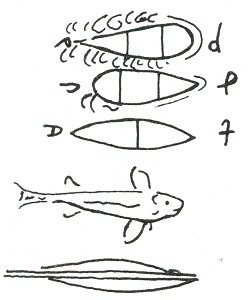 |
Fig 83
"Hydrodynamic
design
of Boats and Fishes",
based
on Institut
de France, Paris, 1510-1515, 50v.
|
Although
Leonardo's
late theory of motion was in the main equivalent to impetus
mechanics,
it thus retained substantial vestiges of classical
Aristotelianism.
Only rarely
did he adopt an argument from the medieval texts in more or
less unabridged
form, but only when he did so can we identify his likely
source.
One of
these
instances is his analysis of compound motion in a projectile
fired from
a moving base.
He opened
his discussion with a consideration of the Ptolemaic problem
of an arrow
shot from a moving ship, first in the same direction as the
ship's motion
and then against it (G.54r).
He then
turned
his attention to the related question of an arrow shot from
the rotating
earth.
If an arrow
is fired vertically upwards from the revolving world, why
does it return
to precisely the same place?
"The
arrow
shot from the centre of the earth to the highest point of
the elements
will ascend and descend by the same straight line,
although the elements
may be in rotation around the centre.
The
gravity
which descends through the elements when they are in
rotation always has
its movement correspond to the direction of the line which
extends from
the commencing point of the movement to the centre of the
world (G.54v).
..it comes about that a stone thrown from a tower does not
strike the side
of the tower before reaching the ground (G.55r)."
The fall
is
vertical in relation to the revolving spheres of fire,
air, water and earth,
but relative to exterior space it can be seen to pursue a
spiral path.
A object
which
fell for twenty-four hours would make a complete
revolution in a spiral
judged from a static viewpoint (see Figure 78).
His
examples
and analysis are those which Oresme adduced in favour of
the earth's rotation.
It is
slightly
disconcerting to find that Oresme, ...
Page 307
...
having
martialled an impressive array of evidence to indicate
that the world revolved,
did not consider the matter proven.
However,
the
equivocation of Oresme's conclusion did not prevent the
efficacy of his,
'experimental' arguments from impressing Leonardo.
The
subtle
duality of a movement which was at once relatively
vertical and absolutely
spiral is typical of the complicated relativities which
operated in natural
science.
Leonardo
saw
nature as weaving an infinite variety of elusive patterns
on the basic
warp and woof of mathematical perfection.
Nowhere
could
nature's endless variations on geometrical themes be seen
more matvellously
than in the dynamics of water, above all in the
configuration of vortices.
As a
foundation
for his studies he outlined a basic classification of
natural spirals,
the first three of which were variations on the basic
schema already illustrated
in Figure 78.
Altogether,
there
were four varieties, namely convex spiral, planar spiral,
concave
spiral and the fourth is the columnar spiral (Figure 84).
Each of
these
possessed its own dynamic properties and reacted to
opposing forces in
a different way.
The
peculiar
form and efficacy of circulatory force in a vortex came
from what he called
"a circumstance worthy of note"; "The spiral or rotary
movement of every
liquid is so much the swifter as it is neal'er the centre
of its revolution",
unlike a wheel in which the movement "is so much slower as
it nears the
centre"(C.A.296vb).
A related
peculiarity was the way in which a rapid vortex tends to
acquire a void
at its centre: "The lateral weight of the
vortex-circulation is two-fold
... and such duplication of weight firstly comes into
being in the revolving
movement of the water and secondly is created on the sides
of this concavity,
supporting itself there ... It makes the concavity in the
form of a pyramid
and makes it so much the more swiftly as the pyramid is
more pointed"(C.A.296vb).
The
"concave
spiral" in water thus prettily combined a pyramidal law of
the type which
had so delighted him in the 1490s with the revolving
motion which is found
so ubiquitously in his late science.
This
combination
gave the vortex its uniquely concentrated force.
The
vortex
was a natural power-drill, gouging remorselessly into
underlying surfaces,
sucking fragmented particles into its whirling mass and
then projecting
them into the surrounding space with violent impetus: "It
strikes and hollows
out the bed in a sudden chasm, for, in addition to the
force of the impact,
there is joined the spiral quality made by the said
revolution, by means
of which those things disturbed by the impact are stirred
up and carried
away"(F .17v).
This
"spiral
quality" could have astonishing effects, both in
remorseless power and
geometrical regularity: "Solid rock of Mugnone, hollowed
out into the form
of vases by the force of the water, is of such precision
that it appears
to be handiwork" (Figure 85).
If the
"concave
spiral" was one of water's most characteristic
configurations, it was only
one of many. Impetus nowhere had more obviously
geometrical consequences
than in fluids, but nowhere was its action more subject to
a tantalizing
variety of intersecting variables.
To
outline
the ...
Page 308
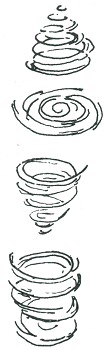 |
Convex
spiral.
Planar
spiral.
Concave
spiral.
Columnar
spiral.
|
Image
left:
"Four
varieties
of spiral ",
based
on Institut
de France, Paris, 1513-1514, 42r.
Fig
84. page
308.
|
...
geometric
theory of motion was one thing; to account for the actual
configurations
adopted by water was very much another.
Leonardo's
note-books leave no doubt that he spent many hours
contemplating water
in motion, either in naturally occurring situations or in
circumstances
he had himself set up to produce particular kinds of flow.
One obvious
problem was actually seeing the motions in a transparent
medium.
To do so he
suggested adding to the currents tiny particles such as
grass seeds or
staining one of two colliding water sources with dye.
When he was
able to observe the motion in the necessary detail its
awesome complexities
impressed themselves upon him to an ever greater degree:
"Running water
has within itself an infinite number of movements which are
greater or
lesser than its principal course.
This is
proved
by [watching] the things supported within two streams of
water which are
the same weight as the water."
The
revealed
motions of such things were "sometimes swift, some-times
slow, and sometimes
turning to the right and sometimes to the left, at one
instant upwards
and at another downwards, turning over and back on itself,
now in one direction
and now in another, obeying all the forces that have power
to move it,
and in the struggles perpetrated by the mobile forces always
as the booty
of the victor" (G.93r).
The
"infinite
number" of geometrical permutations in moving water by no
means persuaded
Leonardo to abandon his quest to encompass them within his
understanding.
Manuscript
F, "begun in Milan on 12th September 1508" (Ir), contains
page after page
dedicated to such matters and comparable discussions feature
prominently
in the Leicester Codex, probably composed partly in Florence
and partly
in Milan.
It is
not hard
to understand the aesthetic qualities which drew him "to
investigate the
many beautiful movements which result from the penetration
of one element
into another" (F.34v).
And a
number
of his analyses ...
Page 309
... are
undeniably
impressive pieces of writing.
But the
total
effect of his writings on water is to my mind rather
discouraging.
An
excessive
accumulation of descriptive details all but obliterates a
framework of
dynamic law which could be adequately stated in a fraction
of the space.
When he
proudly
informed the reader that "in these eight pages there are
seven hundred
and thirty conclusions on water" (Leic. 26v), we may feel
that the boundary
between dedication and obsession has been overstepped,
just as it had been
in his most repetitive pages of geometrical variations
(Plate 83).
We cannot
but be grateful, however, that his obsession resulted in
one of his most
miraculous drawings, illustrated in Plate 84.
The two
studies
at the top of the page belong to an extensive series
dedicated to the turbulent
effects of interruption in a fast flow.
Sometimes
obstructions were placed laterally at the margins of the
stream, creating
between them a brilliant interlace of curvilinear
percussions (e.g. F .89r).
In other
drawings,
as here, rudder-like obstructions cut viciously into the
flow at different
depths and at different angles with an incredible variety
of results.
Here the
water
rushes onwards in a series of gurgling spirals and
sweeping curves, like
twisted pennants blown in a fierce wind.
And the
parallels
with the natural movement of hair, which we have noticed
before, are particularly
apparent in the horse's-mane pattern in the second
demonstration.
The main
drawing
on the page is less hair-like and more floral in nature,
resembling a bouquet
of aquatic blossoms, the translucent equivalent of the
Star of Bethlehem
(see Plate 74).
It is the
most complete of all his water drawings.
It is to
his
hydrodynamics what the "great lady" anatomy is to his
science of the human
body, that is to say, a composite study in which causes
and effects from
many separate analyses are fused together in an
astonishing synthesis.
A set of
drawings
in Manuscript F and at Windsor (especially 12661-2)
represent preliminary
stages in this synthesis, as the components of turbulent
water and submerged
air unfold at first separately and then in conjunction.
He
explained
that there were three factors to be taken into account:
the primary motion
of the falling column of water; the secondary motion of
the accidentally
submerged air; and the reflex motion of the main mass of
water in the pool.
The
vortex
patterns of water alone were intricate enough, but the
admixture of air
bubbles contributed additional complications: "Of the
eddies in water,
all those which begin at the surface are filled with air;
those which have
their origin within the water are filled with water and
these are more
lasting because water within water has no weight"
(C.A.42ra).
In the
drawing
we can see the deeper eddies of "water within water"
happily pursuing their
revolving impetuses to uninterrupted conclusions, while
those mixed with
the bubbles are thrust violently upwards to the surface,
where they "speedily
perish in exploding rosettes."
Leonardo
took
special pleasure in the behaviour and form of the bubbles:
"The air
which
is submerged together with the water. ..returns to the ...
Page 310
... air,
penetrating
the water in sinuous motions, changing its substance into
a great number
of shapes. ..When the air enclosed within the water has
arrived at the
surface it immediately forms the figure of a hemisphere,
and this is enclosed
within an extremely thin film of water.
This
occurs
of necessity because water always has cohesion in itself.
..and this air
having reached the opening of the surface of the water and
not finding
there any weight of water to press it upwards, raises its
head through
the surface of the water with as great a weight of water
joined to it as
the said tenacity can support; and it stops there in a
perfect circle as
the base of a hemisphere, which has the said perfection
because its surface
has been uniformly expanded by the uniform power of the
air.
The
bubble
settles as the impetus of its emergence is expended, and
"because the part
of the water with which this air is clothed is heavier
where it is more
perpendicular to the centre of the circle which forms the
base of the hemisphere.
..it lowers itself more"at the top of its curve, in
accordance with the
rule "that part of a thing supported at its extremities is
so much weaker
as it is more distant from its foundation".
This less
than hemispherical profile is structurally unstable, and
it eventually
"breaks. ..in the third part of its curve; this is proved
with the arches
of walls, and therefore I will not treat of it in these
notes, but will
place it in the book where it is necessary" (Leic. 2sr).
We have
seen
many such analogies between the worlds of the natural and
human engineer,
but none is more delightful than this analysis of an
air-bubble's fragile
architecture.
Such
considerations
of hydrodynamic turbulence, "infinite" though they were,
only comprised
the first of fifteen projected sections in an extensive
treatise on water
in all its aspects:
"Book 1
of
water in itself; book 2 of the sea; book 3 of underground
channels [vene];
book 4 of rivers; book S of the nature of the depths: book
6 of the objects
[obstructions etc.]; book 7 of gravels; book 8 of the
surface of water;
book 9 of the things which move in it; book 10 of the
means of renovating
rivers; book II of conduits; book 12 of canals; book 13 of
machines turned
by water; book 14 of how to make water ascend; book IS of
things which
are consumed by water (Leic. ISV)".
Needless
to
say neither this exhaustive treatise nor the alternative
schemes outlined
elsewhere in his late manuscripts was brought to
conclusion, and the surviving
notebooks do not contain any single "book" which can be
regarded as complete.
However,
some
of the pages in the Leicester Codex, containing large
blocks of continuous
text and neatly disposed illustrations in the margins can
be taken to indicate
the kind of work he had in mind. The pattern of his
projected treatise
is clear from the headings; it was to progress from "pure"
hydrodynamics,
through the geographical study of the earth's irrigation,
to questions
of hydraulic engineering, military and civil.
He
intended
to explain, for example, "how ...
Page 311
... a
river
may be diverted by a few stones if one understands the
line of its current''
(Leic.27v), using the corkscrew vortices to work on man's
behalf, in contrast
to the labour-intensive efforts of the Florentines to
divert the Arno.
The power
which could be placed in man's control was immense.
It was a
power
which promised untold benefits but also threatened untold
harm in the wrong
hands. One of his inventions, which enabled men to swim
under water, he
hesitated to ''divulge, on account of the evil nature of
those men'' who
might put it to destructive use in sinking boats
(Leic.22v).
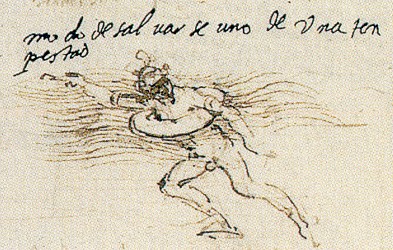
"Study
of
a life preserver,
Ms
Bf. 81
v, c 1487-1490."
|
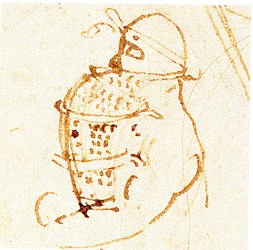
"Study
of
diving suit,
CA
f. 909
v, c. 1485-1487."
|
Pedretti,
Carlo: Leonardo da Vinci - Art and Science.
TAJ Books
27 Ferndown
Gardens,
Cobham, Surrey, KT11 2BH, UK, 2004, page 215.
LEONARDO DA VINCI - Ms. A
Place: Institut
de France,
Paris
Facsimile
(Giunti,
Florence 1990); ca. 1490-92; 22x15 cm
This
manuscript originally
contained 114 leaves, but it was mutilated by Guglielmo Libri
and now only
contains 63. Some of the missing leaves (sold to Lord
Ashburnham by Libri)
were returned to the Institut de France in 1891. The
manuscript contains
studies by Leonardo on proportions and on movement, especially
that of
water. In many notes, he stressed the painter?s need for a
high degree
of scientific training.
fols. 59v-60r:
Studies
of hydrodynamics; sketches of waterfalls and whirlpools.
http://brunelleschi.imss.fi.it/genscheda.asp?appl=LIR&xsl=paginamanoscritto&lingua=ENG&chiave=101471
LEONARDO
DA
VINCI - Studies of waves and waterfalls Ms. A
(IFP),
c. 24v
https://archive.org/details/leonardodavincis007918mbp
(MS. 2038, Bib. Nat, 16 r.)
If you cause your ship to
stop, and place the head of
a long tube in the water,
and place the other extremity
to your ear you will hear
ships at a great distance
from you.
M. vero ' (the reading
adopted by Dr. Richter). MS. has < verso.'
OF CERTAIN INVENTIONS 67
You can also do the same by
placing the head of the
tube upon the ground, and
you will then hear any one
passing at a distance from
you. (B 6 r.)
A WAY OF SAVING ONESELF IN
A TEMPEST
OR SHIPWRECK AT SEA
It is necessary to have a
coat made of leather with
a double hem over the
breast of the width of a finger,
and double also from the
girdle to the knee, and let the
leather of which it is made
be quite air-tight. And
when you are obliged to
jump into the sea, blow out the
lappets of the coat through
the hems of the breast, and
then jump into the sea. And
let yourself be carried by
the waves, if there is no
shore near at hand and you do
not know the sea. And
always keep in your mouth the
end of the tube through
which the air passes into the
garment ; and if once or
twice it should become necessary
for you to take a breath
when the foam prevents you,
draw it through the mouth
of the tube from the air
within the coat. (j? 81 v.)
surfresearch.com.au
Geoff Cater (2007-2014) :
Leonardo da
Vinci : Hydrodynamics, 1515.
http://www.surfresearch.com.au/1515_Leonardo_Hydrodynamics.html