surfresearch.com.au
 |
surfresearch.com.au
luke :
malta, circa 60
|
Luke : St. Paul's Bay, Malta, circa 60.
Luke: The
Acts of the Apostles 27:41- 44.
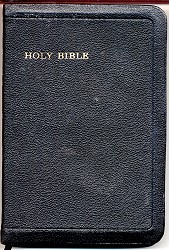
The Holy Bible
(King James Edition)
Eyre and Spottiswoode Limited,
London.
Chapter 27 Verses 41 to 44, page 190.
Introduction.
The earliest
written (purported) first-person report of a shipwreck in
ancient times, Luke's account includes the use of boards to
negotiate the surf zone and safely return to the beach.
Following a
hearing before Herod Agipa III in Ceaserea, Paul is sent to Rome
as a prisoner, in the company of his fellow evangelists
Aristarchus and Luke.
After several
short voyages, they sail from Myra on a grain transport bound
for Rome but extreme weather forces them to the south of Crete
and across the southern Meditteranean where the ship was wrecked
on the coast of Malta, still named St. Paul's Bay. (1)
This is unlikely
the first time that ancient sailors were forced to take such
action, and on the other side of the world, early Polynesian
voyagers no doubt had comparable experiences.
The connection
between the use of a timber plank as a floatation device to
succesfully traverse the surf zone and surfboard riding is
obvious.
Whereas the
technical (as opposed to the theological) events appear a
credible account of such a disaster, its veracity as an
historical document is somewhat questionable.
Initially, note
that modern biblical scholarship indicates that while "Luke the
author" composed both The Gospel According to Luke
and The Book of Acts, he was probably not, as often
assumed, the apostle Luke as identified in the New Testament
Gospels.
Given the
consistent imposition of a religous context on the recorded
events, it is possible that some aspects of Acts are
manufactured to enhance the story.
Finally, as a
literate and educated man, the author was no doubt familiar with
other written accounts of ancient shipwrecks and his report does
contain elements of some of these earlier works.
In particular
there are strong similarites with the earliest and best known
account by Homer in The
Odyessy, circa 800 B.C.
Selections from
other ancient accounts of shipwrecks are included below.
For a map of
Paul's final mission, see:
http://www.biblestudy.org/maps/paul-to-rome-map.html
For some images
of surfing in Malta, circa 2008, see:
http://buntsblog.blogspot.com/2008/02/some-surfing-pics-from-malta.html
Also
Luke Gartside: Surfing in Malta, Wavelengthmag.com,
13th July 2018.
https://www.wavelengthmag.com/surfing-malta-tiny-island-middle-med/
and
Malta Surf School
https://www.maltasurfschool.com/
ACTS 27: 41- 44.
41. And
falling into a place where two seas met, they ran the ship
aground; and the forepart stuck fast, and remained unmoveable,
but the hinder part was broken with the violence of the waves.
42. And the
soldiers' counsel was to kill the prisoners, lest any of them
should swim out, and escape.
43. But the
centurion, willing to save Paul, kept them from their purpose;
and commanded that they which could swim should cast
themselves first into the sea, and get to land.
44. And the
rest, some on boards, and some on broken pieces of the ship.
And so it came
to pass, to pass, that they escaped all safe to land.
Other Accounts of
Ancient Shipwrecks
Aenied (1.44-153)
Quintus Curtius Rufus, History of
Alexander, 4.3.16-18 (9 lines)
Tacitus, Annals 2.23-24. (3
lines) 2.23-24)
Herodotus, The Histories,
3.318; 7.188 — (3 lines and 13 lines)
Thucydides, The Peloponnesian War,
2.6.26; 6.20.104; 8.24.31 and 8.24.24
I cannot locate any of these
references, although cited by several Christian Commentary
websites.
Josephus, Jewish War 1.279-80
There are echoes in Chapters 27-27 of
motifs from ancient literary voyages (e.g. Lucian, Achilles Titus,
Petronius, Charition)
Bill Thayer:
The Histories of Polybius
Loeb Classical
Library, 6 volumes, Greek texts and facing English translation.
Harvard
University Press, 1922-1927.
Translation by W.
R. Paton.
http://penelope.uchicago.edu/Thayer/E/Roman/Texts/Polybius/1*.html
Page 103 [255 B.C.]
10. In the early summer the Romans, having launched
three hundred and fifty ships, sent them off under the command
of Marcus Aemilius and Servius Fulvius, who
proceeded along the coast of Sicily making for Libya.
11. Encountering the Carthaginian fleet near the Hermaeum they
fell on them and easily routed them, capturing one hundred and
fourteen ships with their crews.
12. Then having taken on board at Aspis the lads who remained
in Libya they set sail (1) again for Sicily.
Footnote 1. they sailed: It is often
necessary to use the word "sail," but it should be borne in
mind that the ships were propelled chiefly by oars.
37. They had
crossed the strait in safety and were off the territory of
Camarina when they were overtaken by so fierce a storm and so
terrible a disaster that it is difficult adequately to
describe it owing to its surpassing magnitude.
2. For of
their three hundred and sixty-four ships only eighty were
saved; the rest either foundered or were dashed by the waves
against the rocks and headlands and broken to pieces, covering
the shore with corpses and wreckage.
3. History
tells of no greater catastrophe at sea taking place at one
time.
4.The blame
must be laid not so much on ill-fortune as on the commanders;
for the captains had repeatedly urged them not to sail along
the outer coast of Sicily, that turned towards the Libyan sea,
as it was very rugged and had few safe anchorages: they also
warned them that one of the dangerous astral periods was not
over and another just approaching (for it was between the
rising of Orion and that of Sirius (4) that they undertook the
voyage).
Footnote 4.
between the rising of Orion and that of Sirius: Sirius rises in
July, Orion early in December.
5. The commanders, however, paid no attention to a single word
they said, they took the outer course and there they were in
the open sea thinking to strike terror into some of the cities
they passed by the brilliancy of their recent success and thus
win them over.
6. But now,
all for the sake of such meagre expectations, they exposed
themselves to this great disaster, and were obliged ...
Page 105
...to
acknowledge their lack of judgement.
7. The Romans,
to speak generally, rely on force in all their enterprises,
and think it is incumbent on them to carry out their projects
in spite of all, and that nothing is impossible when they have
once decided on it.
They owe their
success in many cases to this spirit, but sometimes they
conspicuously fail by reason of it and especially at sea.
8. For on land
they are attacking men and the works of man and are usually
successful, as there they are employing force against forces
of the same nature, although even here they have in some rare
instances failed.
9. But when
they come to encounter the sea and the atmosphere and choose
to fight them by force they meet with signal defeats.
10. It was so
on this occasion and on many others, and it will always
continue to be so, until they correct this fault of daring and
violence which makes them think they can sail and travel where
they will at no matter what season.
Even the Jewish historian Josephus mentions a
sea voyage and a shipwreck in his biography.
And little surprise it is that he shifts from first person
singular to first person plural as he recounts it:
I reached
Rome after being in great jeopardy at sea.
For our ship foundered in the midst of the sea of Adria, and
our company of some six hundred souls had to swim all that
night. About daybreak, through God's good providence, we
sighted a ship of Cyrene, and I and certain others, about
eighty in all, outstripped the others and were taken on
board (3; sections 14-16).
|
The Holy Bible
(King James Edition)
Eyre and Spottiswoode
Limited, London.
Luke: The Acts of the
Apostles.
Chapter 27 Verses 41 to 44,
page 190.
|

|
The Surfer's Bible :
New Testament
Bible Society in Australia
Inc
Locked Bag 3, Minto NSW,
2566, 2002.
|

|
The
quotation and the contextual
introductory notes are from:
Knowels, Andrew: The
Bible Guide.
Lion Publishing plc
Sandy Lane, West Oxford,
England, 2001, page 562.
|

surfresearch.com.au
Geoff Cater (2008-2018) :
Luke : St. Paul's Bay, Malta, circa 60.
http://www.surfresearch.com.au/0100_Luke_Acts_27_41_44.html